Le Museum of Jewish Heritage - A Living Memorial to the Holocaust (en français, « le musée du Patrimoine juif »), au sud de Manhattan, à New York, aux États-Unis, est un mémorial dédié aux victimes de l'Holocauste. Il est conçu au début des années 1990 par le cabinet d'architectes américain Roche-Dinkeloo et associés dirigé par Kevin Roche. La forme hexagonale du bâtiment et son toit à 6 degrés symbolisent les six pointes de l'étoile de David et les six millions de Juifs qui périrent dans cette tragédie. Il ouvre ses portes le 15 septembre 1997.

1. Historique

En plus d'une grande exposition en continu sur l'Holocauste qui a pour titre la guerre contre les Juifs, le musée possède deux autres expositions permanentes sur la culture juive, d'une part la vie Juive il y a un siècle, d'autre part le renouveau Juif. Les expositions temporaires et le théâtre Edmond Safra qui fonctionne en tant que salle de spectacles, salle de lecture et salle de projection de films, se situent dans l'aile Robert Morgenthau. Un exemple d'exposition: au-delà de la svastika et de Jim Crow: des écoliers Juifs réfugiés dans des collèges pour Noirs et dans la maison des Morgenthau: un héritage de solidarité. Dans la même aile se trouve le jardin de pierres, un lieu de mémoire conçu par Andy Goldsworthy. Le jardin se compose de 18 blocs de pierre d'où s'élève de chacun d'entre eux un chêne nain pour évoquer l'instinct de survie, le dépassement des traumatismes. Le chiffre 18 a été choisi en raison de la valeur numérologique 18 du mot hébreu chaï qui signifie vie. En 2009, un nouveau concept de visite informatisée autour des notions d'héritage et de mémoire a vu le jour sous l'appellation centre pour perpétuer l'histoire ; différentes projections audio et vidéo ponctuent la présentation au public de plus de 800 objets personnels et plus de 2000 photographies. En 2005, le musée est l'une des 400 institutions sociales et culturelles à bénéficier de la subvention de 20 millions de dollars accordée par la Fondation Carnegie pour la paix internationale. Le musée est associé à la Synagogue d'Oświęcim en Pologne et à JewishGen, un site Web de recherches sur les racines juives. Depuis 2005, le président du musée est l'ancien procureur général Robert M. Morgenthau.

1. Voir aussi

(en) Musées Juifs de New York (en) Musées Juifs des États-Unis (en) Mémorials de l'holocauste

1. Liens externes

Site web officiel, sur mjhnyc.org (consulté le 3 octobre 2010) Plan de l'emplacement du musée, sur mjhnyc.org (consulté le 3 octobre 2010)

Ressource relative au spectacle : Playbill Ressource relative à l'audiovisuel : IMDb

1. Notes et références


1. Source

(en) Cet article est partiellement ou en totalité issu de l’article de Wikipédia en anglais intitulé « Museum of Jewish Heritage » (voir la liste des auteurs). Portail des musées Portail de la Shoah Portail de New York

Nearby Places View Menu
Location Image
0 m

Museum of Jewish Heritage

The Museum of Jewish Heritage, located on Edmond J. Safra Plaza in Battery Park City in Manhattan, New York City, is a historical museum and a memorial to those murdered in The Holocaust. The museum has received more than two million visitors since opening in 1997. The mission statement of the museum is "to educate people of all ages and backgrounds about the broad tapestry of Jewish life in the 20th and 21st centuries—before, during, and after the Holocaust." The museum's building includes two wings: a six-sided building with a pyramid-shaped roof designed to evoke the memory of the six million Jews killed in the Holocaust, and the Robert M. Morgenthau Wing. The six-sided building, opened in 1997, contains the museum's core exhibition galleries. The Morgenthau Wing, opened in 2003, contains the museum's offices, theater, and classrooms, as well as the Irving Schneider and Family exhibition gallery. Both wings were designed by Roche-Dinkeloo.
53 m

Statue of Frances Xavier Cabrini

The Statue of Frances Xavier Cabrini is a statue located in Battery Park City, Manhattan.
Location Image
104 m

Wagner Park

Robert F. Wagner Jr. Park (also known as Wagner Park) is a green space in the Battery Park City neighborhood of Manhattan, New York City.
Location Image
128 m

Skyscraper Museum

The Skyscraper Museum is an architecture museum in the Battery Park City neighborhood of Manhattan in New York City, founded in 1996. The museum focuses on high-rise buildings as "products of technology, objects of design, sites of construction, investments in real estate, and places of work and residence." The Skyscraper Museum also celebrates the architectural heritage of New York and the forces and people who created New York's skyline. Before moving to the current and permanent location in Battery Park City in 2004, the museum was a nomadic institution, holding pop-up exhibitions in four temporary donated spaces around Lower Manhattan since 1996. The Skyscraper Museum was founded and is directed by Carol Willis, a professor of architectural history and urban studies at Columbia University. It includes two exhibition spaces for both permanent and temporary exhibitions, a bookstore, and a mezzanine with its office, situated above the bookstore. The museum can be reached by a ramp starting in the basement.
Location Image
200 m

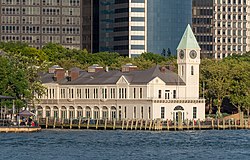
City Pier A

Pier A, also known as City Pier A, is a pier in the Hudson River at Battery Park in Lower Manhattan, New York City. It was built from 1884 to 1886 as the headquarters of the New York City Board of Dock Commissioners (also known as the Docks Department) and the New York City Police Department's (NYPD) Harbor Department. Pier A, the only remaining masonry pier in New York City, contains a two- and three-story structure with a clock tower facing the Hudson River. The pier is a New York City designated landmark and is listed on the National Register of Historic Places (NRHP). The building atop Pier A was designed by George Sears Greene Jr. The original structure is two stories tall and extends west into the Hudson River; the clock tower at the southwestern corner of the building. The eastern, or inshore, end of Pier A was constructed in 1900 and expanded to three stories in 1904. The pier itself is composed of a concrete deck supported by girders. The building originally housed offices for the NYPD and Docks Department, which were subsequently converted into restaurant spaces. The Department of Docks started constructing the pier in July 1884; although the pier deck was completed in 1885, the building was not finished until early 1886. The NYPD occupied Pier A until 1955, while the Department of Docks relocated to the Battery Maritime Building in 1959. The New York City Fire Department (FDNY) used the pier from 1960 to 1992 as a fireboat station. Following a failed attempt to demolish Pier A as part of the development of Battery Park City in the 1970s, the structure was added to the NRHP and became a city landmark. Mayor Ed Koch selected Wings Point Associates to redevelop Pier A in 1988, but the redevelopment was stalled for the next two decades. Pier A was temporarily used as a commuter ferry landing after the September 11 attacks. After the Battery Park City Authority leased Pier A in 2008, it was renovated into a restaurant called Harbor House, which operated from 2014 to 2020.