The Skyscraper Museum is an architecture museum in the Battery Park City neighborhood of Manhattan in New York City, founded in 1996. The museum focuses on high-rise buildings as "products of technology, objects of design, sites of construction, investments in real estate, and places of work and residence." The Skyscraper Museum also celebrates the architectural heritage of New York and the forces and people who created New York's skyline. Before moving to the current and permanent location in Battery Park City in 2004, the museum was a nomadic institution, holding pop-up exhibitions in four temporary donated spaces around Lower Manhattan since 1996. The Skyscraper Museum was founded and is directed by Carol Willis, a professor of architectural history and urban studies at Columbia University. It includes two exhibition spaces for both permanent and temporary exhibitions, a bookstore, and a mezzanine with its office, situated above the bookstore. The museum can be reached by a ramp starting in the basement.

1. Move after September 11, 2001

The original site of the museum was located very close to the World Trade Center. After the September 11 attacks, the museum was forced to close temporarily as its space was commandeered as an emergency information center. In March 2004, the museum reopened in its new permanent home at 39 Battery Place in the neighborhood of Battery Park City at the southern tip of Manhattan. It was the first museum to open in Lower Manhattan after the September 11 attacks. The museum occupies an area of 5,800 square feet (540 m2) on the ground-floor of a mixed-use building, that was donated by the developer. The new site was designed by Roger Duffy of Skidmore, Owings & Merrill, working pro bono. The architect tried to amplify the indoor height of the museum, which is 10 feet (3.0 m). This was arranged by using polished covers of stainless steel on the floors and ceilings, giving the illusion of an infinite vertical space.

1. Selected exhibitions

On September 6, 2006, the museum opened an exhibit on the construction of the World Trade Center and the complex's subsequent history. The exhibit includes the original architectural/engineering model of the World Trade Center. On June 24, 2009, the museum opened China Prophecy: Shanghai, a multi-media exhibition that examines Shanghai's evolving identity as a skyscraper metropolis. Featuring models of the major iconic structures, including Jin Mao, Tomorrow Square, Shanghai World Financial Center, and the new super-tall Shanghai Tower, as well as computer animations, film, drawings, and historic and contemporary photography of the city, the exhibition combines an in-depth look at the new generation of towers with an overview of the sweeping transformation of the city's traditional low-rise landscape into a city of towers. In 2011, the Skyscraper Museum opened a new exhibit called "Supertall!" dedicated to the tallest buildings in the world, those that stand at least 381 meters (1,250 ft), the height of the Empire State Building. The exhibit features qualifying buildings built since 2001 to those that will be built by 2016 as a commemoration of and to demonstrate the irony of the recent popularity of the skyscraper in many countries, despite sentiment that after the September 11 attacks there would be no more desire to live or work in or to build skyscrapers. Besides in-house exhibitions, the museum also sponsors external shows and programs at various locations in the city. Additionally, the museum offers a unique virtual gallery through its website, which is an advanced 3-D archive of Manhattan skyscrapers.

1. See also

List of museums and cultural institutions in New York City Museum of Jewish Heritage

1. Further reading

Filler, Martin (April 2015). New York: Conspicuous Construction. A discussion of Sky High and the Logic of Luxury – an exhibition at the Skyscraper Museum, New York City, October 2013 – June 2014. The New York Review of Books

1. References


1. External links

Official website Online Virtual gallery Archived May 12, 2019, at the Wayback Machine Photos from the Shanghai exhibition opening

Nearby Places View Menu
Location Image
99 m

Wagner Park

Robert F. Wagner Jr. Park (also known as Wagner Park) is a green space in the Battery Park City neighborhood of Manhattan, New York City.
Location Image
117 m

Whitehall Building

The Whitehall Building is a three-section residential and office building next to Battery Park in Lower Manhattan, New York City, near the southern tip of Manhattan Island. The original 20-story structure on Battery Place, between West Street and Washington Street, was designed by Henry Janeway Hardenbergh, while the 31-story Whitehall Building Annex on West Street was designed by Clinton and Russell. The original building and annex are both at 17 Battery Place. Another 22-story addition at 2 Washington Street, an International Style building located north of the original building and east of the annex, was designed by Morris Lapidus. The original Whitehall Building and its annex has a Renaissance Revival style facade, and the two original structures' articulations consist of three horizontal sections similar to the components of a column—namely a base, shaft, and capital. Since the building is located on landfill along the Hudson River, its foundation incorporates a non-standard design. The Whitehall Building is named after the nearby estate of New Amsterdam colonial governor Peter Stuyvesant. The original building was built as a speculative development in 1902–1904 for Robert A. and William H. Chesebrough, a real estate company. The annex was built in 1908–1910, and 2 Washington Street was built in 1972. In 2000, the New York City Landmarks Preservation Commission (LPC) designated the Whitehall Building as an official city landmark. The upper floors of the original building and annex were converted to apartments, while the lower floors remain in use as an office building.
Location Image
128 m

Museum of Jewish Heritage

The Museum of Jewish Heritage, located on Edmond J. Safra Plaza in Battery Park City in Manhattan, New York City, is a historical museum and a memorial to those murdered in The Holocaust. The museum has received more than two million visitors since opening in 1997. The mission statement of the museum is "to educate people of all ages and backgrounds about the broad tapestry of Jewish life in the 20th and 21st centuries—before, during, and after the Holocaust." The museum's building includes two wings: a six-sided building with a pyramid-shaped roof designed to evoke the memory of the six million Jews killed in the Holocaust, and the Robert M. Morgenthau Wing. The six-sided building, opened in 1997, contains the museum's core exhibition galleries. The Morgenthau Wing, opened in 2003, contains the museum's offices, theater, and classrooms, as well as the Irving Schneider and Family exhibition gallery. Both wings were designed by Roche-Dinkeloo.
Location Image
142 m

City Pier A

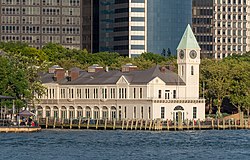
Pier A, also known as City Pier A, is a pier in the Hudson River at Battery Park in Lower Manhattan, New York City. It was built from 1884 to 1886 as the headquarters of the New York City Board of Dock Commissioners (also known as the Docks Department) and the New York City Police Department's (NYPD) Harbor Department. Pier A, the only remaining masonry pier in New York City, contains a two- and three-story structure with a clock tower facing the Hudson River. The pier is a New York City designated landmark and is listed on the National Register of Historic Places (NRHP). The building atop Pier A was designed by George Sears Greene Jr. The original structure is two stories tall and extends west into the Hudson River; the clock tower at the southwestern corner of the building. The eastern, or inshore, end of Pier A was constructed in 1900 and expanded to three stories in 1904. The pier itself is composed of a concrete deck supported by girders. The building originally housed offices for the NYPD and Docks Department, which were subsequently converted into restaurant spaces. The Department of Docks started constructing the pier in July 1884; although the pier deck was completed in 1885, the building was not finished until early 1886. The NYPD occupied Pier A until 1955, while the Department of Docks relocated to the Battery Maritime Building in 1959. The New York City Fire Department (FDNY) used the pier from 1960 to 1992 as a fireboat station. Following a failed attempt to demolish Pier A as part of the development of Battery Park City in the 1970s, the structure was added to the NRHP and became a city landmark. Mayor Ed Koch selected Wings Point Associates to redevelop Pier A in 1988, but the redevelopment was stalled for the next two decades. Pier A was temporarily used as a commuter ferry landing after the September 11 attacks. After the Battery Park City Authority leased Pier A in 2008, it was renovated into a restaurant called Harbor House, which operated from 2014 to 2020.