
Robert F. Wagner Jr. Park (also known as Wagner Park) is a green space in the Battery Park City neighborhood of Manhattan, New York City.

1. History

The park is sited on landfill from the World Trade Center site and opened in 1996. It was designed through a partnership of Rodolfo Machado, Jorge Silvetti, Hannah/Olin, and Lynden B. Miller. The park is named after Robert F. Wagner Jr., who helped negotiate the 1979 master plan for Battery Park City before his sudden death in 1991. The park is just north of City Pier A at the southern end of Manhattan.

1. = South Battery Park City Resiliency Project =

In 2022, the Battery Park City Authority announced plans to demolish and rebuild the park. The park reconstruction was part of the Lower Manhattan Coastal Resiliency flood-resiliency project. Thomas Phifer and AECOM were hired to design the new park. The park demolition attracted opposition from local residents. In response to the public pressure, the Battery Park City Authority enlarged the area dedicated to lawns in the plans, although the rebuilt lawns would still contain 10 percent less green space. The park was temporarily closed for reconstruction beginning in March 2023. Wagner Park reopened on July 29, 2025, after the $296 million renovation was complete. Compared with the original design, the rebuilt park has 48 fewer trees. It was raised from 11 to 20 feet (3.4 to 6.1 m), where 139 trees would be planted, and the shoreline has pools and other features that provide habitats for marine life. There are also gardens and a 63,000-U.S.-gallon (240,000 L) stormwater retention tank, where water flows during rainstorms or floods. A 19,204-square-foot (1,784.1 m2) park pavilion was also built; the pavilion is made of concrete and has a red facade, with archways and cylindrical protrusions on the roof. There is a roof terrace, as well as educational facilities such as classrooms within the pavilion. The rebuilt park uses material saved from the original design, such as wood and stone, and there are plantings and trails throughout the park. Under the rebuilt park, a floodwall descends to the underlying bedrock.

1. Public art

There are several sculptures located in the park, including:

Eyes - by Louise Bourgeois Resonating Bodies - by Tony Cragg Ape & Cat - by Jim Dine

1. References


1. External links

Media related to Robert F. Wagner Jr. Park at Wikimedia Commons

Nearby Places View Menu
Location Image
96 m

City Pier A

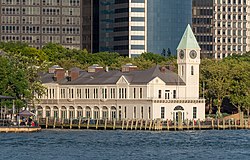
Pier A, also known as City Pier A, is a pier in the Hudson River at Battery Park in Lower Manhattan, New York City. It was built from 1884 to 1886 as the headquarters of the New York City Board of Dock Commissioners (also known as the Docks Department) and the New York City Police Department's (NYPD) Harbor Department. Pier A, the only remaining masonry pier in New York City, contains a two- and three-story structure with a clock tower facing the Hudson River. The pier is a New York City designated landmark and is listed on the National Register of Historic Places (NRHP). The building atop Pier A was designed by George Sears Greene Jr. The original structure is two stories tall and extends west into the Hudson River; the clock tower at the southwestern corner of the building. The eastern, or inshore, end of Pier A was constructed in 1900 and expanded to three stories in 1904. The pier itself is composed of a concrete deck supported by girders. The building originally housed offices for the NYPD and Docks Department, which were subsequently converted into restaurant spaces. The Department of Docks started constructing the pier in July 1884; although the pier deck was completed in 1885, the building was not finished until early 1886. The NYPD occupied Pier A until 1955, while the Department of Docks relocated to the Battery Maritime Building in 1959. The New York City Fire Department (FDNY) used the pier from 1960 to 1992 as a fireboat station. Following a failed attempt to demolish Pier A as part of the development of Battery Park City in the 1970s, the structure was added to the NRHP and became a city landmark. Mayor Ed Koch selected Wings Point Associates to redevelop Pier A in 1988, but the redevelopment was stalled for the next two decades. Pier A was temporarily used as a commuter ferry landing after the September 11 attacks. After the Battery Park City Authority leased Pier A in 2008, it was renovated into a restaurant called Harbor House, which operated from 2014 to 2020.
Location Image
99 m

Skyscraper Museum

The Skyscraper Museum is an architecture museum in the Battery Park City neighborhood of Manhattan in New York City, founded in 1996. The museum focuses on high-rise buildings as "products of technology, objects of design, sites of construction, investments in real estate, and places of work and residence." The Skyscraper Museum also celebrates the architectural heritage of New York and the forces and people who created New York's skyline. Before moving to the current and permanent location in Battery Park City in 2004, the museum was a nomadic institution, holding pop-up exhibitions in four temporary donated spaces around Lower Manhattan since 1996. The Skyscraper Museum was founded and is directed by Carol Willis, a professor of architectural history and urban studies at Columbia University. It includes two exhibition spaces for both permanent and temporary exhibitions, a bookstore, and a mezzanine with its office, situated above the bookstore. The museum can be reached by a ramp starting in the basement.
Location Image
104 m

Museum of Jewish Heritage

The Museum of Jewish Heritage, located on Edmond J. Safra Plaza in Battery Park City in Manhattan, New York City, is a historical museum and a memorial to those murdered in The Holocaust. The museum has received more than two million visitors since opening in 1997. The mission statement of the museum is "to educate people of all ages and backgrounds about the broad tapestry of Jewish life in the 20th and 21st centuries—before, during, and after the Holocaust." The museum's building includes two wings: a six-sided building with a pyramid-shaped roof designed to evoke the memory of the six million Jews killed in the Holocaust, and the Robert M. Morgenthau Wing. The six-sided building, opened in 1997, contains the museum's core exhibition galleries. The Morgenthau Wing, opened in 2003, contains the museum's offices, theater, and classrooms, as well as the Irving Schneider and Family exhibition gallery. Both wings were designed by Roche-Dinkeloo.
152 m

Statue of Frances Xavier Cabrini

The Statue of Frances Xavier Cabrini is a statue located in Battery Park City, Manhattan.