
Robert F. Wagner Jr. Park (also known as Wagner Park) is a green space in the Battery Park City neighborhood of Manhattan, New York City.

1. History

The park is sited on landfill from the World Trade Center site and opened in 1996. It was designed through a partnership of Rodolfo Machado, Jorge Silvetti, Hannah/Olin, and Lynden B. Miller. The park is named after Robert F. Wagner Jr., who helped negotiate the 1979 master plan for Battery Park City before his sudden death in 1991. The park is just north of City Pier A at the southern end of Manhattan.

1. = South Battery Park City Resiliency Project =

In 2022, the Battery Park City Authority announced plans to demolish and rebuild the park. The park reconstruction was part of the Lower Manhattan Coastal Resiliency flood-resiliency project. Thomas Phifer and AECOM were hired to design the new park. The park demolition attracted opposition from local residents. In response to the public pressure, the Battery Park City Authority enlarged the area dedicated to lawns in the plans, although the rebuilt lawns would still contain 10 percent less green space. The park was temporarily closed for reconstruction beginning in March 2023. Wagner Park reopened on July 29, 2025, after the $296 million renovation was complete. Compared with the original design, the rebuilt park has 48 fewer trees. It was raised from 11 to 20 feet (3.4 to 6.1 m), where 139 trees would be planted, and the shoreline has pools and other features that provide habitats for marine life. There are also gardens and a 63,000-U.S.-gallon (240,000 L) stormwater retention tank, where water flows during rainstorms or floods. A 19,204-square-foot (1,784.1 m2) park pavilion was also built; the pavilion is made of concrete and has a red facade, with archways and cylindrical protrusions on the roof. There is a roof terrace, as well as educational facilities such as classrooms within the pavilion. The rebuilt park uses material saved from the original design, such as wood and stone, and there are plantings and trails throughout the park. Under the rebuilt park, a floodwall descends to the underlying bedrock.

1. Public art

There are several sculptures located in the park, including:

Eyes - by Louise Bourgeois Resonating Bodies - by Tony Cragg Ape & Cat - by Jim Dine

1. References


1. External links

Media related to Robert F. Wagner Jr. Park at Wikimedia Commons

Lieux à Proximité Voir Menu
Location Image
100 m

Skyscraper Museum

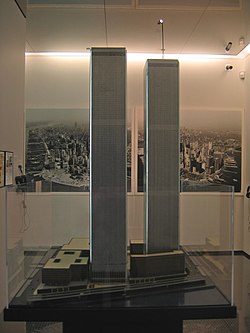
Le Skyscraper Museum (musée des gratte-ciel) est un musée new-yorkais. Comme son nom l'indique, le musée est consacré aux grandes structures et aux grands bâtiments, dans la ville qui compte le plus grand nombre de gratte-ciel célèbres au monde. Le Skyscraper Museum est actuellement unique en son genre, et entend étudier les gratte-ciel comme des « objets de conception » et des « produits de technologie », mais aussi les lieux de construction, les investissements relatifs à l'immobilier et les lieux de travail et/ou de résidence. Le premier Skyscraper Museum était situé à proximité du site du World Trade Center, mais les attentats contraignirent le musée à changer provisoirement d'adresse. Le musée s'est finalement implanté à Battery Park City, à la pointe sud de Manhattan, dans un bâtiment conçu par Roger Duffy et le cabinet d'architectes Skidmore, Owings and Merrill, travaillant pro bono. Le 6 septembre 2006, le musée a consacré une exposition au World Trade Center, avec les plans originaux du site.
Location Image
104 m

Museum of Jewish Heritage

Le Museum of Jewish Heritage - A Living Memorial to the Holocaust (en français, « le musée du Patrimoine juif »), au sud de Manhattan, à New York, aux États-Unis, est un mémorial dédié aux victimes de l'Holocauste. Il est conçu au début des années 1990 par le cabinet d'architectes américain Roche-Dinkeloo et associés dirigé par Kevin Roche. La forme hexagonale du bâtiment et son toit à 6 degrés symbolisent les six pointes de l'étoile de David et les six millions de Juifs qui périrent dans cette tragédie. Il ouvre ses portes le 15 septembre 1997.
Location Image
114 m

City Pier A

Pier A Harbor House (communément appelé City Pier A) est une jetée municipale sur le fleuve Hudson à Battery Park près de l'extrémité sud de Manhattan à New York. Bien qu'elle n'ait joué aucun rôle comme point de débarquement majeur, elle a également été surnommée ces dernières années « Liberty Gateway ». La jetée A est la dernière jetée historique existante de la ville. La jetée a été ajoutée au registre national des lieux historiques en 1975 et a été désignée monument de New York en 1977.
Location Image
224 m

Whitehall Building Annex

Le Whitehall Building Annex est un gratte-ciel situé au 17 Battery Place North dans le Financial District de Manhattan à New York. Il est construit en 1911 et culmine à 129 mètres. Il est l'un des rares gratte-ciel du style Beaux-Arts.
Location Image
258 m

Castle Clinton National Monument

Castle Clinton ou Fort Clinton est un fort circulaire fait de grès, situé à Battery Park à l'extrémité sud de Manhattan, à New York. Classé monument national américain, le fort doit son nom à DeWitt Clinton, gouverneur de l'État de New York qui fait renforcer les défenses sur la baie.