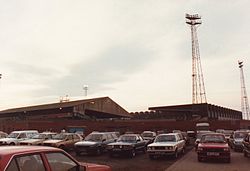
The Kippax was a terraced stand at Manchester City's Maine Road ground in Manchester, England. Originally the Popular Side when the stadium opened in 1923, its name was changed in 1956 when the club built a roof over it, after Kippax Street which ran along the side of the ground (named in turn for the town of Kippax, West Yorkshire). The Kippax was unusual in being a terrace which ran the length of one side of the pitch rather than behind one of the goals. In the summer of 1994, due to the Taylor Report on the Hillsborough disaster, the Kippax was demolished and a new all seater stand built in its place. This new stand was completed in stages over the course of eighteen months and was finally opened by City legend Bert Trautmann in October 1995. It housed 10,178 seated fans, had three tiers and was at the time the highest stand in the country. The club left Maine Road in May 2003 and relocated to the City of Manchester Stadium. Maine Road was demolished in early 2004. Unofficially, the East Stand at the new stadium is also called The Kippax.

Nearby Places View Menu
Location Image
89 m

Maine Road

Maine Road was a football stadium in Moss Side, Manchester, England, that was home to Manchester City from 1923 to 2003. It hosted FA Cup semi-finals, the Charity Shield, a League Cup final and England matches. Maine Road's highest attendance of 84,569 was set in 1934 at an FA Cup sixth round match between Manchester City and Stoke City, a record for an English club ground. At the time of its closure in 2003, Maine Road was an all-seater stadium with a capacity of 35,150 and of haphazard design with stands of varying heights due to the ground being renovated several times over its 80-year history. The following season Manchester City moved to the City of Manchester Stadium in east Manchester, a mile from the city centre and near Ardwick, where the club originally formed in 1880.
Location Image
590 m

Holy Trinity Platt Church

Holy Trinity Platt Church (also known as Holy Trinity Church, Rusholme), is in Platt Fields Park in Rusholme, Manchester, England. It is an active Anglican parish church in the deanery of Hulme, the archdeaconry of Manchester, and the diocese of Manchester. The church is recorded in the National Heritage List for England as a designated Grade II* listed building. It is the second "pot church" designed by Edmund Sharpe, so-called because the main building material used in the construction of the church is terracotta.
Location Image
635 m

Moss Side

Moss Side is an inner-city area of Manchester, England, 1.9 miles (3.1 km) south of the city centre. It had a population of 20,745 at the 2021 census. Moss Side is bounded by Hulme to the north, Chorlton-on-Medlock, Rusholme and Fallowfield to the east, Whalley Range to the south, and Old Trafford to the west. As well as Whitworth Park and Alexandra Park, Moss Side is close to Manchester and Manchester Metropolitan universities. Manchester City Football Club played at Maine Road in Moss Side between 1923 and 2003.
Location Image
701 m

Rusholme

Rusholme () is an area of Manchester, in Greater Manchester, England, two miles (three kilometres) south of the city centre. The population of the ward at the 2011 census was 13,643. Rusholme is bounded by Chorlton-on-Medlock to the north, Victoria Park and Longsight to the east, Fallowfield to the south and Moss Side to the west. It has a large student population, with several student halls and many students renting terraced houses, and suburban houses towards Victoria Park.