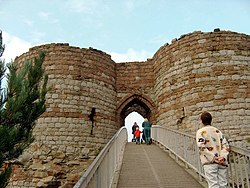
Le château de Beeston est un ancien château fort situé à Beeston dans le Cheshire, en Angleterre. Il est perché sur un rocher escarpé en grès qui s'élève à 110 m au-dessus de la plaine du Cheshire (en). Il fut construit par Ranulph de Blondeville (1170-1232) durant la décennie 1220, après son retour des croisades. En 1237, Henri III reprit le château de Beeston qui fut maintenu en bon état jusqu'au XVIe siècle, période à laquelle il fut considéré comme n'étant plus d'aucune utilité militaire, bien qu'il fût rapidement remis en service en 1643, lors de la Première Révolution anglaise. Le château fut partiellement démoli en 1646, sous les ordres de Cromwell, afin d'empêcher la poursuite de son utilisation comme forteresse. Au cours du XVIIIe siècle, le site fut utilisé comme carrière. Il est raconté qu'un trésor appartenant à Richard II est enfoui dans le parc du château, mais les nombreuses recherches qui ont été menées n'ont pas réussi à en trouver une quelconque trace. Le château est aujourd'hui en ruines. Les murs de la cour extérieure, ainsi que les murs et le corps de garde de la cour intérieure ont été désignés séparément Monuments classés de Grade I par l'English Heritage qui en est aujourd'hui propriétaire.

Nearby Places View Menu
Location Image
0 m

Beeston Castle

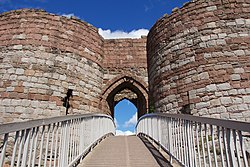
Beeston Castle is a former Royal castle in Beeston, Cheshire, England (grid reference SJ537593), perched on a rocky sandstone crag 350 feet (107 m) above the Cheshire Plain. It was built in the 1220s by Ranulf de Blondeville, 6th Earl of Chester (1170–1232), on his return from the Crusades. In 1237, Henry III took over the ownership of Beeston, and it was kept in good repair until the 16th century, when it was considered to be of no further military use, although it was pressed into service again in 1643, during the English Civil War. The castle was slighted (partly demolished) in 1646, in accordance with Cromwell's destruction order, to prevent its further use as a bastion. During the 18th century, parts of the site were used as a quarry. The castle is a Scheduled Ancient Monument owned and managed by English Heritage. The walls of the outer bailey and the gatehouse and curtain walls of the inner bailey are recorded separately in the National Heritage List for England as designated Grade I listed buildings. A legend states that the royal treasure of Richard II was buried in the castle grounds but many searches have failed to discover the hoard.
Location Image
593 m

Beeston, Cheshire

Beeston is a village and civil parish in the unitary authority of Cheshire West and Chester, which itself is in the ceremonial county of Cheshire in the north of England. It is located approximately 6 miles (9.7 km) south-east of Chester, and approximately 2 miles (3.2 km) south-west of Tarporley, close to the Shropshire Union Canal. According to the 2011 census, Beeston had a population of 188.
Location Image
1.2 km

Peckforton Castle

Peckforton Castle is a Victorian country house built in the style of a medieval castle. It stands in woodland at the north end of Peckforton Hills one mile (2 km) northwest of the village of Peckforton, Cheshire, England. It is recorded in the National Heritage List for England as a designated Grade I listed building. The house was built in the middle of the 19th century as a family home for John Tollemache, a wealthy Cheshire landowner, estate manager, and member of parliament. It was designed by Anthony Salvin in the Gothic style. During the Second World War it was used as a hostel for physically disabled children. The Tollemache family used the castle for occasional gatherings, but otherwise it was unused until 1969. From 1969 to 1980 the castle was leased by the 4th Lord Tollemache to George W. Barrett, and it again became a private residence and closed to the public. The right wing and tower and the castle gardens were restored by Barrett, an American employed by the U.S. Government. His daughter Pascale's wedding was the first to be held in the chapel and a special decree had to be obtained by the Archbishop of Canterbury to legally hold Catholic weddings in the grounds of the castle. During the 1970s and 1980s it was used as a location for shooting films and television programmes. The castle was bought in 1988 by Evelyn Graybill, who converted it into a hotel. In 2006 it was purchased by the Naylor family, who expanded its use to include hosting weddings, conferences and other functions.
Location Image
1.7 km

Beeston Castle and Tarporley railway station

Beeston Castle and Tarporley railway station served the Cheshire villages of Tarporley, Tiverton and Beeston. It was originally a stop on the Crewe to Chester line of the Grand Junction Railway.
Location Image
1.7 km

Brassey Green

Brassey Green is a small rural village near Tarporley, in Tiverton and Tilstone Fearnall civil parish, within the unitary authority of Cheshire West and Chester and the ceremonial county of Cheshire, England. Brassey Green Hall is a two storeyed, 16th century farmhouse and a designated Grade II listed building. It is timber-framed with wattle and daub and rendered brick infill and a slate roof. The 18th century Brassey Green Baptist Chapel is also Grade II listed. Constructed with red brick and a Welsh slate roof, it was restored from 1983 after falling into disrepair. Although no longer a place of worship, it has since been used occasionally by youth groups.