

 English
 Français

Stockton Heath
Stockton Heath est une paroisse civile et un village du Cheshire, en Angleterre.
Nearby Places View Menu

0 m
Stockton Heath
Stockton Heath is a civil parish and suburb of Warrington, in the Borough of Warrington, Cheshire, England. It is located to the north of the Bridgewater Canal and to the south of the Manchester Ship Canal, which divides Stockton Heath from Latchford and north Warrington. It has a total resident population of 6,396.
Victoria Square is at the centre of Stockton Heath and is on the crossroads of the A49 and A56. Until the 1970s, the Victoria Hotel stood on this square but its location has been redeveloped. North of the square is the main shopping area which includes the Forge Shopping Centre, developed on the site of the old forge (Caldwell's). Stockton Heath is home to a number of modern bars and restaurants, as well as traditional public houses. The Red Lion Inn dates back to the early 19th century and the Mulberry Tree on Victoria Square, opened in its present building (replacing earlier premises dating from 1725) in March 1907 [1].
Since 1988, much of the centre of Stockton Heath has been designated a conservation area to preserve its character but, at the same time, there has been redevelopment work with several new bars and restaurants moving into the centre of Stockton Heath.
229 m
St Thomas' Church, Stockton Heath
St Thomas' Church is in Stockton Heath, to the south of Warrington, Cheshire, England. The church is recorded in the National Heritage List for England as a designated Grade II listed building, and is an active Anglican parish church in the diocese of Chester, the archdeaconry of Chester and the deanery of Great Budworth.
354 m
Manchester Ship Canal
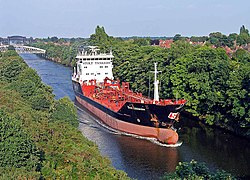
The Manchester Ship Canal is a 36-mile-long (58 km) inland waterway in the North West of England linking Manchester to the Irish Sea. Starting at the Mersey Estuary at Eastham, near Ellesmere Port, Cheshire, it generally follows the original routes of the rivers Mersey and Irwell through the historic counties of Cheshire and Lancashire before joining the latter at Salford Quays. Several sets of locks lift vessels about 60 ft (18 m) to the canal's terminus in Manchester. Landmarks along its route include the Barton Swing Aqueduct, the world's only swing aqueduct, and Trafford Park, the world's first planned industrial estate and one of the largest in Europe.
The rivers Mersey and Irwell were first made navigable in the early 18th century. Goods were also transported on the Runcorn extension of the Bridgewater Canal (from 1776) and the Liverpool and Manchester Railway (from 1830) but by the late 19th century the Mersey and Irwell Navigation had fallen into disrepair and was often unusable. Manchester's business community viewed the charges imposed by Liverpool's docks and the railway companies as excessive. A ship canal was proposed to give ocean-going vessels direct access to Manchester. The region was suffering from the Long Depression; the canal's proponents argued that the scheme would boost competition and create jobs. They gained public support for the scheme, which was first presented to Parliament as a bill in 1882. Faced with stiff opposition from Liverpool, the canal's supporters were unable to gain the necessary act of Parliament to allow the scheme to go ahead until 1885.
Construction took six years, beginning in 1887, and cost just over £15 million (equivalent to £2,107,000,000 in 2023). When the ship canal opened in January 1894 (12 years after the first meeting of the Manchester Ship Canal company) it was the largest river navigation canal in the world and enabled the new Port of Manchester to become Britain's third-busiest port despite being about 40 mi (60 km) inland. Changes to shipping methods and the growth of containerisation during the 1970s and 80s meant that many ships were too big to use the canal and traffic declined, resulting in the closure of the terminal docks at Salford. Although able to accommodate vessels from coastal ships to intercontinental cargo liners, the canal was not large enough for most modern vessels. By 2011 traffic had decreased from its peak in 1958 of 18 million long tons (20 million short tons) of freight each year to about 8 million long tons (9.0 million short tons). The canal is now privately owned by Peel Holdings, whose plans include redevelopment, expansion and an increase in shipping from 8,000 containers a year to 100,000 by 2030 as part of their Atlantic Gateway project.
734 m
Wilderspool
Wilderspool is a district of Warrington, Cheshire, England, near the town centre. It consists of Wilderspool Causeway and the streets coming off it, the limits being the Manchester Ship Canal into Stockton Heath (where it turns into London Road), Bridgefoot (near the town centre), and Centre Park. The district incorporates Priestley College, Wilderspool depot (owned by Warrington's Own Buses), a Morrisons supermarket, and the Riverside Retail Park. Excavations in the area have shown Roman settlement, and there are parts of a walled town with evidence of industrial activity. It was also the site of the Greenall Whitley brewery and Wilderspool Stadium, former home of Warrington Rugby League Football Club.
739 m
Priestley College
Priestley Sixth Form and Community College is a sixth form college in Warrington, Cheshire, England. It also offers adult courses and professional training on another site, and is an associate college of the University of Salford. The college offers a range of courses, including AS/A2 Levels, BTECs, Advanced Diplomas, functional skills, and pre-university foundation courses.