Location Image

Statue of Elizabeth II, York Minster

A statue of Queen Elizabeth II was unveiled at York Minster on 9 November 2022 by King Charles III, two months after the Queen's death in September 2022. The 6ft 7in (2m) tall sculpture was intended to mark the late monarch's Platinum Jubilee and was completed in August 2022, a month before her death. The statue, which stands in a niche on the minster's west front and weighs almost two tonnes, is carved from French lepine limestone. It portrays the Queen wearing her Garter robes and the George IV State Diadem, and holding the orb and sceptre, symbols of authority. The design was chosen by the Queen. The statue was originally to have been unveiled in September 2022, but this was postponed owing to the Queen's death and state funeral that month.

Nearby Places View Menu
Location Image
43 m

2, 3, 4 and 4a Precentor's Court

2, 3, 4, and 4a Precentor's Court is an historic row of three buildings in the English city of York, North Yorkshire. Grade II* listed and standing on Precentor's Court, the buildings date to around 1710. Police constable William Gladin was living at No. 2 in 1872, while cobbler William Bowes was at No. 3.
Location Image
46 m

23 High Petergate

23 High Petergate is a grade I listed building in the city centre of York, in England. The house lies on High Petergate, one of the main streets in York. It was built in about 1779 at the end of a terrace, with a three-storey, four bay front of red brick, and side and back walls of orange brick. Its external appearance is largely original, including the doorway, windows, and ground floor shutters. The top of a drainpipe is inscribed "1780", while a similar one to the rear is marked "1779". To the side of the front door is a torch extinguisher, made of iron. The garden wall is also original. A carriage house was added in the late 19th-century, and there were further alterations to the building in the 20th-century. Inside the building, the main feature is an original staircase, rising through all the stories, with a serpentine balustrade, top lit by a glazed dome, surrounded by neoclassical plasterwork. This staircase is described by Nikolaus Pevsner as "exceptional". The building was grade I listed in 1954.
Location Image
54 m

Purey-Cust Lodge boundary wall

Purey-Cust Lodge boundary wall is an historic structure in the English city of York, North Yorkshire. A Grade II listed building, it dates to 1845. Originally the lodge, walls and gateways to the stone yard of York Minster, since around 1916 it has functioned as the entrance and boundary wall of Purey-Cust Lodge. The height of the wall varies from around 6 metres (20 ft) in its main section, up to around 8.5 metres (28 ft) at the rear of the lodge and down to around 4.5 metres (15 ft) for the section that runs along Precentor's Court. There are three gates, two of which feature nail-studded boarded gates; the third is an iron gate providing access to lodge's driveway. This gate is flanked by the coats of arms of St Peter and the Deanery of York. To the right of the iron gate, the wall is habitable. It features windows, at two levels, of single or paired square-headed lights with diamond lattice glazing. On the garden side, the lodge is of two low storeys. The ground-floor windows include one- and two-light small- and large-pane casements, as well as a 2x2 and a 2x6-pane Yorkshire sash. On the first floor, there are three 2x2s. The interior of the walls has not been inspected.
Location Image
56 m

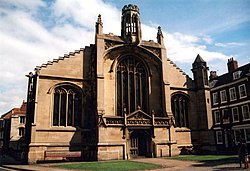
St Michael le Belfrey, York

St Michael le Belfrey is an Anglican church in York, England. It is situated at the junction of High Petergate and Minster Yard, directly opposite York Minster, in the centre of the city.