23 High Petergate is a grade I listed building in the city centre of York, in England. The house lies on High Petergate, one of the main streets in York. It was built in about 1779 at the end of a terrace, with a three-storey, four bay front of red brick, and side and back walls of orange brick. Its external appearance is largely original, including the doorway, windows, and ground floor shutters. The top of a drainpipe is inscribed "1780", while a similar one to the rear is marked "1779". To the side of the front door is a torch extinguisher, made of iron. The garden wall is also original.

A carriage house was added in the late 19th-century, and there were further alterations to the building in the 20th-century. Inside the building, the main feature is an original staircase, rising through all the stories, with a serpentine balustrade, top lit by a glazed dome, surrounded by neoclassical plasterwork. This staircase is described by Nikolaus Pevsner as "exceptional". The building was grade I listed in 1954.

Nearby Places View Menu
Location Image
21 m

25–29 High Petergate

25–29 High Petergate is a Grade II* listed terrace in the city centre of York, in England. The terrace lies on High Petergate, one of the main streets in York. Nos. 27 and 29 were designed by John and George Bowes and completed by 1701, while No. 25 was added in 1707. All three are three storeys tall, with an attic, and built of orange brick, on a stone plinth. Each is of a different width: No. 25 is five bays wide, No. 27 two bays, and No. 29 four bays. The centre bay of No. 25 is slightly forward of the rest of the facade. Internally, the original staircase of No. 29 survives, while No. 25 has an early 19th-century staircase, and No. 27 was entirely refitted in the 19th century. No. 27 also has some stained glass, designed by Thomas Hodgson in 1801. The front doors all date from around 1800. At the back, all three have gables: curved on No. 25, and Dutch on Nos. 27 and 29. The three buildings are in commercial use. No. 25 is the Guy Fawkes Hotel, which has a plaque installed by the York Dungeon claiming that Guy Fawkes was born on the site. However, there is no evidence of this, and the York Civic Trust instead argues that he was born on nearby Stonegate.
Location Image
26 m

Second Boer War Memorial, York

The Second Boer War Memorial lies in the city centre of York, in England. The war memorial lies on Duncombe Place, near York Minster. It commemorates the soldiers from Yorkshire who died in the Second Boer War, between 1899 and 1902. In total, there are 1,459 names on the memorial. It was designed by G. F. Bodley and constructed by Robert Bridgeman & Sons. The memorial is in the Perpendicular Gothic style and is built of Ketton stone. It stands on an octagonal stepped base, and its upright is also octagonal, with buttresses and topped with finials. Its top is in a lantern form, and atop that is a cross and small shield. The front has eight niches, holding a statue representing different forces: a sailor, cavalryman, artilleryman, infantryman, imperial yeoman, militiaman, volunteer and nurse. The initial statue of a sailor showed him holding a Lee-Enfield Magazine Rifle Mark I, which was rejected as overly aggressive, and instead installed at the library in Lichfield. The memorial was unveiled on 3 August 1905, in the presence of Frederick Roberts, 1st Earl Roberts. In 1961, the memorial was struck by lightning. In 1968, it was Grade II* listed.
Location Image
34 m

St Michael le Belfrey, York

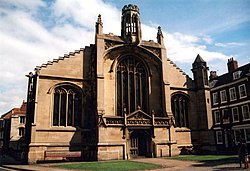
St Michael le Belfrey is an Anglican church in York, England. It is situated at the junction of High Petergate and Minster Yard, directly opposite York Minster, in the centre of the city.
Location Image
46 m

Statue of Elizabeth II, York Minster

A statue of Queen Elizabeth II was unveiled at York Minster on 9 November 2022 by King Charles III, two months after the Queen's death in September 2022. The 6ft 7in (2m) tall sculpture was intended to mark the late monarch's Platinum Jubilee and was completed in August 2022, a month before her death. The statue, which stands in a niche on the minster's west front and weighs almost two tonnes, is carved from French lepine limestone. It portrays the Queen wearing her Garter robes and the George IV State Diadem, and holding the orb and sceptre, symbols of authority. The design was chosen by the Queen. The statue was originally to have been unveiled in September 2022, but this was postponed owing to the Queen's death and state funeral that month.