25–29 High Petergate is a Grade II* listed terrace in the city centre of York, in England. The terrace lies on High Petergate, one of the main streets in York. Nos. 27 and 29 were designed by John and George Bowes and completed by 1701, while No. 25 was added in 1707. All three are three storeys tall, with an attic, and built of orange brick, on a stone plinth. Each is of a different width: No. 25 is five bays wide, No. 27 two bays, and No. 29 four bays. The centre bay of No. 25 is slightly forward of the rest of the facade. Internally, the original staircase of No. 29 survives, while No. 25 has an early 19th-century staircase, and No. 27 was entirely refitted in the 19th century. No. 27 also has some stained glass, designed by Thomas Hodgson in 1801. The front doors all date from around 1800. At the back, all three have gables: curved on No. 25, and Dutch on Nos. 27 and 29. The three buildings are in commercial use. No. 25 is the Guy Fawkes Hotel, which has a plaque installed by the York Dungeon claiming that Guy Fawkes was born on the site. However, there is no evidence of this, and the York Civic Trust instead argues that he was born on nearby Stonegate.

Nearby Places View Menu
Location Image
21 m

23 High Petergate

23 High Petergate is a grade I listed building in the city centre of York, in England. The house lies on High Petergate, one of the main streets in York. It was built in about 1779 at the end of a terrace, with a three-storey, four bay front of red brick, and side and back walls of orange brick. Its external appearance is largely original, including the doorway, windows, and ground floor shutters. The top of a drainpipe is inscribed "1780", while a similar one to the rear is marked "1779". To the side of the front door is a torch extinguisher, made of iron. The garden wall is also original. A carriage house was added in the late 19th-century, and there were further alterations to the building in the 20th-century. Inside the building, the main feature is an original staircase, rising through all the stories, with a serpentine balustrade, top lit by a glazed dome, surrounded by neoclassical plasterwork. This staircase is described by Nikolaus Pevsner as "exceptional". The building was grade I listed in 1954.
Location Image
22 m

St Michael le Belfrey, York

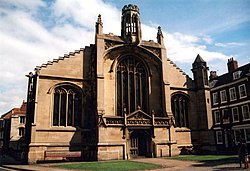
St Michael le Belfrey is an Anglican church in York, England. It is situated at the junction of High Petergate and Minster Yard, directly opposite York Minster, in the centre of the city.
Location Image
34 m

33–35 High Petergate

33–35 High Petergate is a mediaeval building in the city centre of York, in England. The oldest part of the building was constructed in the 14th century as part of a terrace facing Stonegate, this part is now known as 60 Stonegate. The main part of the building, two houses now numbered 33 and 35 High Petergate, is timber framed and was originally of two jettied storeys, built at an unknown date. Around 1600, a jettied second floor and attic were added, and 60 Stonegate was combined with the High Petergate row. At the corner of the building is a dragon post inscribed ":ANNO:DO:1646". In the early 18th century, an extension was added at the rear of the building, doubling its depth. 33 Petergate was altered in the early 19th century, and a small brick-built rear wing was added. Later in the century, shop fronts were inserted at ground level, and these survive. Inside, there are several early doors and the upper part of the staircase in No. 35 is also early, while the lower part is 18th century. The staircase in No. 33 is early 19th century. The building was Grade II* listed in 1954. It is currently divided into two shops, with flats above.
Location Image
35 m

1 Minster Gates and 38 High Petergate

1 Minster Gates and 38 High Petergate is a historic building in the city centre of York, England. The building was constructed in about 1500, at one of the most prestigious locations in the city, the junction of High Petergate and Minster Gates. It was originally a three-storey timber-framed, jettied house, with a fourth storey added in the late 16th century. In the late 18th century, the facades on both streets were rebuilt in brick. In 1801, the house was split into two properties, and the ground floor was converted into retail space, with shop windows added. This work was probably undertaken for John Wolstenholme, who ran a bookshop out of the building, and a statue of Minerva survives at the corner of the building, constructed to advertise his business. Its restoration was funded by York Civic Trust. The building has been Grade II* listed since 1954. 1 Minster Gates is occupied by Shared Earth, an ethical trade shop founded in 1986. It employs prisoners nearing the end of their sentences, but was in the news in 2024 after one ex-offender employed by the business stole £17,000 of its money. Since 1976, 38 High Petergate has been the Japanese Print Shop, selling Japanese woodblock prints. The building has a two-bay front on Minster Gates, and a seven-bay front on High Petergate. Some timber-framing remains, although the external walls are now in brown brick, while the roof is pantiled. There are two doors to Minster Gates, one now blocked, and one 28-pane window, with a fanlight above. To High Petergate, four similar windows flank a door. Two of the fanlights are inscribed: "Stationery" and "Prints". The statue of Minerva shows her reclining on a pile of books. The three leftmost bays have now been divided into two further shops, each with a separate front. Inside, there is an altered 18th-century straight staircase from the ground floor to the first, and a winding staircase from there up to the third floor. There is a second 18th-century staircase at the rear of the building. The ground-floor shop entered from Minster Gates has three early doorframes, and a second room has a shallow dome. The first-floor room of 38 High Petergate has an old fireplace, and a room entirely panelled in early 17th-century work.