

 English
 Français

Norwood (Yorkshire du Nord)
Norwood est une paroisse civile du Yorkshire du Nord, en Angleterre.
Nearby Places View Menu

0 m
Norwood, North Yorkshire
Norwood is a civil parish in North Yorkshire, England. Several areas of Norwood are significantly affluent, with a large number of high-value properties. According to the 2001 UK census, Norwood parish had a population of 200, increasing to 216 at the 2011 Census. The parish lies on the eastern side of the Washburn Valley, and includes the eastern side of Swinsty Reservoir. It is situated adjacent to the Yorkshire Dales National Park and lies within Nidderdale National Landscape (AONB).
There is no village in the parish. The population is spread among a number of hamlets and scattered farms, including Norwood Bottom and Bland Hill. Norwood Hall is a 17th-century Grade II listed building. Dob Park Bridge is a packhorse bridge, probably of 17th century origin, over the River Washburn.
Norwood is pronounced locally as "Norood", just as Warwick is pronounced "Warrick".
Until 1950 the parish was known as Clifton with Norwood. It was historically a township in the parish of Fewston, and became a separate civil parish in 1866. Until 1974 it was part of the West Riding of Yorkshire. From 1974 to 2023 it was part of the Borough of Harrogate, it is now administered by the unitary North Yorkshire Council.

1.3 km
Scow Hall
Scow Hall is a historic building near Norwood, North Yorkshire, a village in England.
The farmhouse was built as a timber framed aisle hall in the 16th century, and rebuilt in stone in the 17th century. It was further altered and extended in the 19th century. In 1900, it was purchased by Leeds City Council as part of a waterworks scheme, but continued to be let out as a farmhouse until 1926, when a replacement was built. It was thereafter used as a blacksmiths' shop, cow house, dovecote and chicken coop in increasingly poor condition.
In 1952, local historian Fred Morrell convinced the Royal Commission on the Historical Monuments of England to study the building, and it was grade II* listed in 1966. In 1976, Leeds City Council sold it to Ann Skelton, who restored the property as a house. The remainder of the farm is owned by Yorkshire Water, which lets it to young farmers for five-year periods as part of a scheme to train them in sustainable agriculture.
The house has a timber-framed core encased in gritstone, and has a stone slate roof. There are two storeys and five bays. The doorway has chamfered quoined jambs, a triangular head, and a hood mould. Most of the windows are mullioned. Inside, much of the timber framing remains.

1.8 km
Swinsty Reservoir
Swinsty Reservoir is a reservoir in the Washburn valley north of Otley and west of Harrogate in Yorkshire, England. Construction began in 1871 and was completed in 1878. The capacity is about 866 million gallons, with a surface area of 63 hectares. It can be found from the A59 road.
The reservoir is below and directly adjoining Fewston Reservoir. The area around the reservoirs is popular with walkers.
1.9 km
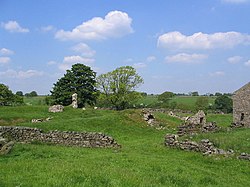
John O'Gaunt's Castle
John O'Gaunt's Castle was a royal hunting lodge. It is situated in the civil parish of Haverah Park near Harrogate, now in North Yorkshire (historically in the West Riding of Yorkshire).

2.1 km
Beaver Dyke Reservoirs
Beaver Dyke Reservoirs were two water supply reservoirs (one of which is still extant), 5 miles (8 km) west of Harrogate in North Yorkshire, England. The main reservoir, also known as Lower Beaver Dyke Reservoir, was constructed in 1890 and had a surface area of 9 ha (22 acres). In 2008 the reservoir's owner, Yorkshire Water, decided that it was not economic to maintain its ageing structures. It was decommissioned between 2013 and 2015 by breaching its dam and channelling a stream in the bed of the former reservoir. A residual lake of 0.5 ha (1.2 acres) was retained. The water of the reservoir was relatively nutrient rich, but it was known to suffer from potentially toxic blooms of Cyanobacteria.
The smaller reservoir (also called John O'Gaunts Reservoir due to the proximity of John O'Gaunt's Castle) is still filled with water.