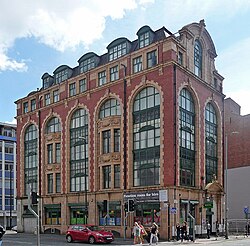
Oldham Street is in Manchester city centre and forms part of the city's historic Northern Quarter district. The Northern Quarter is dominated by buildings that were built before the Second World War. The street runs from Piccadilly northwards to Great Ancoats Street on the edge of Ancoats, beyond which it continues further north as Oldham Road, the A62. The street is a part of Manchester which is on a tentative list as a UNESCO World Heritage Site. The Methodist Central Hall stands on the east side. Until the 1970s Oldham Street formed one of the principal shopping areas of Manchester city centre. However the construction of the large indoor Arndale Centre to the west during this decade saw most of the well known and long established high street stores closed or relocated.

Nearby Places View Menu
Location Image
107 m

River Tib

The River Tib is a minor tributary of the River Medlock in Manchester, England. It has been culverted along its entire length since about 1783 and now runs beneath Manchester city centre. Tib Street (53°29′01″N 2°14′05″W) and Tib Lane are named after the watercourse. During the Roman period, the Tib marked the boundary of the vicus or settlement of Mamucium; the river continued to mark Manchester's boundary until medieval times, as well as providing drinking water. A notion concerning the Tib's name, coined by Geoffrey Ashworth in his book The Lost Rivers of Manchester, is that the river was given its name by homesick Roman soldiers after the River Tiber, but with the word shortened to reflect the size difference between the two rivers. Alternatively, the name may derive from the Celtic word for "watercourse". The river's source is a spring in Miles Platting (53°29′36″N 2°13′08″W), from where it flows underneath Oldham Road and the eponymous Tib Street to reach the city centre. After flowing underneath West Mosley Street, the Tib crosses Princess Street to flow underneath the Manchester Town Hall Extension, the Central Library and the Midland Hotel's dining room, before joining the Medlock at Gaythorn (now First Street, 53°28′23″N 2°14′52″W), close to Deansgate railway station. Parts of the Rochdale Canal around Lock 89 (Tib Lock) can be emptied into the River Tib by opening a small, original wooden trap door installed during construction. Lock 89 was one of the bottom nine locks opened in 1800.
Location Image
195 m

Greater Manchester Police Museum

The Greater Manchester Police Museum is a former police station converted into a museum and archives detailing the history of policing in Greater Manchester, England. It was home to Manchester City Police and then its successors Manchester and Salford Police and Greater Manchester Police from 1879 until 1979. Upon its conversion to a museum in 1981, the interior was redesigned to reflect its past and now serves as a reminder of Victorian policing. On 5 June 1994, the building was Grade II listed as the Former Newton Street Police Station.
Location Image
197 m

50 Newton Street

50 Newton Street is a Grade II listed former warehouse in Manchester, England. It is located on Newton Street in the Northern Quarter area of the city. It was built in 1906–08 by a design from Charles Clegg & Son and was designed with a degree of flair and panache and is described by English Heritage as an example of "Free Baroque" architecture. The hat factory it replaced was destroyed by fire in 1906. As of 2024, the building is planned to be fully renovated by Sean Boyd of Boyd & Co. Capital Investments Limited.
203 m

Sunshine Studios

Sunshine Studios is an international dance organisation. It was founded by hip-hop teacher Jerry Tse (a.k.a. JV) in Manchester, England, in 2006 with his flat mate Tim Barlow. Sunshine Studios gives artists of various performing and visual arts studio space and the chance to run public classes. It uses a similar business model to other dance studios such as Pineapple Studios in London and Steps on Broadway in New York City. The studios offer a variety of workshops and nearly 100 classes per week. These include urban art, live music, hip-hop, ballet, tap, jazz, salsa, pilates, pole-dancing, flamenco, cheerleading, contemporary dance, breakdancing and other forms of performing arts.