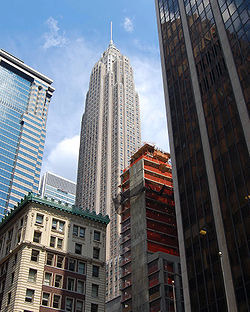
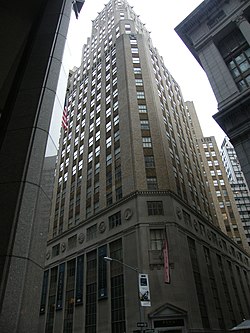
L'American International Building est un gratte-ciel de Manhattan, à New York, situé au 70 Pine Street, Financial District, New York. Il mesure 290 mètres avec son antenne (259 mètres si on ne compte que le toit) et compte 66 étages, séparés de 3,75 mètres.

1. Description

Le bâtiment a été construit entre 1930 et 1932, dans une période de « course aux gratte-ciel », marquée par la construction de gratte-ciel aujourd'hui mythiques comme l'Empire State Building ou le Chrysler Building. L'American International est construit dans un style art déco, bien que son sommet soit plus proche de l'architecture gothique. L'American International Building était le plus haut bâtiment de downtown Manhattan (pointe sud de Manhattan) jusqu'à la construction du World Trade Center en 1973. Après les attentats du 11 septembre 2001, l'American International est redevenu le plus haut édifice de Downtown Manhattan, jusqu'à l'achèvement de la Freedom Tower en 2014. Le bâtiment est couramment appelé American International par les New-Yorkais. Le building était autrefois la propriété de la compagnie pétrolière Cities Service Company, ce qui lui valait le surnom de Cities Service Building. Mais le gratte-ciel fut vendu à la compagnie d'assurances American International Group (AIG), alors que la Cities Service Company déménageait dans l'Oklahoma, à Tulsa. L'American International Group possède toujours le bâtiment, où elle a placé son siège mondial, cependant, la Cities Service Company détient toujours des bureaux dans l'immeuble. Le bâtiment possède un « observatoire » au soixante-sixième étage offrant une vue sur downtown et toute la ville. Autrefois public, il est aujourd'hui réservé aux employés de l'American International Group. En outre, le gratte-ciel était à l'origine pourvu d'ascenseurs à double étage, afin d'améliorer la desserte de la tour, mais ces ascenseurs furent supprimés peu de temps après, à cause de leur manque de popularité. L'idée a cependant été reprise par le Citigroup Center, dans les années 1970.

1. Dans la culture populaire

L'American International est apparu dans de nombreux films se déroulant à New York. On a ainsi pu le voir dans Spiderman (bien qu'il soit situé dans le film dans le quartier de Midtown pour les besoins du tournage), Gangs of New York (lors de la scène finale montrant l'évolution de la ville), Independence Day, Armageddon, Capitaine Sky et le monde de demain, Team America, police du monde, ou dans le dessin animé de Disney, Oliver et Compagnie.

1. Annexes


1. = Articles connexes =

Liste des plus hautes constructions de New York Architecture à New York

1. = Liens externes =

(en) Site officiel Ressources relatives à l'architecture : The Skyscraper Center Structurae

Portail de New York Portail des gratte-ciel

Nearby Places View Menu
Location Image
9 m

1831 City Bank of New York theft

The 1831 City Bank of New York theft took place on March 19, 1831, in New York City, New York, United States, when burglars stole $245,000 (1831 values) from the City Bank (now Citibank) on Wall Street, using a set of copied keys. The theft is regarded as one of the first bank heists in U.S. history. The amount stolen would come to over $52 million in 2013 currency. Initial reports variously reported the names of the culprits as Edward Smith, Edward Jones, James Honeyman and James Murray. A modern source, drawing on period newspapers, identifies the thieves as James Honeyman and William J. Murray. Murray and Honeyman, who used both "Smith" and "Jones" as aliases, spent $60,000 before their arrest. Murray fled to Philadelphia, while Honeyman remained in New York under an alias. Both were captured, convicted, and sentenced to five years in Sing Sing Prison. The Connecticut Courant reported that the suspect, Smith (Honeyman), was apprehended "due to the acuteness and indefatigable vigilance of High Constable Hays." Honeyman had been apprehended in the previous year for robbing "Mr. Schenck's store" in Brooklyn. He was a "Morocco (leather) dresser" by trade who kept a small shoe store on the Bowery where he allowed "dissipated profligates" to gather. Constable Hays found nothing during his first search of the Division Street rooms where Honeyman lived with his wife and two children. Tipped off by the keeper of the lodging house, who saw Honeyman carrying a trunk out of his rooms, the "acute" Constable Hays returned later in the week, and he decided to search the trunks remaining in the apartment. This time, he found most of the stolen money hidden under clothing in one of the trunks. The suspect was seized and taken to New York's colonial-era Bridewell prison. Authorities recovered: $57,328 in City Bank notes; $501,118 in "various city notes;" $44,000 in Lansingburgh Bank Notes (a bank in Lansingburgh, New York); $20,000 in notes issued by the "Morris Canal"; $8,272 recorded as "uncurrent - belonging to S. & M. Allen"; and $40 worth of counterfeit notes. $63,000 of stolen money was never recovered, a sum that included 398 doubloons.
Location Image
35 m

60 Wall Street

60 Wall Street (formerly the J.P. Morgan Bank Building or Deutsche Bank Building) is a 55-story, 745-foot-tall (227 m) skyscraper on Wall Street in the Financial District of Lower Manhattan in New York City, New York, U.S. The tower was designed by Kevin Roche and John Dinkeloo of Roche-Dinkeloo and originally built for J.P. Morgan & Co. The building's design was intended to fit its surroundings with a postmodern, Greek Revival, and neoclassical look. Since 2017, 60 Wall Street has been mostly owned by GIC Singapore, with Paramount Group as the minority owner. 60 Wall Street was designed with 1.7×10^6 ft2 (160,000 m2) of floor area. The building's four-story base was designed with columns resembling architectural arcades, while the upper stories are faced in glass and stone. The eight stories below the hip roof contain corners that resemble columns. The ground floor contains an enclosed public atrium connecting the building's entrances at Wall and Pine Streets, with plantings and a subway entrance. The second through fourth floors were designed as trading floors, while the other stories were offices for J.P. Morgan & Co. and then Deutsche Bank. What is now 60 Wall Street replaced several buildings occupied by Cities Service. The American International Group and Bank of New York originally planned a 60-story office tower on the site in 1979, but these plans were abandoned in 1982. The site was then acquired by Park Tower Realty Company, who sold it in 1985 to J.P. Morgan & Co. The project was finished in 1989, with J.P. Morgan occupying the whole building. Starting in 2001, the building served as the American headquarters of Deutsche Bank after the Deutsche Bank Building was severely damaged and 4 World Trade Center was destroyed in the September 11 attacks. The Paramount Group bought the building in 2007, and GIC bought a majority stake from Paramount in 2017. The owners announced a renovation of 60 Wall Street in 2021, after Deutsche Bank announced its intention to move out; the plans prompted protests from preservationists, who advocated for the facade and lobby to be preserved.
Location Image
61 m

63 Wall Street

63 Wall Street, originally the Wall and Hanover Building, is a 37-story skyscraper on Wall Street in the Financial District of Manhattan in New York City. Built in 1929, it was designed by Delano & Aldrich as the headquarters of Brown Brothers & Co.
Location Image
65 m

48 Wall Street

48 Wall Street, formerly the Bank of New York & Trust Company Building, is a 32-story, 512-foot-tall (156 m) skyscraper on the corner of Wall Street and William Street in the Financial District of Lower Manhattan in New York City. Built in 1927–1929 in the Neo-Georgian and Colonial Revival styles, it was designed by Benjamin Wistar Morris. The current structure is the third to be erected on the same plot, as the Bank of New York had previously erected buildings on the site in 1797 and 1858. The structure was erected during a period when many skyscrapers were being erected in Lower Manhattan. 48 Wall Street is designed with many neo-Georgian details. The lowest three stories, built over a raised basement, were used as the banking floor and feature large arched windows on the second story, as well as pediments over the entrances. The top of the building contains a cupola designed in the Federal style and topped by a statue of an eagle. The Bank of New York moved out of 48 Wall Street in 1998, after which it was renovated extensively. Museum of American Finance occupied the former banking hall from 2007 to 2018; it was replaced by Will & Wall, a multi-purpose event venue. The building was designated a city landmark by the New York City Landmarks Preservation Commission in 1998 and was added to the National Register of Historic Places (NRHP) in 2003. It is also a contributing property to the Wall Street Historic District, a NRHP district created in 2007.
Location Image
69 m

Crown Shy

Crown Shy is a restaurant in New York City, New York in the Financial District. It is located on the ground floor of 70 Pine Street and is associated with Saga; a 2 star Michelin Star restaurant on the 63rd floor; and OverStory, a cocktail bar on the 64th floor which was ranked as the third best bar in the world and the second best in the United States behind Double Chicken Please on The World's 50 Best Bars in 2023. The restaurant serves American cuisine and has received a Michelin star.