

 English
 Français

Prudhoe Castle
Prudhoe Castle is a ruined medieval English castle situated on the south bank of the River Tyne at Prudhoe, Northumberland, England. It is a Scheduled Ancient Monument and a Grade I listed building.
Nearby Places View Menu

509 m
Prudhoe
Prudhoe ( PRUD-ə) is a town and civil parish in the south of Northumberland, England. It is 11 miles (18 km) west of Newcastle upon Tyne and situated on a steep, north-facing hill on the south bank of the River Tyne. Prudhoe had a population of 11,675 at the 2011 census, making it the second largest town in the Tyne Valley after Hexham.
Nearby villages include Ovingham, Ovington, Wylam, Stocksfield, Hedley on the Hill and Mickley.

667 m
Prudhoe railway station
Prudhoe is a railway station on the Tyne Valley Line, which runs between Newcastle and Carlisle via Hexham. The station, situated 12 miles 1 chain (12.0 mi; 19.3 km) west of Newcastle, serves the town of Prudhoe and villages of Mickley and Ovingham in Northumberland, England. It is owned by Network Rail and managed by Northern Trains.

687 m
Ovingham
Ovingham is a village and civil parish in the Tyne Valley of south Northumberland, England. It lies on the River Tyne 10 miles (16 km) east of Hexham with neighbours Prudhoe, Ovington, Wylam and Stocksfield.
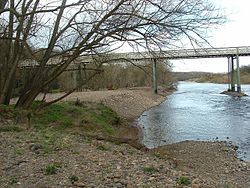
The River Tyne provided an obstacle between Ovingham and Prudhoe until 20 December 1883, when a toll bridge (Ovingham Bridge) was finally opened, taking the place of the ferry. The steel tubes are marked Dorman Long Middlesbrough, the firm which designed and built the Sydney Harbour Bridge and the Tyne Bridge.
829 m
Ovingham Bridge
Ovingham Bridges are a pair of side-by-side vehicle and pedestrian bridges across the River Tyne linking Ovingham and Prudhoe in Northumberland, England. Following a lengthy refurbishment programme by Northumberland County Council, Ovingham Bridge re-opened to vehicles on 5 September 2016.
The vehicle bridge is a single track of reduced width for cars and light vans only. There is no footpath; pedestrians use the separate footbridge that runs alongside and with the same deck level. The centre piers are set wider, allowing the deck to spread and two vehicles can pass, although this is rare. No traffic controls are installed; drivers observe the far end and wait or enter the bridge using a set of unwritten rules that usually function well.