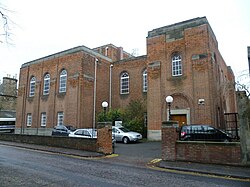
St Columba's Catholic Church, Edinburgh

St Columba's Church, Edinburgh is a Roman Catholic church located in the Newington district of Edinburgh, Scotland.

1. History

The foundation stone of the church was laid on Easter Tuesday 23 April 1889 and it was officially opened on Sunday 17 November of that year. The building was designed in the classic Renaissance style by Rhoderic Cameron. Notable features include a collection of statues in the window niches. The presbytery and hall were added by Reginald Fairlie, 1927. It is a Category B listed building.
A two-manual pipe organ by Matthew Copley was installed in 1997.

1. Parish organisation

From 2017 the parishes in Edinburgh were organised into clusters to better coordinate their resources. St Columba's is one of four parishes in Cluster 4 along with St Peter's, Sacred Heart and St Mark's. The Edinburgh Group of the Ordinariate of Our Lady of Walsingham meet in St Columba's.

1. References


1. External links

St Columba's Church

Nearby Places View Menu
Location Image
70 m

Newington, Edinburgh

Newington is a neighbourhood of southern Edinburgh, Scotland. Developed from the early 19th century, it is an affluent, predominantly residential area. Located between 1 and 2+1⁄2 miles (1.5 and 4 kilometres) south of Edinburgh city centre, Newington is bounded to the east by St Leonard's and Prestonfield; to the south by Cameron Toll and Nether Liberton; to the west by Blackford, the Grange, and Sciennes; and to the north by the Southside, Edinburgh. Historically part of the parishes of St Cuthbert's and Liberton in the county of Midlothian, Newington was incorporated into the city of Edinburgh between 1832 and 1896. Originally part of the ancient forest of Drumselch, the lands of Newington were feued by the town council of Edinburgh from 1586. Aside from small developments, the area was predominantly rural until Benjamin Bell purchased the lands in 1805 and began to develop them as a suburb. Around this time, the construction of a new route from Edinburgh's New Town to Liberton via Newington was accelerating the southward development of the city. From the 1850s, bus services connected Newington to the city centre while trams arrived in 1871. Newington station opened to passengers in 1884. By this time, the area was almost entirely developed. In the latter half of the 19th century, institutions including the Longmore Hospital, the Royal Blind Asylum, and St Margaret's School set up in Newington. Newington station closed to passengers in 1962. Northern Newington consists of dense early Victorian tenements and Georgian terraces. South of Salisbury Road, these give way to sparser, late Georgian and early Victorian developments, some of which were founded as gated communities. Southern Newington includes Victorian villas and terraces as well as some former industrial buildings. With a population of around 11,000, Newington today remains an affluent, primarily residential suburb. The area is also one of the most diverse in Edinburgh. Newington houses Edinburgh's only synagogue as well as the headquarters of Historic Environment Scotland and the Causewayside site of the National Library of Scotland.
Location Image
91 m

Longmore House

Longmore House, formerly Longmore Hospital, on Salisbury Place, Newington, Edinburgh, is the headquarters of Historic Environment Scotland. The property is designated a Category B listed building.
185 m

Edinburgh Geographical Institute

The Edinburgh Geographical Institute was founded as a map publisher by famed Scottish geographer and cartographer John George Bartholomew in 1888.
Location Image
313 m

Edinburgh Synagogue

The Edinburgh Synagogue is an Orthodox Jewish congregation and synagogue, located at 4a Salisbury Road in the Newington area of Edinburgh, Scotland, in the United Kingdom. Established in 1816 as the Edinburgh Hebrew Congregation, the congregation worships in the Ashkenazi rite, under the auspices of the Chief Rabbi of the United Hebrew Congregations of the Commonwealth. The current synagogue building was opened in 1932, replacing a converted chapel on Graham Street which had served as the synagogue since 1898.