

 English
 Français

Holy Cross and St Helen Church is a Roman Catholic church in St Helens, Merseyside. The church was built in 1860 by the Society of Jesus. It was designed by Joseph John Scoles and is a Grade II listed building.
Nearby Places View Menu

74 m
North West Museum of Road Transport
The North West Museum of Road Transport (formerly St. Helens Transport Museum or St. Helens Bus Museum) is located at the old St. Helens Corporation Transport bus depot in Hall Street, St Helens, Merseyside, England.

160 m
St Helens Central railway station
St Helens Central railway station (previously known as St. Helens Shaw Street) is a railway station serving the town of St Helens, Merseyside, England. It is on the Liverpool to Wigan Line from Liverpool Lime Street to Wigan North Western. The station is managed by Northern Trains, and is served by TransPennine Express and Northern Trains.
The station is on the Merseytravel City Line. The City Line is the name given to local rail routes out of Liverpool Lime Street operated by companies other than Merseyrail. The City Line appears on Merseytravel network maps as red, and covers the Liverpool-Wigan Line.
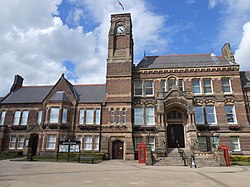
228 m
St Helens Town Hall
St Helens Town Hall is a municipal building in Bickerstaffe Street in St Helens, Merseyside, England. Although the town hall itself, which is the headquarters of St Helens Council, is not a listed building, there are two telephone kiosks flanking the entrance which are listed.

277 m
St Helens, Merseyside
St Helens () is a large town in Merseyside, England, with a population of 117,308. It is the administrative centre of the Metropolitan Borough of St Helens which had a population of 183,200 at the 2021 Census.
The town is 6 miles (10 kilometres) north of the River Mersey, in the south-west part of historic Lancashire. The town was initially a small settlement within the historic county's ancient hundred of West Derby in the township of Windle but by the mid-1700s the town had developed into a larger urban area beyond the townships borders. By 1838 the council was formally made responsible for the administration of Windle and the three other townships of Eccleston, Parr and Sutton that were to form the town's traditional shape. In 1868 the town was incorporated as a municipal borough, then later became a county borough in 1887. In 1974 the town was made a metropolitan borough within the new Metropolitan County of Merseyside by the Local Government Act 1972, with an expanded administrative responsibility for several nearby towns and villages.
The town was famous for its heavy industry, particularly its role in the coal mining industry, glassmaking, chemicals and copper smelting and sail making that drove its growth throughout the Industrial Revolution. Originally home to a large number of industrial employers such as Beechams, the Gamble Alkali Works, Ravenhead Glass, United Glass Bottles (UGB), Triplex, Daglish Foundry, Greenall's brewery, the glass producer Pilkington is the town's only remaining large industrial employer.
The town is today most famous for its Rugby League team St Helens R.F.C. who have won 3 World Club Challenge cups in recent years, and museums such as the North West Museum of Road Transport, the World of Glass and art installations such as Dream.