

 English
 Français
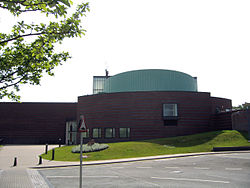
The Brindley
The Brindley is a theatre in the town of Runcorn, Cheshire, England. Located by the Bridgewater Canal, the centre is named after the canal's engineer, James Brindley. It opened in autumn 2004; the architects were John Miller and Partners. The building is owned and operated by Halton Borough Council.
Nearby Places View Menu

123 m
Runcorn
Runcorn is an industrial town and cargo port within the Borough of Halton in Cheshire, England. It lies on the south bank of the River Mersey, where the estuary narrows to form the Runcorn Gap, and is located approximately 15 miles (24 km) southeast of Liverpool and 29 miles (47 km) southwest of Manchester. The Runcorn built-up area had a population of 61,145 at the 2021 census.
Runcorn was founded by Æthelflæd of Mercia in 915 AD as a fortification against the Viking invasion at a narrowing of the River Mersey. Under Norman rule, Runcorn fell under the Barony of Halton and an Augustinian abbey was established there in 1115. It remained a small and isolated settlement until the Industrial Revolution, when the 1776 extension of the Bridgewater Canal to Runcorn established it as a port linking coastal Liverpool with inland Manchester and Staffordshire. The docks enabled the growth of industry, initially shipwrights and sandstone quarries; in the late 18th and early 19th centuries, it was a spa and health resort, but this ended with the growth of polluting industries, especially soap and chemical works. In 1964, Runcorn was designated a new town and expanded eastward, absorbing neighbouring settlements and more than doubling its population.
The Silver Jubilee Bridge, Mersey Gateway, and Runcorn Railway Bridge span the River Mersey and the Manchester Ship Canal in Runcorn. Its location between Liverpool and Manchester and its links to the rail, motorway, and canal networks have made it a major centre for the manufacturing, logistics, and wholesale and retail industries.

284 m
Holy Trinity Church, Runcorn
Holy Trinity Church is in Runcorn, Cheshire, England. It is an active Anglican parish church in the diocese of Chester, the archdeaconry of Chester and the deanery of Frodsham. Its benefice is combined with that of All Saints, Runcorn. It is recorded in the National Heritage List for England as a designated Grade II listed building.

421 m
Carnegie Library, Runcorn
The Carnegie Library is in Egerton Street, Runcorn, Cheshire, England. It is recorded in the National Heritage List for England as a designated Grade II listed building and "possesses special architectural and historic interest within a national context". It was built in 1906 as an extension to Waterloo House and the existing library with a grant from Andrew Carnegie, and closed in 2012.

466 m
All Saints' Church, Runcorn
All Saints' Church is the parish church of Runcorn, Cheshire, England, sited on the south bank of the River Mersey overlooking Runcorn Gap. There is a tradition that the first church on the site was founded by Ethelfleda in 915. That was replaced, probably in about 1250, by a medieval church that was altered and extended in the 14th and 15th centuries. By the 19th century the building's structure had deteriorated and become dangerous, and it was replaced by a new church, built between 1847 and 1849 to the designs of Anthony Salvin.
The church is built in local sandstone and is in Early English style with a tall steeple at the southwest corner. Some of the furniture in the church was moved from the previous building, as were some of the memorials, the majority of which are to members of the Brooke family from nearby Norton Priory.
All Saints is an active Anglican parish church in the diocese of Chester, arranging services on Sundays and home groups during the week, in addition to weddings and funerals. The church is designated as a Grade II* listed building.