

 English
 Français
Bolton WtE
The Bolton WtE is a waste power station constructed in 1971 in Bolton, and is a major landmark of its skyline. The incinerator burns up to 20 tonnes (22 tons) of household waste per hour or 85,000 t (94,000 tons) per year, and can generate up to 11 MW of electricity. The plant is operated by Suez Recycling and Recovery UK. The Bolton incinerator is the only household waste incinerator in Greater Manchester.
Nearby Places View Menu
321 m
Raikes Park Greyhound Stadium
Raikes Park Greyhound Stadium, also known as Bolton Greyhound Stadium, was a greyhound racing track in Bolton, Greater Manchester in north-west England. It is not to be confused with the Westhoughton Greyhound Track, which was another track in nearby Westhoughton.

340 m
Burnden
Burnden is a district in the town of Bolton in Greater Manchester, England. It is located about 1 mile (2 km) southeast of Bolton town centre.
Historically a part of Lancashire, Burnden derives its name from two Old English words. The first part "burn" means a stream or a brook and is more popularly used in the Scottish Lowlands. The second part "dene" or "denu" means a valley. Combined, they mean a brook flowing through a valley. Burnden Brook was a small tributary of the River Croal, but has since been culverted and now runs beneath Manchester Road.
In the late 18th century, Burnden was the site of the Burnden Poorhouse which was used by many townships of the parishes of Bolton le Moors and Deane to house their paupers.
For just over a hundred years Burnden was the site of Burnden Park, the home of Bolton Wanderers. The stadium featured in a noted 1953 painting by the Salford-born artist L.S. Lowry, Going to the Match, which is now on public display at The Lowry arts centre in Salford Quays.
The area was described as a ghost town after the stadium, the Normid superstore and the greyhound track closed in quick succession in the late 1990s.
380 m
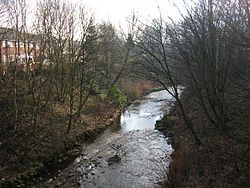
River Tonge
The River Tonge is a short river, splitting Bolton from contiguous Tonge, both in Greater Manchester, England.
The Tonge is formed at the Meeting of the Waters, where Astley Brook, from Smithills in the west, meets the Eagley Brook drawing on more sources to the north. The Tonge meanders southwards, to the east of Bolton, past Springfield where it is joined by Bradshaw Brook, at the end of its route from the Jumbles and Wayoh reservoirs, close to Tonge Fold. The Tonge joins the smaller and thus counterintuitively superseding Croal at Darcy Lever, shortly before the Croal's confluence with the River Irwell.
Tonge Bridge section is a tract north of Tonge Bridge designated as a site of special scientific interest (SSSI). The 0.7-hectare (1.7-acre) site comprises the steep west right bank of the river. It was designated an SSSI 1987 for its geological interest, principally the fluvial sandstone which has yielded pteridosperm seeds, known as Trigonocarpus. The well preserved nature of the seeds make it of considerable sedimentological and palaeogeographic interest. It is one of only seven geological SSSIs in Greater Manchester.
In 2017, invasive walking catfish Clarias were recovered from the river.

553 m
Darcy Lever railway station
Darcy Lever railway station served the Darcy Lever area of eastern Bolton between 1848 and 1951.