

 English
 Français

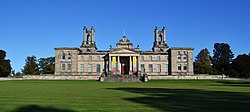
The John Watson's Institution was a school established in Edinburgh, Scotland in 1762. The building was designed in the Greek Revival style in 1825 by architect William Burn, FRSE (1789–1870). Following the closure of the school in 1975, the building was left vacated for a number of years before becoming home to Modern One of the Scottish National Gallery of Modern Art.
1. History
In 1762 John Watson, an Edinburgh solicitor and Writer to the Signet, left the residue of his estate for charitable purposes for children in the Edinburgh area. In 1975 the school was closed and in 1984 the organisation was changed by Parliament to the John Watson's Trust in order to distribute funds from the sale of its assets. The school magazine was known as The Levite.
1. Headmasters


1. = John Forbes, ll.d., d.d. (1840–) =
John Forbes (1802–1899) became Headmaster, and Governor of John Watson's Institution around 1840. He was a son of Patrick Forbes (1776–1847), a minister in the Church of Scotland from 1829 to 1830 and a Professor of Humanities and Chemistry at the University of Aberdeen.
1. = John Langhorne (1897–1925) =
John Langhorne was born at Tonbridge, Kent, in 1862. He was educated at Westminster School and Trinity College, Cambridge. His first appointments were Queen Elizabeth's school, Dedham and Christ's College, Finchley. He moved to Edinburgh in 1890 and for seven years was master at Loretto School, which had been founded by a distant relative, Thomas Langhorne. John Langhorne died whilst on a visit to Barnard Castle on 27 August 1925 and is buried there. He had been a member of the Association for Teachers in Secondary Schools (Scotland). After his death a bronze tablet was installed in his memory at the school. He was the son of the Reverend John Langhorne and died without issue.
1. Alumni
Marion Stevenson, missionary to Africa, and opponent of female genital mutilation. James Drummond Young, Lord Drummond Young, judge of the Supreme Courts of Scotland and Chairman of the Scottish Law Commission. Oliver Shaw Rankin, Scottish scholar and theologian.
1. People
James Dunsmure (1846–1907), served as Physician to the Institution in the late 19th Century.
1. Gallery


1. Bibliography


1. = Annotations =


1. = Notes =


1. = References =
Nearby Places View Menu

Scottish National Gallery of Modern Art
Modern Two

Thomas Anderson (botanist)
