

 English
 Français
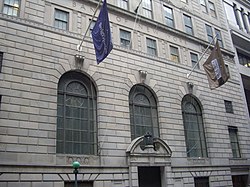
48 Wall Street
48 Wall Street aussi connu sous le nom de Bank of New York Bulding est un bâtiment construit en 1928 sur le terrain de la banque qui y était depuis 1797, sur le coin de Wall Street et William Street dans le quartier financier de New York. Elle a été inscrite au Registre national des lieux historiques en 2003.
1. Références


1. Source


1. Liens externes
Ressources relatives à l'architecture : Registre national des lieux historiques The Skyscraper Center Structurae
Portail des gratte-ciel Portail du Registre national des lieux historiques Portail de New York
Nearby Places View Menu

7 m
48 Wall Street
48 Wall Street, formerly the Bank of New York & Trust Company Building, is a 32-story, 512-foot-tall (156 m) skyscraper on the corner of Wall Street and William Street in the Financial District of Lower Manhattan in New York City. Built in 1927–1929 in the Neo-Georgian and Colonial Revival styles, it was designed by Benjamin Wistar Morris.
The current structure is the third to be erected on the same plot, as the Bank of New York had previously erected buildings on the site in 1797 and 1858. The structure was erected during a period when many skyscrapers were being erected in Lower Manhattan. 48 Wall Street is designed with many neo-Georgian details. The lowest three stories, built over a raised basement, were used as the banking floor and feature large arched windows on the second story, as well as pediments over the entrances. The top of the building contains a cupola designed in the Federal style and topped by a statue of an eagle.
The Bank of New York moved out of 48 Wall Street in 1998, after which it was renovated extensively. Museum of American Finance occupied the former banking hall from 2007 to 2018; it was replaced by Will & Wall, a multi-purpose event venue. The building was designated a city landmark by the New York City Landmarks Preservation Commission in 1998 and was added to the National Register of Historic Places (NRHP) in 2003. It is also a contributing property to the Wall Street Historic District, a NRHP district created in 2007.
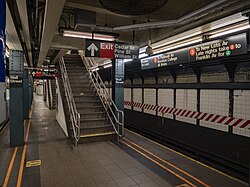
36 m
Wall Street station (IRT Broadway–Seventh Avenue Line)
The Wall Street station is a station on the IRT Broadway–Seventh Avenue Line of the New York City Subway, located at the intersection of Wall Street and William Street in the Financial District of Manhattan. It is served by the 2 train at all times and the 3 train at all times except late nights.

39 m
55 Wall Street
55 Wall Street, formerly the National City Bank Building, is an eight-story building on Wall Street between William and Hanover streets in the Financial District of Lower Manhattan in New York City, New York, United States. The lowest three stories were completed in either 1841 or 1842 as the four-story Merchants' Exchange and designed by Isaiah Rogers in the Greek Revival style. Between 1907 and 1910, McKim, Mead & White removed the original fourth story and added five floors to create the present building. Since 2006, the banking room has functioned as an event venue called the Cipriani Wall Street, while the upper stories have been a condominium development known as the Cipriani Club Residences.
55 Wall Street's granite facade includes two stacked colonnades facing Wall Street, each with twelve columns. Inside is a cruciform banking hall with a 60-foot (18 m) vaulted ceiling, Corinthian columns, marble floors and walls, and an entablature around the interior. The banking hall was among the largest in the United States when it was completed. The offices of Citibank's predecessor National City Bank were in the corners of the banking hall, while the fourth through eighth floors were used as office space. The facade and part of the interior are New York City designated landmarks, and the building is listed on both the New York State Register of Historic Places and the National Register of Historic Places (NRHP) as a National Historic Landmark. It is also a contributing property to the Wall Street Historic District, listed on the NRHP.
The Merchants' Exchange building replaced a structure that had burned down in the Great New York City Fire of 1835. 55 Wall Street subsequently hosted the New York Stock Exchange, then the United States Custom House until a new Custom House building was developed on Bowling Green in the 1900s. After 55 Wall Street was expanded, it served as the headquarters of National City Bank from 1908 to 1961; Citibank continued to own the building until 1992. The upper stories operated as a hotel from 2000 to 2003. Cipriani S.A. and Steve Witkoff began converting the upper stories to condominiums in 2004, while Cipriani operated the banking room as an event venue.

40 m
56 Pine Street
56 Pine Street – originally known as the Wallace Building after its developer, James Wallace – at 56-58 Pine Street between Pearl and William Streets in the Financial District of Manhattan, New York City, was built in 1893-94 and was designed by Oscar Wirz in the Romanesque Revival style.
The building's facade consists of brick, stone and terra cotta and features colonnettes, deeply inset windows and rounded arched openings. The flowered panels and fantastic heads which embellish the building is "some of the finest Byzantine carving in New York."
The building was designated a New York City landmark in 1997 and was added to the National Register of Historic Places in 2003. It is also a contributing property to the Wall Street Historic District, a NRHP district created in 2007.

49 m
1831 City Bank of New York theft
The 1831 City Bank of New York theft took place on March 19, 1831, in New York City, New York, United States, when burglars stole $245,000 (1831 values) from the City Bank (now Citibank) on Wall Street, using a set of copied keys. The theft is regarded as one of the first bank heists in U.S. history. The amount stolen would come to over $52 million in 2013 currency. Initial reports variously reported the names of the culprits as Edward Smith, Edward Jones, James Honeyman and James Murray. A modern source, drawing on period newspapers, identifies the thieves as James Honeyman and William J. Murray.
Murray and Honeyman, who used both "Smith" and "Jones" as aliases, spent $60,000 before their arrest. Murray fled to Philadelphia, while Honeyman remained in New York under an alias. Both were captured, convicted, and sentenced to five years in Sing Sing Prison.
The Connecticut Courant reported that the suspect, Smith (Honeyman), was apprehended "due to the acuteness and indefatigable vigilance of High Constable Hays." Honeyman had been apprehended in the previous year for robbing "Mr. Schenck's store" in Brooklyn. He was a "Morocco (leather) dresser" by trade who kept a small shoe store on the Bowery where he allowed "dissipated profligates" to gather. Constable Hays found nothing during his first search of the Division Street rooms where Honeyman lived with his wife and two children. Tipped off by the keeper of the lodging house, who saw Honeyman carrying a trunk out of his rooms, the "acute" Constable Hays returned later in the week, and he decided to search the trunks remaining in the apartment. This time, he found most of the stolen money hidden under clothing in one of the trunks. The suspect was seized and taken to New York's colonial-era Bridewell prison. Authorities recovered: $57,328 in City Bank notes; $501,118 in "various city notes;" $44,000 in Lansingburgh Bank Notes (a bank in Lansingburgh, New York); $20,000 in notes issued by the "Morris Canal"; $8,272 recorded as "uncurrent - belonging to S. & M. Allen"; and $40 worth of counterfeit notes. $63,000 of stolen money was never recovered, a sum that included 398 doubloons.