Location Image

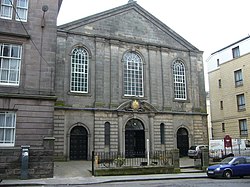
Edinburgh Royal Maternity Hospital and Simpson Memorial Maternity Pavilion

The Edinburgh Royal Maternity and Simpson Memorial Pavilion was a maternity hospital in Lauriston, Edinburgh, Scotland. Its services have now been incorporated into the Royal Infirmary of Edinburgh at Little France.

1. History

Midwifery in Edinburgh, as a part of the medical curriculum, began in 1756 with Thomas Young, professor of midwifery. Early provisions for midwifery consisted of four maternity beds at Edinburgh's Royal Infirmary in 1756. Young's predecessor, Alexander Hamilton, was responsible for establishing the independent Edinburgh General Lying-in Hospital which afforded students the opportunity for practical experience. ("Lying-in" is an archaic term for childbirth, referring to the long bedrest prescribed for new mothers in their postpartum confinement.) It was based at Park Place and opened in either 1791 or 1793. It became known as the Edinburgh Royal Maternity Hospital in 1846. In 1879, using funds collected to commemorate Sir James Young Simpson's contribution to obstetrics, a purpose-built maternity hospital was opened in Edinburgh, to provide a facility where the poor could access medical supervision for childbirth. It was named the Edinburgh Royal Maternity and Simpson Memorial Hospital. The Married Women's Pavilion, which was located in the west wing under the original plans by architects MacGibbon and Ross, had to be postponed in 1879 due to insufficient funds. It was eventually opened by Lady Candida Louise Hay, 10th Marchioness of Tweeddale in 1895. By 1910, the capacity of the facility was under strain, and following the First World War, the hospital expanded into several flats in nearby Lauriston Park and Graham Street to cope with increased demand. Britain's first ante-natal clinic began at this site in 1915, to be followed, in 1926, by a post-natal clinic when the facility amalgamated with the Royal Infirmary of Edinburgh. The new Simpson Memorial Maternity Pavilion, which was designed by Thomas W. Turnbull in the classical style, opened in 1939. The initial provisions of the hospital consisted of two lying–in wards, a labour ward, a dispensary, kitchens and administrative quarters, as well as quarters for the matron, two house surgeons and seven or eight nurses. The facility was directly managed by the Royal Infirmary of Edinburgh, within a grouping of hospitals that would become the Royal Infirmary of Edinburgh National Health Service Trust in 1994. After services transferred to the Simpson Centre for Reproductive Health at the Royal Infirmary of Edinburgh's new site in Little France, the Simpson Memorial Maternity Pavilion closed in March 2002.

1. Notable births

Actor Sean Connery - 25 August 1930. The Beatles' original bassist Stuart Sutcliffe - 23 June 1940. Scottish Conservative leader Ruth Davidson - 10 November 1978.

1. See also

Margaret Myles

1. References
Nearby Places View Menu
Location Image
67 m

Forest Café

The Forest, also referred to as Forest Café, was an independent social centre and arts centre located in central Edinburgh, Scotland. It was notable for being run by volunteers as a charitable, self-sustaining not-for-profit. The Forest was initially housed at a West Port venue from 2000 to 2003, then housed at 3 Bristo Place in the former Edinburgh Seventh Day Adventist Church, a building owned by the Edinburgh University Settlement until August 2011. It featured a two-room café with performance space, a single room art gallery named Total Kunst, a radical library named Old Hat Books housed in the café front room, an Action Room for consensus process based organisational working group meetings and internet access, artist gallery spaces, a meeting cum screen printing and crafting room, a rehearsal/music studio, a walk-in freezer, a woodworking and machining room, a darkroom specialising in alternative photographic process, and unisex toilets. In August 2012 The Forest reopened at 141 Lauriston Place, Tollcross where it continued its activity as a volunteer-run vegetarian cafe with regular free events and workshops, assuming a pivotal role in the revival of the independent community development in central Edinburgh. In 2022 the physical space closed citing difficulties arising from the COVID-19 pandemic, despite arts activities continuing decentrally.
68 m

Palladium Theatre, Edinburgh

The Palladium Theatre was a theatre at East Fountainbridge in Edinburgh, Scotland. It was originally built as the Royal Circus by John Henry Cooke, opening in 1886. By 1908, it had been converted for use as a cinema and was rebuilt as a purpose-built cinema in 1911. After it closed as a cinema in 1932, it was used as a theatre by Millicent Ward and her Company (during which time John Le Mesurier made his professional stage debut there) until 1935 when it reverted to use as a venue for variety shows. During this period of its existence, stars including Lex McLean, Donald Peers, Robert Wilson and The Alexander Brothers performed there. By the 1950s it was in use as a venue in the early years of the Edinburgh Festival Fringe. It finally closed for theatrical use in 1966, and was then converted into a bingo hall. In the late 1960s and early 1970s, it was a nightclub known as the White Elephant, before changing its name in the late 1970s to Valentino's. During this time it hosted bands including Slade, The Cure, U2 and New Order. For a time it was also known as The Muscular Arms. The venue was demolished in 1984 and the site is now occupied by Government offices.
73 m

Tollcross, Edinburgh

Tollcross is a major road junction to the south west of the city centre of Edinburgh, Scotland which takes its name from a local historical land area. It lies between the more affluent area of Bruntsfield and the Grassmarket.
Location Image
146 m

Sacred Heart, Edinburgh

Sacred Heart, Edinburgh, formally known as the Catholic Church of the Sacred Heart of Jesus, is a Roman Catholic church run by the Society of Jesus, close to the city centre of Edinburgh, Scotland, United Kingdom. It is situated in Lauriston, midway between the Grassmarket and Tollcross, on the edge of Edinburgh’s historic Old Town. The church building was opened in 1860 and is a category A listed building.