

 English
 Français

Rue Týnská
La rue Týnská est une voie de Prague.
1. Situation et accès
Cette rue de la Vieille Ville de Prague mène de la rue Štupartská à la rue Dlouhá. L'arrière de l'église Notre-Dame du Týn est bordée par la rue Týnská. La partie de la rue entre Štupartská et le temple Týnský où se trouve l'entrée de la Cour de Týn (Ungelt) est si petite qu'elle ne figure pas dans les adresses postales.
1. Bâtiments remarquables et lieux de mémoire
Maison U Černého slona (À l'éléphant noir), n° 1 Maison Niendertheymerovský, n° 2 Palais Golz-Kinsky, n° 3/5 Maison U Černé koule (À la boule noire), n ° 7 N° 8 Maison U Tří per (Aux trois Plumes), n° 10 Maison de l'étoile d'argent, n° 12
Portail de l’architecture et de l’urbanisme Portail de Prague
Nearby Places View Menu
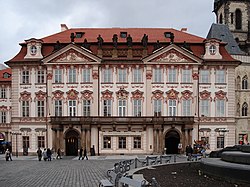
65 m
Kinský Palace (Prague)
Kinský Palace (Czech: Palác Kinských, German: Palais Goltz-Kinsky) is a former palace and now an art museum in Prague, Czech Republic. It is located on the Old Town Square in the Old Town quarter of Prague. The palace's name refers to its former ownership by the Kinsky (Czech: Kinský) noble family.

73 m
Stone Bell House
The Stone Bell House (Czech: Dům U Kamenného zvonu) is located on the Old Town Square in Prague. It is located next to the Kinský Palace on the corner of Old Town Square and Týnská street.
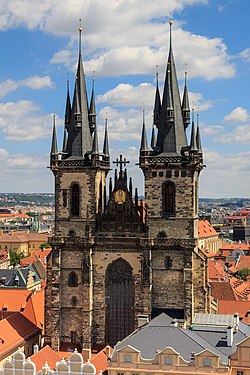
91 m
Church of Our Lady before Týn
The Church of the Mother of God before Týn (in Czech Kostel Matky Boží před Týnem, also Týnský chrám ("Týn Church") or just Týn), or Church of Our Lady before Týn, is a Gothic church and a dominant feature of the Old Town of Prague, Czech Republic. It has been the main church of this part of the city since the 14th century. The church's two towers are 80 m high, and each tower's spire is topped by eight smaller spires in two layers of four.

94 m
Ministry of Regional Development (Czech Republic)
The Ministry of Regional Development of the Czech Republic (Czech: Ministerstvo pro místní rozvoj České republiky) is a government ministry, which was established in 1996 and is a central government authority in the following areas: Regional policy, Housing policy, Development of housing stock, Letting of flats and non-residential premises, Spatial planning, Building rules, Expropriation, Investment policy, Tourism and Funeral services.

115 m
Jan Hus Memorial
The Jan Hus Memorial (Czech: Pomník mistra Jana Husa) stands at one end of Old Town Square, Prague in the Czech Republic. The huge monument depicts victorious Hussite warriors and Protestants who were forced into exile 200 years after Hus in the wake of the lost Battle of the White Mountain during the Thirty Years' War, and a young mother who symbolises national rebirth.
The monument was so large that the sculptor designed and built his own villa and studio where the work could be carried out. It was unveiled in 1915 to commemorate the 500th anniversary of Jan Hus' martyrdom. The memorial was designed by Ladislav Šaloun and paid for solely by public donations.
Born in 1369, Hus became an influential religious thinker, philosopher, and reformer in Prague. He was a key predecessor to the Protestant movement of the sixteenth century. In his works he criticized religious moral decay of the Catholic Church.
Accordingly, the Czech patriot Hus believed that mass should be given in the vernacular, or local language, rather than in Latin. He was inspired by the teachings of John Wycliffe. In the following century, Hus was followed by many other reformers - e.g. Martin Luther, John Calvin and Huldrych Zwingli. Hus was ultimately condemned by the Council of Constance and burned at the stake in 1415. This led to the Hussite Wars.