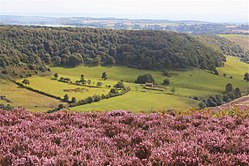
Newton Dale Halt railway station is a request stop on the North Yorkshire Moors Railway and serves as a stopping off point for walkers around Newton Dale and Cropton Forest in the North York Moors National Park, North Yorkshire, England. When the station was opened, the station signs were written as Newtondale Halt. The halt was built by the North Yorkshire Moors Railway using materials from Warrenby Halt, near Redcar. The halt was a new construction that was a joint enterprise between the NYMR, the Forestry Commission and the North York Moors National Park Authority. The station was opened on 23 April 1981 by Hector Monro (Minister for Sport), near to the former Newtondale signal box that had last been used in 1930 and was demolished by the NYMR in 1995 due to it being unsafe. The station is a request stop, and there is no road access to the site. Newton Dale Halt is known for being one of the remotest stations in England due to the lack of road access. A small NER style wooden waiting shelter was erected at the halt in 2003. It is based on the design of the one which used to stand at Sledmere and Fimber on the closed Malton & Driffield Railway but reduced in size and eliminating the windows. There are four different waymarked walks from Newton Dale Halt, provided by the National Park in conjunction with the Forestry Commission. The walks vary in length and difficulty to suit most walkers. The longer walks take the walker to Levisham station. For the more enthusiastic (and better equipped) walker there are public footpaths leading elsewhere, including Goathland station but definitive maps are advisable.

Nearby Places View Menu
Location Image
1.4 km

Newton Dale

Newton Dale, or Newtondale, is a narrow dale within the North York Moors National Park in North Yorkshire, England. It was created by meltwater from a glacier carving the narrow valley. Water still flows through the dale and is known as Pickering Beck. The dale starts between Goathland Moor and Lockton High Moor where water runs southwards towards Pickering. In its upper reaches, the dale is very twisting and deep with the floor of the dale being 490 feet (150 m) above sea level.
Location Image
1.6 km

Hole of Horcum

The Hole of Horcum is a section of the valley of the Levisham Beck, upstream of Levisham and Lockton, in the Tabular Hills of the North York Moors National Park in northern England.
Location Image
1.8 km

Saltersgate Inn

The Saltersgate Inn (also known as the Legendary Saltersgate Inn) is a closed public house at Lockton High Moor on the A169 road between Pickering and Whitby in North Yorkshire, England. The pub was notable for having a fire that was never allowed to burn out, as a legend stated that if it did, the devil would spring forth from the flames. The structure was built c. 1648 and converted into a pub in the 18th century; it closed in 2007 and the building was demolished in 2018.
Location Image
3.6 km

RAF Fylingdales

Royal Air Force Fylingdales (RAF Fylingdales) is a Royal Air Force station on Snod Hill in the North York Moors, England. Its motto is Vigilamus ("We are watching"). It is a radar base, former part of the Ballistic Missile Early Warning System (BMEWS), and now part of the Solid State Phased Array Radar System (SSPARS). As part of intelligence-sharing arrangements between the United States and United Kingdom (see, for example, the UKUSA Agreement), data collected at RAF Fylingdales are shared between the two countries. Its primary purpose is to give the British and US governments warning of an impending ballistic missile attack (part of the so-called four minute warning during the Cold War). A secondary role is the detection and tracking of orbiting objects; Fylingdales is part of the United States Space Surveillance Network. As well as its early-warning and space-tracking roles, Fylingdales has a third function – the Satellite Warning Service for the UK. It keeps track of spy satellites used by other countries, so that secret activities in the UK can be carried out when they are not overhead. The armed services, defence manufacturers and research organisations, including universities, take advantage of this facility.