

 English
 Français
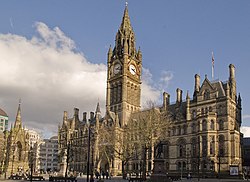
Hôtel de ville de Manchester
L’hôtel de ville de Manchester (anglais : Manchester Town Hall) est un monument néo-gothique de la ville de Manchester, en Angleterre. Il s'agit du siège du Manchester City Council, et il abrite diverses institutions de la gouvernance locale. Au nord de l'hôtel de ville se trouve l'Albert Square et au sud le St Peter's Square, où se trouve le cénotaphe de Manchester (en), face à l'entrée sud du bâtiment. Achevé par l'architecte Alfred Waterhouse en 1877, le bâtiment présente d'imposantes peintures murales réalisées par l'artiste Ford Madox Brown représentant d'importants évènements dans l'histoire de la ville. Le bâtiment est désormais classé parmi l'English Heritage depuis 1952.
Nearby Places View Menu
0 m
Manchester Town Hall
Manchester Town Hall is a Victorian, neo-Gothic municipal building in Manchester, England. It is the ceremonial headquarters of Manchester City Council and houses a number of local government departments. The building faces Albert Square to the north and St Peter's Square to the south, with Manchester Cenotaph facing its southern entrance.
Designed by architect Alfred Waterhouse, the town hall was completed in 1877. The building contains offices and grand ceremonial rooms such as the Great Hall which is decorated with Ford Madox Brown's imposing Manchester Murals illustrating the history of the city. The entrance and Sculpture Hall contain busts and statues of influential figures including Dalton, Joule and Barbirolli. The exterior is dominated by the clock tower which rises to 280 feet (85 m) and houses Great Abel, the clock bell.
In 1938, a detached Town Hall Extension was completed and is connected by two covered bridges over Lloyd Street. The town hall was designated as a Grade I listed building on 25 February 1952. Both the building and the adjacent Albert Square have been closed since 2018 for refurbishment and are scheduled to be reopened in Spring 2027.

9 m
City Centre (ward)
City Centre ward was a ward of the local authority Manchester City Council from 2004 to 2018. The population of Manchester city centre grew significantly in the 21st century, therefore as recommended by the Local Government Boundary Commission for England (LGBCE), the ward was replaced in May 2018 with two new electoral wards, Deansgate and Piccadilly.
It is represented in Westminster by Lucy Powell, from the Labour Co-op Party, Member of Parliament for Manchester Central.

44 m
Cottonopolis
Cottonopolis was a 19th-century nickname for Manchester, as it was a metropolis and the centre of the cotton industry.
The Manchester warehouse which we lately visited, was a building fit for the Town Hall of any respectable municipality; a stately, spacious, and tasteful edifice; rich and substantial as its respectable proprietors, the well-known firm of Banneret and Co. There are nearly a hundred such buildings in Manchester; –not so large, perhaps, for this is the largest; but all in their degree worthy of Cottonopolis.

64 m
Manchester Town Hall Extension
Manchester Town Hall Extension was built between 1934 and 1938 to provide additional accommodation for local government services. It was built between St Peter's Square and Lloyd Street in Manchester city centre, England. English Heritage designated it a grade II* listed building on 2 October 1974. Its eclectic style was designed to be a link between the ornate Gothic Revival Manchester Town Hall and the Classical architecture of the Central Library.

71 m
Manchester
Manchester is a city in Greater Manchester, England. It had a population of over 589,000 in 2024. It borders the Cheshire Plain to the south, the Pennines to the north and east, and the city of Salford to the west. The two cities and the surrounding towns form one of the United Kingdom's most populous conurbations, the Greater Manchester Built-up Area, which has a population of 2.87 million.
The history of Manchester began with the civilian settlement associated with the Roman fort of Mamucium or Mancunium, established around AD 79 on a sandstone bluff near the confluence of the rivers Medlock and Irwell. Historically part of Lancashire, areas of Cheshire south of the River Mersey were incorporated into Manchester in the 20th century. Throughout the Middle Ages Manchester remained a manorial township, but began to expand significantly with a boom in textile manufacture during the Industrial Revolution, which resulted in it becoming the world's first industrialised city. Manchester attained city status in 1853. The Manchester Ship Canal opened in 1894, creating the Port of Manchester and linking the city to the Irish Sea, 36 miles (58 km) to the west. Its fortune declined after the Second World War, owing to deindustrialisation, and the 1996 Manchester bombing led to extensive investment and regeneration.
Following considerable redevelopment, Manchester was the host city for the 2002 Commonwealth Games. The city is notable for its architecture, its musical exports, its links to media, its links to science and engineering, its sports clubs and its transport connections.