English
 Français

Manchester
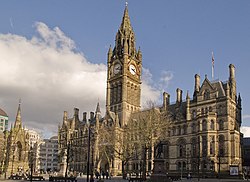
Manchester is a city in Greater Manchester, England. It had a population of over 589,000 in 2024. It borders the Cheshire Plain to the south, the Pennines to the north and east, and the city of Salford to the west. The two cities and the surrounding towns form one of the United Kingdom's most populous conurbations, the Greater Manchester Built-up Area, which has a population of 2.87 million. The history of Manchester began with the civilian settlement associated with the Roman fort of Mamucium or Mancunium, established around AD 79 on a sandstone bluff near the confluence of the rivers Medlock and Irwell. Historically part of Lancashire, areas of Cheshire south of the River Mersey were incorporated into Manchester in the 20th century. Throughout the Middle Ages Manchester remained a manorial township, but began to expand significantly with a boom in textile manufacture during the Industrial Revolution, which resulted in it becoming the world's first industrialised city. Manchester attained city status in 1853. The Manchester Ship Canal opened in 1894, creating the Port of Manchester and linking the city to the Irish Sea, 36 miles (58 km) to the west. Its fortune declined after the Second World War, owing to deindustrialisation, and the 1996 Manchester bombing led to extensive investment and regeneration. Following considerable redevelopment, Manchester was the host city for the 2002 Commonwealth Games. The city is notable for its architecture, its musical exports, its links to media, its links to science and engineering, its sports clubs and its transport connections.
Nearby Places View Menu

Cottonopolis

Lawrence Buildings

Memorial Hall, Manchester