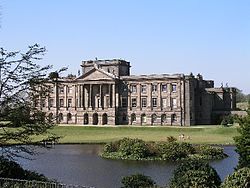
Lyme Park est un grand domaine de 700 hectares, situé non loin de Manchester et au sud de Disley, dans le Cheshire, en Angleterre. Acquis par sir Thomas Danyers in 1346, il passa aux Legh de Lyme par mariage en 1388. Le domaine a été cédé au National Trust en 1946 par le 3e baron Newton (en) (1888 - 1960). Il comprend une vaste country house entourée de jardins classiques (formal gardens), au milieu d'un parc abritant diverses espèces de cervidés, dans le Peak District. La résidence elle-même est la plus grande du Cheshire depuis qu'Eaton Hall fut démoli en 1961 . Les bâtiments actuels datent de la fin du XVIe siècle mais ont été modifiés vers 1720. L'intérieur a été rénové en 1815 et les jardins créés à la fin du XIXe siècle. C'est un monument classé « Grade I » ((en) listed building ; (fr) édifice d'un intérêt exceptionnel) par l'English Heritage. Sa bibliothèque contient un incunable exceptionnel, le missel de Caxton.

Nearby Places View Menu
Location Image
0 m

Lyme Park

Lyme Park is a large estate south of Disley, Cheshire, England. It is managed by the National Trust and consists of a mansion house surrounded by formal gardens and a deer park in the Peak District National Park. The house is the largest in Cheshire and is recorded in the National Heritage List for England as a designated Grade I listed building. The estate was granted to Sir Thomas d'Anyers in 1346 and passed to the Leghs of Lyme by marriage in 1388. It remained in the possession of the Legh family until 1946, when it was given to the National Trust. The house dates from the latter part of the 16th century. Modifications were made to it in the 1720s by Giacomo Leoni, who retained some of the Elizabethan features and added others, particularly the courtyard and the south range. It is difficult to classify Leoni's work at Lyme, as it contains elements of both Palladian and Baroque styles. Further modifications were made by Lewis Wyatt in the 19th century, especially to the interior. Formal gardens were created and developed in the late 19th and early 20th centuries. The house, gardens and park have been used as locations for filming and they are open to the public. The Lyme Caxton Missal, an early printed book by William Caxton, is on display in the Library.
Location Image
113 m

Lyme Handley

Lyme Handley, sometimes known as Lyme, is a former civil parish, now in the parish of Kettleshulme and Lyme Handley, in between Disley and Stockport, in the unitary authority area of Cheshire East and the ceremonial county of Cheshire, England. According to the 2001 census, it had a population of 151. It is also greenbelt area on the suburbs of Greater Manchester, attracting many visitors in the summer months for walking and picnics and in winter for sledging. The most famous feature of Lyme is Lyme Park, a Tudor house with gardens created in the 1720s. This was made most famous when it featured as Mr Darcy's house in the BBC dramatisation of Pride and Prejudice. The three-storey house has 17 acres (69,000 m2) of well-maintained Victorian era gardens and is also open to visitors for guided tours of the house, which contains a large collection of English clocks. The rest of the area consists of small farms which were all once part of the Handley estate but parcelled off at the turn of the 20th century. These mostly farm sheep with some cattle. In the past Lyme Handley had its own flax mill, providing a use for a crop other than grass that could be grown on a relatively infertile soil type; although the mill remains, it is no longer functional.
Location Image
1.4 km

Bowstones

The Bowstones or Bow Stones are a pair of Anglian cross shafts in Cheshire, England. Situated beside the old ridgeway between Disley and Macclesfield, overlooking Lyme Park, the Cheshire Plain, the city of Manchester and the hills of the Peak District, they are a scheduled monument. The western shaft is 1.22 metres (4 ft 0 in) high and tapers from circumference of 1.25 m (4 ft 1 in) at the base to 0.86 m (2 ft 10 in) at the top. The eastern shaft is 0.98 m (3 ft 3 in) high and has a circumference of 1.27 m (4 ft 2 in). Both are decorated with interlaced carvings in a style indicating a date of the 10th century or earlier. There is some later lettering engraved. Their round cross section and their erection as a pair is unusual for crosses of this era. They may have been moved to their current location in the 16th century by Sir Piers Legh of Lyme Hall. Two stone cross heads on display at the hall may have originally surmounted the shafts. Local legend states that the name is derived from their use by Robin Hood and his men to re-string their bows. Their location on a prominent ridgeline on the edge of the Peak District National Park with extensive views, near to the popular visitor attraction of Lyme Park and by the crossing of several public footpaths (including the Gritstone Trail) and a minor road make them a well-visited site.
Location Image
1.6 km

Bollinhurst Reservoir

The Bollinhurst Reservoir was constructed in Lyme Park in 1872 for the Stockport District Waterworks Company. At the time of the First World War, it had a capacity of 84.46 million gallons.
Location Image
2.2 km

Higher Poynton railway station

Higher Poynton was a railway station serving the eastern side of the town of Poynton, in Cheshire, England. It was opened in 1869 by the Macclesfield, Bollington and Marple Railway (MB&M), a joint line constructed and operated by the Manchester, Sheffield and Lincolnshire Railway (MS&L) and North Staffordshire Railway (NSR).