Location Image

Boulevard Zighoud-Youcef

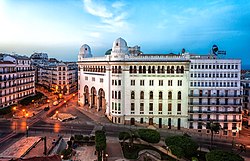
Le boulevard Zighoud-Youcef (en arabe : شارع زيغود يوسف) est une voie d'Alger.

1. Situation et accès

Ce boulevard situé dans la commune d'Alger-Centre constitue la majeure partie du boulevard du front de mer face au port d'Alger entre le boulevard Mohamed-Khemisti au niveau de la Rampe Tafourah et le boulevard Che-Guevara, à hauteur du square Port-Saïd.

Il s'agit d'un large boulevard d'Alger qui offre une vue en terrasse sur le port qu'il surplombe de 15 m. Il est constitué d'immeubles haussmanniens à arcades. Le boulevard est accessible par bus de l'ETUSA, lignes 7, 90, 101, 113. Un ascenseur permet de rejoindre la gare d'Alger.

1. Origine du nom

Il porte le nom du héros de la guerre d'indépendance algérienne Zighoud Youcef (1921-1956).

1. Historique

Anciennement boulevard Sadi-Carnot du nom de l'ancien président de la République française. Il est construit par Frédéric Chassériau entre 1860 et 1866 au-dessus de voûtes qui donnent sur le port. Les immeubles qui s'y trouvent y ont été établis entre 1870 et 1930, la plupart ont des fonctions administratives. Deux rampes, la rampe Magenta et la rampe Chasse-Loup Laubat permettent de rejoindre la gare et le port d'Alger. À l'indépendance de l'Algérie, cet axe est renommé boulevard Zighoud-Youcef.

1. Bâtiments remarquables et lieux de mémoire

no 7 : Conseil de la nation no 8 : Siège de la commission bancaire de la Banque d'Algérie no 16 : Siège de la Wilaya d'Alger no 18 : Siège de l'Assemblée populaire nationale no 20 : Hôtel Safir no 29 : Air Algérie, Division Commerciale Sous Direction Fidélisation et Gestion Clientèle.

1. Notes et références

Portail des routes Portail d'Alger

Nearby Places View Menu
Location Image
238 m

Battle of Algiers (1956–1957)

The Battle of Algiers (also called the great repression of Algiers) was a campaign fought during the Algerian War. It consisted of urban guerrilla warfare and terrorist attacks carried out by the National Liberation Front (FLN) against the French authorities in Algiers, and by the French authorities, army, and French terrorist organizations against the FLN. Both sides targeted civilians throughout the battle. The conflict began with attacks by the FLN against the French forces and Pieds-Noirs (European settlers) followed by a terrorist attack on Algerian civilians in Algiers by a group of settlers, part of the terrorist group "La Main Rouge", aided by the police. Reprisals followed and the violence escalated, leading the French Governor-General to deploy the French Army in Algiers to suppress the FLN. Civilian authorities gave full powers to General Jacques Massu who, operating outside legal frameworks between January and September 1957, eliminated the FLN from Algiers. The use of torture, forced disappearances and illegal executions by the French later caused controversy in France.
246 m

Hacène Harcha Arena

Harcha Hassan Arena is an indoor sporting arena located in Algiers, Algeria. The capacity of the arena is 8,000 spectators. It hosts indoor sporting events such as Handball, Basketball, Volleyball and hosts the home matches of MC Alger. It also hosted many international competitions.
Location Image
262 m

Grande Poste d'Alger

The Algiers Central Post Office, (Arabic: بريد الجزائر المركزي, French: Grande Poste d'Alger) is a masterpiece of Neo-Moorish (or Jonnasrt) architecture and one of Algeria's most famous landmarks. Situated at the intersection of Boulevard Mohamed-Khemisti and Rue Larbi Ben M'hidi in the center of Algiers, it represents the city's intricate colonial past as well as its architectural development.
Location Image
353 m

Icosium

Icosium (Punic: ʾY KSM, "Island of the Owls"; Ancient Greek: Ἰκόσιον, Ikósion) was a Phoenician and Punic settlement in modern-day Algeria. It was part of Numidia and later became an important Roman colony and an early medieval bishopric (now a Latin titular see) in the casbah area of modern Algiers.
Location Image
461 m

Government Palace (Algiers)

The Government Palace (Arabic: قصر الحكومة, French: Palais du Gouvernement), known before 1962 as Gouvernement général, is the office of the Prime Minister of Algeria and a major public building in Algiers. At the time of its inauguration in 1933, with a surface of 33,000 m2, it was the largest administrative building of the entire French state.