Le Fairmont San Francisco est un hôtel de luxe situé à San Francisco dans le quartier Nob Hill.

1. Histoire

Le Fairmont San Francisco a été nommé en hommage à l'ingénieur des mines et sénateur James Graham Fair (1831–1894), connu sous le nom de Bonanza Jim. Le projet de construction est mené par ses filles, Tessie et Virginia Fair. La construction démarre en 1902 sur le monticule de terre appartenant à James Graham Fair et légué à ses filles. En 1906, alors que les constructions sont toujours en cours, les filles Fair vendent le Fairmont peu de temps avant son ouverture, et son nouvel architecte devient Julia Miller. Deux semaines avant son ouverture, le séisme de 1906 à San Francisco ravage la ville. La structure de l'hôtel est intacte, mais un incendie s'est propagé dans le bâtiment. Le bâtiment est racheté par les filles Fair, rénové, et il ouvre ses portes le 18 avril 1907. Il a hébergé des hommes d'État dont Harry S. Truman lors de la création des Nations unies en 1945. Il a été désigné monument historique en 1987. Dans la nuit du 1er janvier 2026, la fille de l’acteur américain Tommy Lee Jones, âgée de 34 ans, est retrouvée morte au 14e étage de l’hôtel.

1. Description

Le Fairmont San Francisco est situé au 950 Mason street, dans le quartier Nob Hill à San Francisco. L'hôtel compte 592 chambres et suites.

1. Notes et références


1. Annexes


1. = Liens externes =

Ressources relatives à l'architecture : Office of Historic Preservation Registre national des lieux historiques The Skyscraper Center

(en) Site officiel

Portail du Registre national des lieux historiques Portail de l’hôtellerie Portail de San Francisco

Nearby Places View Menu
534 m

The Beige Room

The Beige Room, also known simply as Beige Room, was an American nightclub known for gay female impersonators, in operation from 1949 to 1958 and located at 831 Broadway in the North Beach neighborhood of San Francisco, California.
Location Image
565 m

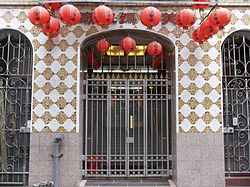
Ma-Tsu Temple (San Francisco)

The Ma-Tsu Temple is a Taoist temple in San Francisco's Chinatown. Founded in 1986, it is dedicated to Matsu and has foundational ties to the Chaotian Temple in Beigang, Yunlin, Taiwan. Its founding has been described as reflective of both a change in Chinese American demographics following the Immigration and Nationality Act of 1965 and the rise of a transnational Taiwanese-American community economically enabled by the Taiwan Miracle of the 1980s. The temple was originally located on Grant Avenue before moving to its present location on Becket Street in 1996. It is not to be confused with the Tin How Temple two blocks to the south, which is likewise dedicated to Matsu (carrying one of her popular names in Cantonese), but was founded in 1910 and is the oldest extant Taoist temple in Chinatown.
Location Image
574 m

Great Star Theater

The Great Star Theater, formerly known as Great China Theater, is a 410-seat theater located at 636 Jackson Street in San Francisco's Chinatown. It was built in 1925 for the Chinese opera and is the last Chinese theater in any Chinatown in the United States.
Location Image
596 m

Barbary Coast, San Francisco

The Barbary Coast was a red-light district during the second half of the 19th and early 20th centuries in San Francisco that featured dance halls, concert saloons, bars, jazz clubs, variety shows, and brothels. Its nine block area was centered on a three block stretch of Pacific Street, now Pacific Avenue, between Montgomery and Stockton Streets. Pacific Street was the first street to cut through the hills of San Francisco, starting near Portsmouth Square and continuing east to the first shipping docks at Buena Vista Cove. The Barbary Coast was born during the California gold rush, when the population of San Francisco was growing at an exponential rate due to the rapid influx of tens of thousands of miners trying to find gold. The early decades of the Barbary Coast were marred by persistent lawlessness, gambling, administrative graft, vigilante justice, and prostitution; however with the passage of time, the city's government gained strength and competence, and the Barbary Coast's maturing entertainment scene of dance halls and jazz clubs influenced American culture. The Barbary Coast's century-long evolution passed through many substantial incarnations due to the city's rapid cultural development during the transition to the 20th century. Its former location now is overlapped by Chinatown, North Beach, and Jackson Square.
Location Image
602 m

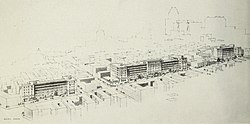
Ping Yuen

Ping Yuen and North Ping Yuen (sometimes collectively called The Pings) form a four-building public housing complex in the north end of Chinatown, San Francisco along Pacific Avenue. In total, there are 434 apartments. The three Pings on the south side of Pacific (West, Central, and East Ping Yuen) were dedicated in 1951, and the North Ping Yuen building followed a decade later in 1961. Some of the largest murals in Chinatown are painted on Ping Yuen, which are prominent landmark buildings taller than the typical two- or three-story Chinatown buildings that date back to the early 1900s. The formal effort to build Ping Yuen started in 1939 after Chinatown was called "the worst [slum] in the world"; it was the first public housing project completed in the neighborhood, and unlike the typical single room occupancy housing of Chinatown, featured private bathrooms and kitchens for each apartment when the first building opened in 1951. Like most buildings in Chinatown, it was designed by western architects with Chinese thematic elements. Although it was touted as potentially drawing more tourists to the area, it soon became known as a dangerous place, with the July 4 shooting over fireworks sales that occurred at Ping Yuen leading to the Golden Dragon massacre of 1977. The murder of Julia Wong in 1978 inspired residents to go on a rent strike, led by future mayor Ed Lee, for improvements to building maintenance and security. Ownership of Ping Yuen passed from the city to the Chinatown Community Development Center in 2016, which is continuing to work with residents' associations to improve conditions.