
Le Financial District est un quartier d'affaires situé à l'extrême sud de l'arrondissement de Manhattan dans la ville de New York, dans lequel sont implantés les sièges des plus grandes sociétés et institutions financières de la ville, dont la Bourse de New York. Ce district comprend la partie de Manhattan située au sud de City Hall Park, à l'exception de Battery Park. On considère que le cœur de ce quartier se trouve à l'intersection entre Wall Street et Broad Street. À l'angle de Nassau Street et Wall Street, on trouve le Federal Hall National Memorial, musée construit à l'emplacement de l'ancien bâtiment qui a abrité en 1789 et 1790 le premier Capitole des États-Unis, à l'époque de George Washington. Bien qu'il y ait également quelques appartements et hôtels dans le Financial District, le quartier est surtout une destination pour ceux qui viennent travailler dans ses nombreux bureaux. À la fin du XVIe siècle, cette zone de Manhattan était une colonie hollandaise qui s'appelait La Nouvelle-Amsterdam, et on peut encore trouver quelques exemples de l'architecture coloniale au sud de Pearl Street, perdus au milieu des gratte-ciel.

Portail de la finance Portail de New York

Nearby Places View Menu
Location Image
0 m

Financial District, Manhattan

The Financial District of Lower Manhattan, also known as FiDi, is a neighborhood located on the southern tip of Manhattan in New York City. It is bounded by the West Side Highway on the west, Chambers Street and City Hall Park on the north, Brooklyn Bridge on the northeast, the East River to the southeast, and South Ferry and the Battery on the south. The City of New York was created in the modern-day Financial District in 1624, and the neighborhood roughly overlaps with the boundaries of the New Amsterdam settlement in the late 17th century. The district comprises the offices and headquarters of many of the city's major financial institutions, including the New York Stock Exchange and the Federal Reserve Bank of New York. Anchored on Wall Street in the Financial District, New York City has been called both the leading financial center and the most economically powerful city of the world, and the New York Stock Exchange is the world's largest stock exchange by total market capitalization. Several other major exchanges have or had headquarters in the Financial District, including the New York Mercantile Exchange, NASDAQ, the New York Board of Trade, and the former American Stock Exchange. The Financial District is part of Manhattan Community District 1, and its primary ZIP Codes are 10004, 10005, 10006, 10007, and 10038. It is patrolled by the 1st Precinct of the New York City Police Department.
Location Image
23 m

Group of Four Trees (Jean Dubuffet)

Group of Four Trees is an abstract outdoor sculpture completed in 1972 by the French 20th-century artist Jean Dubuffet. Originally commissioned by the American banker and philanthropist David Rockefeller, the work measures 43 feet and is installed in the public plaza of 28 Liberty Street (formerly One Chase Manhattan Bank Plaza) between Nassau Street and Pine Street in Financial District, Manhattan. Dubuffet, a leading figure in the Art Brut movement, considered Group of Four Trees as part of his Hourloupe series. The series, originating from ballpoint pen doodles in 1962, features flat, interlocking shapes and striated coloring in red, white, and blue against black backgrounds. At the time of installation, Group of Four Trees was the largest outdoor sculpture in New York City and was said to have dramatized "the increasing environmental interdependence between architecture and outside sculpture" in the 1970s. It was Dubuffet's first outdoor sculpture installed in the United States.
Location Image
39 m

28 Liberty Street

28 Liberty Street, formerly known as One Chase Manhattan Plaza, is a 60-story International Style skyscraper between Nassau, Liberty, William, and Pine Streets in the Financial District of Manhattan in New York City. The building, designed by Gordon Bunshaft of Skidmore, Owings & Merrill (SOM), opened in 1961. It is 813 feet (248 m) tall. 28 Liberty Street occupies only about 28 percent of its 2.5-acre (1.0 ha) site. It consists of 60 above-ground stories, a ground-level concourse, and five basement levels. The tower is surrounded by a plaza that contains a sunken Japanese rock garden, designed by Isamu Noguchi, to the south. The building's design is similar to that of SOM's earlier Inland Steel Building in Chicago. It contains a stainless steel facade with black spandrels below the windows. The superstructure contains 40 steel columns, arranged around the perimeter and clustered around the core to maximize usable space. When the tower opened, it accommodated 7,500 employees but contained only 150 private offices. David Rockefeller, then executive vice president of Chase Manhattan Bank, proposed the tower in the 1950s as a means to keep the newly merged bank (Chase National and the Manhattan Company) in Lower Manhattan while merging its 8,700 employees into one facility. Construction started in early 1957, and the building's tower opened in early 1961. One Chase Manhattan Plaza was nearly fully occupied from its opening, with numerous financial and legal tenants. The building's basements and plaza opened in 1964; during its early years, the structure faced some early challenges such as the discovery of weakened facade panels, a fire, and a bombing. The building was renovated in the early 1990s, and Chase moved its headquarters out in 1997. The New York City Landmarks Preservation Commission designated the building a landmark in 2008. Chase Manhattan's parent company, JPMorgan Chase, sold the building to Fosun International, a Chinese investment company, in 2013; the building was subsequently renamed 28 Liberty Street.
Location Image
68 m

Our Lady of Victory Church (Manhattan)
The Church of Our Lady of Victory, also known as the War Memorial Church, is a Roman Catholic parish church in the Roman Catholic Archdiocese of New York, located at 60 William Street on the northeast corner of William Street and Pine Street in the Financial District of Manhattan, New York City. It was established in 1944, during World War II, by Cardinal Francis Spellman, Archbishop of New York and Apostolic Vicar for the U.S. Armed Forces from December 11, 1939, to December 2, 1967, at a time when "victory in the war was in sight but not yet assured." A quote from Cardinal Spellman greets worshipers at the front door: "This Holy Shrine is dedicated to Our Lady of Victory in Thanksgiving for Victory won by our valiant dead, our soldier’s blood, our country’s tears, shed to defend men’s rights and win back men’s hearts to God." A Soldier's Shrine is in the lower chapel, and the Teresa Benedicta Auschwitz Memorial in the lobby commemorates a victim of the Holocaust. A 9-11 Remembrance Book is displayed. Today, the church primarily serves as a place for daytime worship, rather than as a neighborhood church.
Location Image
80 m

40 Wall Street

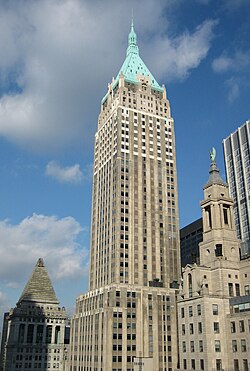
40 Wall Street (also the Trump Building; formerly the Bank of Manhattan Trust Building and Manhattan Company Building) is a 927-foot-tall (283 m) neo-Gothic skyscraper on Wall Street between Nassau and William streets in the Financial District of Manhattan in New York City, New York, U.S. Erected in 1929–1930 as the headquarters of the Manhattan Company, the building was designed by H. Craig Severance with Yasuo Matsui and Shreve & Lamb. The building is a New York City designated landmark and is listed on the National Register of Historic Places (NRHP); it is also a contributing property to the Wall Street Historic District, an NRHP district. The building is on an L-shaped site. While the lower section has a facade of limestone, the upper stories incorporate a buff-colored brick facade and contain numerous setbacks. The facade also includes spandrels between the windows on each story, which are recessed behind the vertical piers on the facade. At the top of the building is a pyramid with a spire at its pinnacle. Inside, the lower floors contained the Manhattan Company's double-height banking room, a board room, a trading floor, and two basements with vaults. The remaining stories were rented to tenants; there were private clubs on several floors, as well as an observation deck on the 69th and 70th floors. Plans for 40 Wall Street were revealed in April 1929, with the Manhattan Company as the primary tenant, and the structure was opened on May 26, 1930. 40 Wall Street and the Chrysler Building competed for the distinction of world's tallest building at the time of both buildings' construction; the Chrysler Building ultimately won that title. 40 Wall Street initially had low tenancy rates due to the Great Depression and was not fully occupied until 1944. Ownership of the building and the land underneath it, as well as the leasehold on the building, has changed several times throughout its history. Since 1982, the building has been owned by two German companies. The leasehold was held by interests on behalf of Philippine dictator Ferdinand Marcos in the mid-1980s. A company controlled by developer and later U.S. president Donald Trump bought the lease in 1995.