

 English
 Français

Hyde Road est un ancien stade de football établi à West Gorton, Manchester, en Angleterre. Il fut le stade de Manchester City et de ses prédécesseurs depuis sa construction, en 1887, jusqu'en 1923, lorsque le club emménagea à Maine Road.
Nearby Places View Menu
0 m
Hyde Road (stadium)
Hyde Road was a football stadium in West Gorton, Manchester, England. It was home to Manchester City F.C. and their predecessors from its construction in 1887 until 1923, when the club moved to Maine Road. It was named after Hyde Road, a road which begins at the east end of Ardwick Green South in Ardwick and runs east towards Hyde. At the boundary between Gorton and Denton it continues as Manchester Road.
Before its use as a football ground, the site was an area of waste ground, and in its early days the ground had only rudimentary facilities. The first stand was built in 1888, but the ground had no changing facilities until 1896; players had to change in a nearby public house, the Hyde Road Hotel. By 1904 the ground had developed into a 40,000-capacity venue, hosting an FA Cup semi-final between Newcastle United and The Wednesday the following year.
The stands and terraces were arranged in a haphazard manner due to space constraints, and by 1920 the club had outgrown the cramped venue. A decision to seek an alternative venue was hastened in November 1920, when the Main Stand was destroyed by fire. Manchester City moved to the 80,000-capacity Maine Road in 1923, and Hyde Road was demolished shortly afterward. One structure from the ground is still in use in the 21st century, a section of roofing which was sold for use at The Shay, a stadium in Halifax.
258 m
Manchester Martyrs
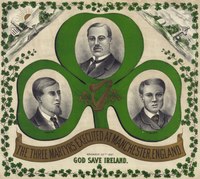
The Manchester Martyrs (Irish: Mairtirígh Mhanchain) were three Irish Republicans – William Philip Allen, Michael Larkin, and Michael O'Brien – who were hanged in 1867 following their conviction of murder after an attack on a police van in Manchester, England, in which a police officer was accidentally shot dead, an incident that was known at the time as the Manchester Outrages. The three men were members of the Irish Republican Brotherhood, also known as the Fenians, an organisation dedicated to ending British rule in Ireland, and were among a group of 30 to 40 Fenians who attacked a horse-drawn police van transporting two arrested leaders of the Brotherhood, Thomas J. Kelly and Timothy Deasy, to Belle Vue Gaol. Police Sergeant Charles Brett, travelling inside with the keys, was shot and killed while looking through the keyhole of the van as the attackers attempted to force the door open by shooting the lock.
Kelly and Deasy were released after another prisoner in the van took the keys from Brett's body and passed them to the group outside through a ventilation grill; the pair were never recaptured, despite an extensive search. Although Allen and Larkin admitted taking part in the attack, none of the defendants was accused of firing the fatal shot, but they were convicted on the basis of "joint enterprise" for taking part in a criminal enterprise that ended in the killing. The trial has nonetheless been described by an eminent Irish historian as "unsatisfactory", and the evidence as "dubious".
Two others were also charged and found guilty of Brett's murder, Thomas Maguire and Edward O'Meagher Condon, but their death sentences were overturned—O'Meagher Condon's through the intercession of the United States government (he was an American citizen), and Maguire's because the evidence given against him was considered unsatisfactory by the court. Allen, Larkin and O'Brien were publicly hanged on a temporary structure built on the wall of Salford Gaol, on 23 November 1867, in front of a crowd of 8,000–10,000.
Ireland reacted with revulsion and anger to the executions, and Allen, Larkin and O'Brien were hailed as political martyrs. Annual commemorations were held throughout Ireland, and monuments were built in many Irish towns. Brett, the first Manchester City Police officer to be killed on duty, is memorialised in a monument in St Ann's Church.

330 m
Church of St Benedict, Ardwick
The Church of St Benedict is a redundant church in the Ardwick district of Manchester, England. The church is dedicated to the saint Benedict of Nursia, was designed by J. S. Crowther for a Manchester merchant John Marsland Bennett, and built in 1880. It is generally considered to be Crowther's masterpiece and is a Grade II* listed building. Declared redundant in the early 2000s, the church was home to Parthian Climbing Manchester, formerly the Manchester Climbing Centre. Parthian Climbing Manchester closed permanently in July 2025.

332 m
Ardwick railway station
Ardwick railway station serves the industrial area of Ardwick, in east Manchester, England; it is located about one mile (1.5 km) south-east of Manchester Piccadilly, on both the Glossop line and Hope Valley Line. Plans to close the station permanently were shelved in 2006, due to increasing activity in the area. From the Summer 2024 timetable, the station has just two trains calling per day on Mondays–Fridays and one train per day on Saturdays.

333 m
Ardwick train depot
The Ardwick train depot is a passenger multiple unit maintenance depot in Ardwick, Greater Manchester. The depot was opened in 2006 for the servicing of Siemens-built Class 185 DMUs, which are used on the TransPennine Express franchise. It was electrified in 2012–13 to allow the servicing of Siemens Class 350/4 EMUs.