

 English
 Français
SS Ina Mactavish was a small coaster that was wrecked in 1907 with the loss of two lives.
Nearby Places View Menu

1.0 km
Birling, Northumberland
Birling is a small settlement in the civil parish of Warkworth, in the county of Northumberland, England. It is situated immediately to the north of the village of Warkworth on the A1068, separated from Warkworth by the River Coquet. There are facilities for static and touring caravans at Birling. To the east are Warkworth Golf Club, Birling Links and beach.
Birling Manor, an 18th-century house, with an extension dated 1752, is a Grade II listed building. The 19th century coach house and 18th century hen house, associated with Birling Manor, are also both listed buildings.

1.5 km
Church of St Lawrence, Warkworth
The Church of St Lawrence is situated in the village of Warkworth in Northumberland. It is a grade I listed building within the Diocese of Newcastle and dedicated to St Lawrence of Rome.

1.9 km
Warkworth, Northumberland
Warkworth is a village in Northumberland, England. It is probably best known for its well-preserved medieval castle, church and hermitage. The population of Warkworth was 1,574 in 2011, increasing to 1,772 at the 2021 Census.
The village is situated in a loop of the River Coquet, about 1 mile (1.6 km) from the Northumberland coast and lies on the main A1068 road. It is 30 miles (48 km) north of Newcastle, and about 40 miles (64 km) south of the Scottish border. An ancient bridge of two arches crosses the river at Warkworth, with a fortified gateway on the road mounting to the castle, the site of which is surrounded on three sides by the river.
Warkworth is popular with visitors for its old buildings, its walks by the River Coquet, and its proximity to the Northumberland Coast, an Area of Outstanding Natural Beauty (AONB). It is twinned with Warkworth, New Zealand, which is named after it.
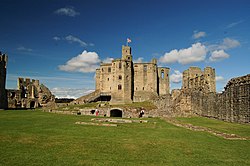
1.9 km
Warkworth Castle
Warkworth Castle is a ruined medieval castle in Warkworth in the English county of Northumberland. The village and castle occupy a loop of the River Coquet, less than a mile from England's north-east coast. When the castle was founded is uncertain: traditionally its construction has been ascribed to Prince Henry of Scotland, Earl of Northumbria, in the mid-12th century, but it may have been built by King Henry II of England when he took control of England's northern counties. Warkworth Castle was first documented in a charter of 1157–1164 when Henry II granted it to Roger fitz Richard. The timber castle was considered "feeble", and was left undefended when the Scots invaded in 1173.
Roger's son Robert inherited and improved the castle. Robert was a favourite of King John, and hosted him at Warkworth Castle in 1213. The castle remained in the family line, with periods of guardianship when heirs were too young to control their estates. King Edward I stayed overnight in 1292 and John de Clavering, descendant of Roger fitz Richard, made the Crown his inheritor. With the outbreak of the Anglo-Scottish Wars, Edward II invested in castles, including Warkworth, where he funded the strengthening of the garrison in 1319. Twice in 1327 the Scots besieged the castle without success.
John de Clavering died in 1332 and his widow in 1345, at which point The 2nd Baron Percy of Alnwick took control of Warkworth Castle, having been promised Clavering's property by Edward III. Henry Percy, 1st Earl of Northumberland, added the imposing keep overlooking the village of Warkworth in the late 14th century. The fourth earl remodelled the buildings in the bailey and began the construction of a collegiate church within the castle, but work on the latter was abandoned after his death. Although The 10th Earl of Northumberland supported Parliament during the English Civil War, the castle was damaged during the conflict. The last Percy earl died in 1670. In the mid-18th century the castle found its way into the hands of Hugh Smithson, who married the indirect Percy heiress. He adopted the surname "Percy" and founded the dynasty of the Dukes of Northumberland, through whom possession of the castle descended.
In the late 19th century, the dukes refurbished Warkworth Castle and Anthony Salvin was commissioned to restore the keep. The 8th Duke of Northumberland gave custody of the castle to the Office of Works in 1922. Since 1984 English Heritage has cared for the site, which is a Grade I listed building and a Scheduled Ancient Monument.