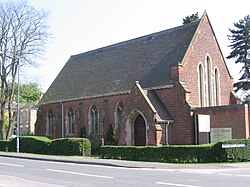
Brough ou Brough-on-Humber est une ville du Yorkshire de l'Est, en Angleterre. Elle est située sur la rive nord de l'estuaire de l'Humber, à une vingtaine de kilomètres à l'ouest du centre-ville de Kingston-upon-Hull. Avec le village voisin de Elloughton, elle forme la paroisse civile d'Elloughton-cum-Brough, qui comptait 10 075 habitants au moment du recensement de 2011.

1. Étymologie

Comme les autres villes et villages portant ce nom en Angleterre, le nom Brough dérive du vieil anglais burh désignant une place fortifiée. Celui du Yorkshire de l'Est est attesté vers 1200 sous la forme Burg. Le toponyme celtique pourrait être dérivé de petuarios qui signifie « quatrième », en l'occurrence « le quatrième fort » ou « la quatrième ville » (cf. m. gallois petwerydd, v. breton petguare, breton pevare, quatrième). La ville de Pithiviers est un ancien Ped(e)uerius (Pedeverius, 843 (CH2, 64), vicaria Petvarensis, 1025) et se situe à la limite supposée du territoire des Carnutes avec les Parisii.

1. Histoire

La ville correspond à l'antique Petuaria, la civitas du peuple des Parisii sous domination romaine. L'archevêque d'York Walter de Gray lui octroie le statut de borough en 1239, mais les libertés associées ne semblent pas avoir été exercées par ses habitants pendant plusieurs siècles. C'est dans la région de Brough que le bandit de grands chemins Dick Turpin commet ses derniers vols de chevaux en 1737.

1. Articles liés

Aérodrome de Brough (en)

1. Références

Portail du Yorkshire

Nearby Places View Menu
Location Image
0 m

Brough, East Riding of Yorkshire

Brough ( BRUF, locally ) is a town in the East Riding of Yorkshire, England. It is part of the civil parish of Elloughton-cum-Brough with the neighbouring village of Elloughton. Brough is situated on the edge of the Yorkshire Wolds and the town serves as a gateway to the rolling hills of the Wolds. The Yorkshire Wolds Way National Trail also passes by the eastern end of Brough. Brough has a long association with BAE Systems. Brough has been recognised as one of the most desirable and affluent places to live in Yorkshire, with a rising affluent population and a growing reputation for prestige, quality of life, and thriving communities such as Elloughton-cum-Brough In Bloom.
183 m

Petuaria

Petuaria (or Petuaria Parisorum) was originally a Roman fort situated where the town of Brough in the East Riding of Yorkshire now stands. Petuaria means something like 'quarter' or 'fourth part', incorporating the archaic Brythonic *petuar, 'four' (compare modern Welsh pedwar). It was founded in 70 AD and abandoned in about 125. The adjacent civitas (civil town), ferry-crossing and (attested) port which grew over and replaced the fort survived until about 370, and was probably the capital of the Celtic tribe called the Parisi. Petuaria marked the southern end of the Roman road known now as Cade's Road, which ran roughly northwards for a hundred miles to Pons Aelius (modern day Newcastle upon Tyne). The section from Petuaria to Eboracum (York) was also the final section of Ermine Street.
Location Image
293 m

Brough railway station

Brough railway station serves the town of Brough in the East Riding of Yorkshire, England. It is managed by TransPennine Express, and also served by Northern, Hull Trains and London North Eastern Railway. The station was originally opened by the Hull and Selby Railway in 1840 and at one time had four tracks passing through. The course of the additional outer tracks (and the two disused platform faces) are still visible, although these were removed in the early 1970s.
Location Image
1.0 km

Brough Aerodrome

Brough Aerodrome (ICAO: EGNB) was a private use aerodrome located at Brough, East Riding of Yorkshire, England. It is now disused with the last known flight out of the airfield occurring in 2011. The airfield closed in 2013. The site is now crossed by a new road "Baffin Way" serving the town.
Location Image
1.3 km

Elloughton

Elloughton is a village in the East Riding of Yorkshire, England. It is situated approximately 12 miles (19 km) to the west of Hull to the south of the A63 road. It lies on the southern end of the Yorkshire Wolds. It is conjoined with Brough that lies to the south-east, with which it forms the civil parish of Elloughton-cum-Brough. Elloughton lies within the Parliamentary constituency of Goole and Pocklington. The name Elloughton possibly derives from the Old Norse elgr meaning 'heathen temple', or the personal name Helgi, and the Old English dūn meaning 'hill'. Elloughton Primary School is an integral part of the village. The church dedicated to St Mary was designated a Grade II* listed building in 1968 and is now recorded in the National Heritage List for England, maintained by Historic England. In 1823, Elloughton was in the Wapentake of Harthill, a part of the Liberty of St Peter's. The patron of the Church of St Mary was the York Minster prebendary of Wetwang. Within the village was a Methodist and a Calvinist chapel. The village had a population of 318, with occupations including six farmers, two carpenters, two tailors, a blacksmith, a shoemaker, and a bricklayer. Also directory-listed were three yeomen, a school master, a gentlewoman, and a curate. Once a week two carriers operated between the village and Hull.