

 English
 Français

Stone Street (Manhattan)
Stone Street est une rue du Financial District à New York.
1. Situation et accès
Elle est située à Manhattan dans le quartier historique du Financial District.
1. Origine du nom
Elle doit son nom actuel au pavage en pierres (Stone en anglais).
1. Historique
Elle s'appelait autrefois « Brewers Street ». En 1660 elle était appelée « Brouwer Straet ». Elle a été divisée en deux parties par la construction de la tour Goldman Sachs dans les années 1980.
1. Bâtiments remarquables et lieux de mémoire


1. Notes et références


1. Voir aussi
Portail des routes Portail de New York
Nearby Places View Menu
0 m
Stone Street (Manhattan)
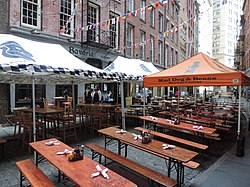
Stone Street is a short street in the Financial District of Manhattan in New York City. The street, which runs in two sections, was originally a continuous roadway between Whitehall Street in the west and Hanover Square in the east. The section between Broad Street and Coenties Alley was eliminated in 1980 to make way for the Goldman Sachs building at 85 Broad Street. The one-block-long western section between Whitehall and Broad Streets carries vehicular traffic, while the two-block-long eastern section between Coenties Alley and Hanover Square is a pedestrian zone.
Stone Street is one of New York's oldest streets, incorporating two 17th-century roads in the Dutch colony of New Amsterdam. In 1658 it became the first cobbled street in New Amsterdam. After the British conquered the colony, the street was called Duke Street before being renamed Stone Street, for its cobblestone paving, in 1794. Many of the early structures around Stone Street were destroyed in the Great Fire of 1835, after which Stone Street was redeveloped with stores and lofts for dry-goods merchants and importers. Following many decades of neglect, Stone Street was restored in the late 20th century and the eastern section became a restaurant area.
Stone Street contains several prominent structures, including 1 Hanover Square, a National Historic Landmark. The eastern portion of the street and the surrounding buildings are designated as the Stone Street Historic District, which is both listed on the National Register of Historic Places and protected by the New York City Landmarks Preservation Commission. In addition, the remaining portions of the street are part of the Financial District's street layout, a city landmark.
27 m
Stadt Huys Site
The Stadt Huys (an old Dutch spelling, meaning city hall) was the first city hall in New York City, New York. It was built in 1642 by the Dutch, when the settlement was named New Amsterdam. The building was used until 1697, when the structure was no longer deemed safe for occupants. The structure was located at present 71 Pearl Street (now demolished) in the modern-day Financial District of Lower Manhattan.
The Stadt Huys block archaeology project took place in 1979–1980 and was New York City's first large-scale archaeological excavation. At the time, it was one of the most expensive and most productive projects of urban archeology undertaken in an American city. Many logistical procedures for urban archaeology had to be developed as the project evolved. Most of these procedures have become a model for performing large-scale excavations in the city.
39 m
New York Cotton Exchange
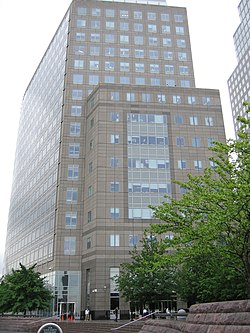
The New York Cotton Exchange (NYCE) is a commodities exchange founded in 1870 by a group of one hundred cotton brokers and merchants in New York City. In 1998, the New York Board of Trade (NYBOT) became the parent company of the New York Cotton Exchange, and it is now owned by IntercontinentalExchange (ICE).
The NYCE had its first permanent headquarters at 1 Hanover Square from 1872 to 1885, though it remained on Hanover Square, Manhattan, for over a century. Since 2003, its headquarters and trading facility have been in One North End Avenue.

57 m
Coenties Slip
Coenties Slip is a street in the Financial District of Manhattan in New York City. It runs southeast for two blocks in Lower Manhattan from Pearl Street to South Street. A walkway runs an additional block north from Pearl Street to Stone Street.
The slip was originally an artificial inlet in the East River for the loading and unloading of ships that was land-filled in 1835. The entire length of the road is a pedestrian street, though before 2013, the block north of Water Street carried vehicular traffic.

84 m
1 Hanover Square
One Hanover (formerly known as India House, Hanover Bank Building, and New York Cotton Exchange Building) is a commercial building at 1 Hanover Square, on the southwestern edge of the square, in the Financial District of Lower Manhattan in New York City. It was the site of the United States' first cotton futures exchange, the New York Cotton Exchange. As of 2022, One Hanover is owned by SomeraRoad Inc., which uses the building as its headquarters.
One Hanover is composed of four originally separate structures. The main structure is a three-story brownstone building designed in the Italian Renaissance style and completed in 1854. The brownstone contains the building's main entrance facing Hanover Square. Adjoining the brownstone are three brick structures at 60–64 Stone Street, which date to 1836 and were built as commercial stores. The brick buildings are four stories tall but are the same height as the brownstone. Inside are maritime-themed spaces that are used by Harry's Bar, Ulysses Folk House, and the India House club.
The brownstone initially served as the headquarters of the Hanover Bank, while other commercial tenants occupied the brick buildings. The New York Cotton Exchange, founded in 1870, occupied the building from 1872 to 1885. The building subsequently served as the headquarters of W.R. Grace and Company until the early 1910s. In 1914, the structures were purchased by the India House, a private club for gentlemen involved in foreign commerce, which continues to occupy the building. Over the years, various architects have made renovations to One Hanover Square, with the three Stone Street stores being gradually combined with the brownstone structure between the 1870s and 1910s. Restaurants have also been housed in various portions of One Hanover Square throughout its history. SomeraRoad bought the building in 2022 and renovated it into an office building the next year.
One Hanover's design, especially in regard to its later use as the India House clubhouse, has received critical acclaim. The building was designated a city landmark by the New York City Landmarks Preservation Commission (LPC) in 1965, was added to the National Register of Historic Places (NRHP) in 1972, and became a National Historic Landmark in 1977. It is a contributing property to the Stone Street Historic District, which was designated by the LPC in 1996 and by the NRHP in 1999. 1 Hanover Square has been depicted in works of popular culture, including the 2001 film Kate & Leopold.