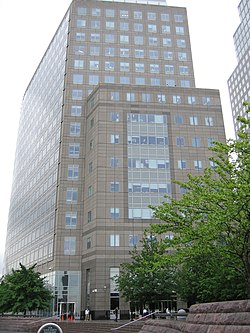
The New York Cotton Exchange (NYCE) is a commodities exchange founded in 1870 by a group of one hundred cotton brokers and merchants in New York City. In 1998, the New York Board of Trade (NYBOT) became the parent company of the New York Cotton Exchange, and it is now owned by IntercontinentalExchange (ICE). The NYCE had its first permanent headquarters at 1 Hanover Square from 1872 to 1885, though it remained on Hanover Square, Manhattan, for over a century. Since 2003, its headquarters and trading facility have been in One North End Avenue.

1. History


1. = Formation =

The NYCE was founded in 1870 by a group of one hundred cotton brokers and merchants, and is the oldest commodities exchange in the city. In the spring and summer of 1870, a group of cotton merchants and brokers doing business in New York began planning an improvement on their "loose and informal association of persons active in the cotton trade," spending weeks preparing to create an association that was governed by rules and "equally fair to all" in its cotton dealings. In the middle of August 1870, the forming organization voted for officers and managers, and the Exchange was organized officially on September 7, 1870. Founding president was Stephen D. Harrison. The Exchange earned a charter from the State of New York and its legislature on April 8, 1871. Its first permanent headquarters was 1 Hanover Square (later known as India House) in New York City. The NYCE moved to 1 Hanover Square on May 4, 1872. Well into the 20th century, cotton was a leading American commodity for both export and domestic consumption. In that era, other major exchanges existed in the United States. Several were founded within a few years of the founding of New York Cotton Exchange: the New Orleans Cotton Exchange, the Mobile Cotton Exchange, the Memphis Cotton Exchange, and the Savannah Cotton Exchange. Another important exchange was the Liverpool Cotton Exchange in Liverpool, England. The NYCE and the Memphis Cotton Exchange are the only organizations of that group still active today.

1. = Cotton Year Book and subsidiaries =

Annually until 1958, the NYCE published the Cotton Year Book, which contained the year's statistics on the cotton industry. Over the years, the NYCE created various subsidiaries to trade non-cotton contracts, including the Wool Associates, the Citrus Associates, the Tomato Products Associates, and the Financial Instruments Exchange (FINEX). The exchange diversified its product line over the years to also deal in wool and orange juice futures. In 1985 the NYCE began dealing in financial futures and options.

1. = Subsidiary of ICE =

In 1998, the New York Board of Trade (NYBOT) became the parent company of both the New York Cotton Exchange and the Coffee, Sugar and Cocoa Exchange (founded 1882). It is now owned by IntercontinentalExchange (ICE). The New York Cotton Exchange was a tenant on the 8th floor of 4 World Trade Center until September 11, 2001. Following the terrorist attacks that day, it had to relocate to temporary facilities in Long Island City that had been set up as an emergency backup location following the 1993 World Trade Center bombing. Since 2003, its headquarters and trading facility have been in the New York Mercantile Exchange Building in lower Manhattan.

1. See also

Cotton factor Mobile Cotton Exchange, the third cotton exchange in the U.S., founded after New Orleans Exchange Memphis Cotton Exchange, founded 1874 Cotton production in the United States

1. References


1. External links

New York Board of Trade

Nearby Places View Menu
Location Image
39 m

Stone Street (Manhattan)

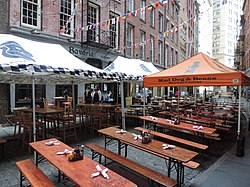
Stone Street is a short street in the Financial District of Manhattan in New York City. The street, which runs in two sections, was originally a continuous roadway between Whitehall Street in the west and Hanover Square in the east. The section between Broad Street and Coenties Alley was eliminated in 1980 to make way for the Goldman Sachs building at 85 Broad Street. The one-block-long western section between Whitehall and Broad Streets carries vehicular traffic, while the two-block-long eastern section between Coenties Alley and Hanover Square is a pedestrian zone. Stone Street is one of New York's oldest streets, incorporating two 17th-century roads in the Dutch colony of New Amsterdam. In 1658 it became the first cobbled street in New Amsterdam. After the British conquered the colony, the street was called Duke Street before being renamed Stone Street, for its cobblestone paving, in 1794. Many of the early structures around Stone Street were destroyed in the Great Fire of 1835, after which Stone Street was redeveloped with stores and lofts for dry-goods merchants and importers. Following many decades of neglect, Stone Street was restored in the late 20th century and the eastern section became a restaurant area. Stone Street contains several prominent structures, including 1 Hanover Square, a National Historic Landmark. The eastern portion of the street and the surrounding buildings are designated as the Stone Street Historic District, which is both listed on the National Register of Historic Places and protected by the New York City Landmarks Preservation Commission. In addition, the remaining portions of the street are part of the Financial District's street layout, a city landmark.
Location Image
46 m

1 William Street (New York City)

1 William Street (formerly the J. & W. Seligman & Company Building and the Lehman Brothers Building; also the Banca Commerciale Italiana Building) is an office building in the Financial District of Lower Manhattan in New York City. The building was erected in 1906–1907 and was designed by Francis H. Kimball in conjunction with Julian Clarence Levi. It was created for the Seligmans, a prominent German Jewish family who founded an investment bank called J. & W. Seligman. From 1929 to 1980, the building was the headquarters of investment bank Lehman Brothers, and was subsequently bought by Banca Commerciale Italiana. The 11-story structure, clad in limestone with a steel frame, is located at the southern corner of the five-pointed intersection of William, South William, and Beaver Streets. It occupies a quadrilateral lot, with an acute angle between South William Street to the west and William Street to the east. In 1996, the building was designated as a landmark by the New York City Landmarks Preservation Commission. In 2007, the building was designated as a contributing property to the Wall Street Historic District, a National Register of Historic Places district.
Location Image
49 m

1 Hanover Square

One Hanover (formerly known as India House, Hanover Bank Building, and New York Cotton Exchange Building) is a commercial building at 1 Hanover Square, on the southwestern edge of the square, in the Financial District of Lower Manhattan in New York City. It was the site of the United States' first cotton futures exchange, the New York Cotton Exchange. As of 2022, One Hanover is owned by SomeraRoad Inc., which uses the building as its headquarters. One Hanover is composed of four originally separate structures. The main structure is a three-story brownstone building designed in the Italian Renaissance style and completed in 1854. The brownstone contains the building's main entrance facing Hanover Square. Adjoining the brownstone are three brick structures at 60–64 Stone Street, which date to 1836 and were built as commercial stores. The brick buildings are four stories tall but are the same height as the brownstone. Inside are maritime-themed spaces that are used by Harry's Bar, Ulysses Folk House, and the India House club. The brownstone initially served as the headquarters of the Hanover Bank, while other commercial tenants occupied the brick buildings. The New York Cotton Exchange, founded in 1870, occupied the building from 1872 to 1885. The building subsequently served as the headquarters of W.R. Grace and Company until the early 1910s. In 1914, the structures were purchased by the India House, a private club for gentlemen involved in foreign commerce, which continues to occupy the building. Over the years, various architects have made renovations to One Hanover Square, with the three Stone Street stores being gradually combined with the brownstone structure between the 1870s and 1910s. Restaurants have also been housed in various portions of One Hanover Square throughout its history. SomeraRoad bought the building in 2022 and renovated it into an office building the next year. One Hanover's design, especially in regard to its later use as the India House clubhouse, has received critical acclaim. The building was designated a city landmark by the New York City Landmarks Preservation Commission (LPC) in 1965, was added to the National Register of Historic Places (NRHP) in 1972, and became a National Historic Landmark in 1977. It is a contributing property to the Stone Street Historic District, which was designated by the LPC in 1996 and by the NRHP in 1999. 1 Hanover Square has been depicted in works of popular culture, including the 2001 film Kate & Leopold.
Location Image
62 m

56 Beaver Street

56 Beaver Street (also known as the Delmonico's Building and 2 South William Street) is a structure in the Financial District of Manhattan in New York City, United States. Designed by James Brown Lord, the building was completed in 1891 as a location of the Delmonico's restaurant chain. The current building, commissioned by Delmonico's chief executive Charles Crist Delmonico, replaced Delmonico's first building on the site, which had been built in 1837. The building is a New York City designated landmark and a contributing property to the Wall Street Historic District, a National Register of Historic Places district. The eight-story structure, clad in brick, brownstone, architectural terracotta, occupies a triangular lot at the western corner of the five-pointed intersection of William, South William, and Beaver Streets. The facade is articulated into three horizontal sections similar to the components of a column, namely a two-story base, a five-story shaft, and a one-story capital. The building contains a curved corner with a portico that provides access to the restaurant on the lower stories. Inside, there is a restaurant space in the basement and first story, while the upper floors contain 40 condominiums. The current building opened on July 7, 1891, with the restaurant at the base and top floor, as well as office space on the third through seventh floors. After 56 Beaver Street was sold to the American Merchant Marine Insurance Company in 1917, the restaurant was closed, and the building became an office structure known as the Merchant Marine House. The building was then sold twice in the 1920s before the City Bank-Farmers Trust Company foreclosed on the building. In 1926 Oscar Tucci purchased the lower level and first floor, then opened a restaurant. Tucci eventually acquired the entire building; his family continued to run the restaurant until the 1980s. The building's upper stories were renovated in the early 1980s. From 1982 to 1993, under a licensing agreement with the Tuccis, Ed Huber operated Delmonico's at 56 Beaver Street. Time Equities acquired the building in 1995; converting the upper stories into apartments; the lower stories operated yet again as a restaurant from 1998 to 2020. Delmonico's is scheduled to reopen in late 2023.