
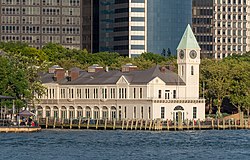
Pier A Harbor House (communément appelé City Pier A) est une jetée municipale sur le fleuve Hudson à Battery Park près de l'extrémité sud de Manhattan à New York. Bien qu'elle n'ait joué aucun rôle comme point de débarquement majeur, elle a également été surnommée ces dernières années « Liberty Gateway ». La jetée A est la dernière jetée historique existante de la ville. La jetée a été ajoutée au registre national des lieux historiques en 1975 et a été désignée monument de New York en 1977.

1. Histoire

Pier A a été construit de 1884 à 1886 pour servir de siège au New York City Board of Dock Commissioners (plus tard connu sous le nom de Department of Docks); il a également servi de résidence à la police du port. L'ingénieur chargé de la construction et de la conception était George Sears Greene Jr. (1837-1922), qui avait été ingénieur en chef du New York City Board of Docks de juillet 1875 à 1898 . Il était le fils de l'ingénieur civil et général de l'Union George S. Greene (1801-1899) . Le toit du bâtiment, en étain, a été peint en vert pour ressembler à la couleur du cuivre oxydé. Lors d'une rénovation menée par la Battery Park City Authority, ce toit a été remplacé par du cuivre. La jetée a été agrandie en 1900 et à nouveau en 1919 avec une horloge installée dans la tour de la jetée en mémoire des 116000 militaires américains décédés pendant la Première Guerre mondiale . L'horloge est une horloge de navire et a été donnée par Daniel G. Reid, fondateur de United States Steel Corporation . L'horloge a été dévoilée à midi le 25 janvier 1919 par le contre-amiral Josiah S. McKean, avec des discours prononcés par le maire John Francis Hylan et le commissaire des quais George Murray Hulbert. Il s'agirait du premier monument commémoratif de la Première Guerre mondiale érigé aux États-Unis . Le service d'incendie de la ville de New York a utilisé la jetée de 1960 à 1992 comme station de bateaux-pompes . En 1991, l'American Merchant Mariners Memorial a été installé sur un brise-lames en pierre reconstruit juste au sud de Pier A, relié à un quai. Conçu par le sculpteur Marisol Escobar, le mémorial représente quatre marins marchands avec leur navire en perdition après avoir été attaqué par un sous-marin pendant la Seconde Guerre mondiale. L'un des marins est dans l'eau et est couvert par la mer à chaque marée haute . À partir de 1992, la jetée était vacante et tombait en ruine. Plusieurs propositions de réaménagement ont échoué; par exemple, en 2007, Daniel L. Doctoroff, maire adjoint pour le développement économique, a proposé d'utiliser le bâtiment de la jetée pour le terminal de ferry vers la statue de la Liberté et Ellis Island et d'autres destinations portuaires .

Une restauration de la jetée a commencé en 2009. Le restaurant et bar de Pier A, Pier A Harbor House, a ouvert ses portes au public en novembre 2014 .

1. Dans la culture populaire

La jetée a été brièvement présentée dans le thriller de 1965 Mirage avec Gregory Peck et Diane Baker.

1. Références


1. Liens externes

Daytonian à Manhattan: siège du département des docks de 1886 - Pier A Portail de l’architecture et de l’urbanisme Portail du Registre national des lieux historiques Portail de New York

Nearby Places View Menu
Location Image
37 m

City Pier A

Pier A, also known as City Pier A, is a pier in the Hudson River at Battery Park in Lower Manhattan, New York City. It was built from 1884 to 1886 as the headquarters of the New York City Board of Dock Commissioners (also known as the Docks Department) and the New York City Police Department's (NYPD) Harbor Department. Pier A, the only remaining masonry pier in New York City, contains a two- and three-story structure with a clock tower facing the Hudson River. The pier is a New York City designated landmark and is listed on the National Register of Historic Places (NRHP). The building atop Pier A was designed by George Sears Greene Jr. The original structure is two stories tall and extends west into the Hudson River; the clock tower at the southwestern corner of the building. The eastern, or inshore, end of Pier A was constructed in 1900 and expanded to three stories in 1904. The pier itself is composed of a concrete deck supported by girders. The building originally housed offices for the NYPD and Docks Department, which were subsequently converted into restaurant spaces. The Department of Docks started constructing the pier in July 1884; although the pier deck was completed in 1885, the building was not finished until early 1886. The NYPD occupied Pier A until 1955, while the Department of Docks relocated to the Battery Maritime Building in 1959. The New York City Fire Department (FDNY) used the pier from 1960 to 1992 as a fireboat station. Following a failed attempt to demolish Pier A as part of the development of Battery Park City in the 1970s, the structure was added to the NRHP and became a city landmark. Mayor Ed Koch selected Wings Point Associates to redevelop Pier A in 1988, but the redevelopment was stalled for the next two decades. Pier A was temporarily used as a commuter ferry landing after the September 11 attacks. After the Battery Park City Authority leased Pier A in 2008, it was renovated into a restaurant called Harbor House, which operated from 2014 to 2020.
Location Image
114 m

Wagner Park

Robert F. Wagner Jr. Park (also known as Wagner Park) is a green space in the Battery Park City neighborhood of Manhattan, New York City.
Location Image
132 m

Skyscraper Museum

The Skyscraper Museum is an architecture museum in the Battery Park City neighborhood of Manhattan in New York City, founded in 1996. The museum focuses on high-rise buildings as "products of technology, objects of design, sites of construction, investments in real estate, and places of work and residence." The Skyscraper Museum also celebrates the architectural heritage of New York and the forces and people who created New York's skyline. Before moving to the current and permanent location in Battery Park City in 2004, the museum was a nomadic institution, holding pop-up exhibitions in four temporary donated spaces around Lower Manhattan since 1996. The Skyscraper Museum was founded and is directed by Carol Willis, a professor of architectural history and urban studies at Columbia University. It includes two exhibition spaces for both permanent and temporary exhibitions, a bookstore, and a mezzanine with its office, situated above the bookstore. The museum can be reached by a ramp starting in the basement.
Location Image
137 m

Castle Clinton

Castle Clinton (also known as Fort Clinton and Castle Garden) is a restored circular sandstone fort within Battery Park at the southern end of Manhattan in New York City, United States. Built from 1808 to 1811, it was the first American immigration station, predating Ellis Island. More than 7.5 million people arrived in the United States at Fort Clinton between 1855 and 1890. Over its active life, it has also functioned as a beer garden, exhibition hall, theater, and public aquarium. The structure is a New York City designated landmark and a U.S. national monument, and it is listed on the National Register of Historic Places. Fort Clinton was originally known as the West Battery or the Southwest Battery, occupying an artificial island off the shore of Lower Manhattan. Designed by John McComb Jr., with Jonathan Williams as consulting engineer, the fort was garrisoned in 1812 but was never used for warfare. In 1824, the New York City government converted Fort Clinton into a 6,000-seat entertainment venue known as Castle Garden, which operated until 1855. Castle Garden then served as an immigrant processing depot for 35 years. When the processing facilities were moved to Ellis Island in 1892, Castle Garden was converted into the first home of the New York Aquarium, which opened in 1896 and continued operating until 1941. The fort was expanded and renovated several times during this period. In the 1940s, New York City parks commissioner Robert Moses proposed demolishing Fort Clinton as part of the construction of the nearby Brooklyn–Battery Tunnel. This led to a prolonged debate over the fort's preservation, as well as the creation of the Castle Clinton National Monument in 1946. The National Park Service took over the fort in 1950. After several unsuccessful attempts to restore the fort, Castle Clinton reopened in 1975 following an extensive renovation. Since 1986, it has served as a visitor center and a departure point for ferries to the Statue of Liberty National Monument.
Location Image
175 m

The Battery (Manhattan)

The Battery, formerly known as Battery Park, is a 25-acre (10 ha) public park located at the southern tip of Manhattan Island in New York City facing New York Harbor. The park is bounded by Battery Place on the north, with Bowling Green to the northeast, State Street on the east, New York Harbor to the south, and the Hudson River to the west. The park contains attractions such as an early 19th-century fort named Castle Clinton; multiple monuments; and the SeaGlass Carousel. The surrounding area, known as South Ferry, contains multiple ferry terminals, including the Staten Island Ferry's Whitehall Terminal; a boat launch to the Statue of Liberty National Monument (which includes Ellis Island and Liberty Island); and a boat launch to Governors Island. The park and surrounding area are named for the artillery batteries that were built in the late 17th century to protect the fort and settlement behind them. By the 1820s, the Battery had become an entertainment destination and promenade, with the conversion of Castle Clinton into a theater venue. During the mid-19th century, the modern-day Battery Park was laid out and Castle Clinton was converted into an immigration and customs center. The Battery was commonly known as the landing point for immigrants arriving in New York City until 1892, when the immigration center was relocated to Ellis Island in the middle of the harbor. Castle Clinton (sometimes called, Castle Garden) then hosted the New York Aquarium from 1896 to 1941. By the 20th century, the quality of Battery Park had started to decline, and several new structures were proposed within the park, many of which were not built. In 1940, the entirety of Battery Park was closed for twelve years due to the construction of the Brooklyn–Battery Tunnel and the Battery Park Underpass. The park reopened in 1952 after a renovation, but then subsequently went into decline. The Battery Conservancy, founded in 1994 by Warrie Price, underwrote and funded the restoration and improvement of the once-dilapidated park. In 2015, the Conservancy restored the park's historical name, "the Battery".