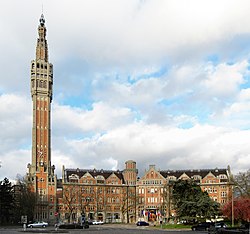
L’hôtel de Marchiennes est un hôtel particulier situé à Lille, dans le département du Nord. Ce site est desservi par la station de métro Mairie de Lille.

1. Localisation

L'hôtel est situé au 191 de la rue Pierre-Mauroy à Lille.

1. Histoire

Situé à l'intérieur des murs de la ville fortifiée, l'hôtel était un ancien refuge de l'abbaye de Marchiennes qui servait de logement à l'abbé de Marchiennes et aux religieux de passage. Le refuge est fondé en 1620 par Jean de Joncquoy, abbé de Marchiennes, à partir de deux maisons achetées à la communauté des Minimes. Seul le porche, daté de 1626, subsiste des constructions d'origine. Les bâtiments qui demeurent ont été édifiés entre 1710 et 1720 pour la partie centrale et l'aile nord, puis ajoutés au XIXe siècle pour l'aile sud. La famille d'industriels du textile Boniface propriétaire depuis 1804 s'opposa à la destruction de l'hôtel programmée dans le cadre de la rénovation du quartier Saint-Sauveur et obtint son classement au titre des monuments historiques le 3 novembre 1958. C'est dans cet hôtel que fut fondé en 1964 l'association de sauvegarde Renaissance du Lille Ancien.

1. Architecture

De style classique français importé à Lille après le rattachement au royaume de France, l'hôtel comprend trois ailes réparties autour d'une cour centrale.

1. Le refuge dans son environnement

Les propriétaires de 1958 ont pu empêcher la destruction de l'hôtel, non la construction d'une barre à sa droite. Les 6 copropriétaires de 2013 se sont vainement opposés à celle d'un bâtiment de 5 étages à sa gauche.

1. Notes et références


1. Voir aussi

Liste des monuments historiques de Lille Liste des monuments historiques du Nord Portail de la métropole européenne de Lille Portail de l’architecture et de l’urbanisme Portail des monuments historiques français

Nearby Places View Menu
Location Image
165 m

Siege of Lille (1940)

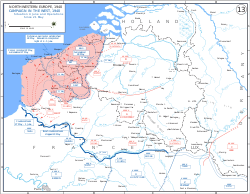
The siege of Lille or Lille pocket (28–31 May 1940) took place during the Battle of France in the Second World War. The siege of the French IV Corps and V Corps (about 40,000 men) of the First Army (General René Prioux) was conducted by four German infantry divisions supported by three panzer divisions. The III Corps of the First Army had managed to retreat to the Lys river with the British Expeditionary Force (BEF) divisions nearby. The two surrounded French corps resisted German attacks until forced to surrender at midnight on 31 May/1 June. The defence of the Lille Pocket enabled more Allied troops to retreat into the Dunkirk perimeter and take part in the Battle of Dunkirk.
Location Image
276 m

Hôtel de Ville, Lille

The Hôtel de Ville (French pronunciation: [otɛl də vil], City Hall) is a municipal building in Lille, France. Built between 1924 and 1932 in Art Deco style of Flemish neo-Renaissance inspiration, it was designated a Monument historique by the French Government in May 2002. Its belfry is a UNESCO World Heritage Site, inscribed in 2005 along with many other Belfries of Belgium and France in recognition of its architecture and importance in the history of municipal power in Europe. The latter should not be confused with the belfry of Lille's Chamber of Commerce, also emblematic of the city. The Town Hall is located on the Place Roger Salengro, next to the Porte de Paris, in the eastern part of the city centre. This site is served by the Mairie de Lille metro station on line 2 of the Lille Metro.
287 m

Canton of Lille-4

The canton of Lille-4 is an administrative division of the Nord department, northern France. It was created at the French canton reorganisation which came into effect in March 2015. Its seat is in Lille. It consists of the following communes: Lezennes Lille (partly) Ronchin
Location Image
293 m

Christ Church, Lille

Christ Church Lille is an English-speaking Anglican Church located in the city of Lille in Nord-Pas-de-Calais, the Flemish area of France. Christ Church Lille is part of the Church of England, Diocese in Europe.
Location Image
329 m

University of Lille

The University of Lille (French: Université de Lille, abbreviated as ULille, UDL or univ-lille) is a French public research university based in Lille, in the Nord department of Upper France. It has its origins in the University of Douai (1559), and resulted from the merger of three universities – Lille 1 University of Science and Technology, Lille 2 University of Health and Law, and Charles de Gaulle University – Lille III in 2018. With more than 80,000 students, it is one of the largest universities in France and one of the largest French-speaking universities in the world. Since 2017, the university has been funded as one of the French universities of excellence. It benefits from an endowment of 500 million euros to accelerate its strategy in education, research, international development and outreach. With 66 research labs, 350 PhD theses supported per year and 3,000 scientific publications each year, it is well represented in the research community; it collaborates with many organizations (Pasteur Institute of Lille, CHU Lille University Hospital, CNRS, INSERM, INRA, INRIA etc.) and schools (École Centrale de Lille, École des Mines-Télécom de Lille-Douai (IMT Lille Douai), Sciences Po Lille etc.). Until 2019, the university was the main component of the Community of Universities and Institutions (COMUE) Lille Nord de France. It still operates the European Doctoral College, which federates universities and other higher learning institutes in the Hauts-de-France region.