

 English
 Français
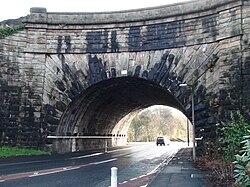
Ewood Aqueduct is a high embankment carrying the Leeds and Liverpool Canal over the River Darwen and the B6447 road near Blackburn, Lancashire, England. Built of sandstone in the early 19th century, it is a Grade II listed building.
Nearby Places View Menu
383 m
Blackburn Royal Infirmary
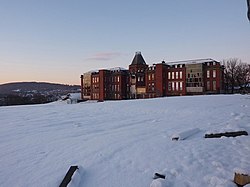
The Blackburn Royal Infirmary was an acute District General Hospital in Blackburn, Lancashire. It was managed by East Lancashire Hospitals NHS Trust.
589 m
Ewood Park
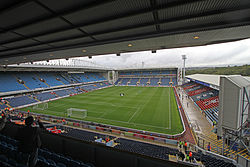
Ewood Park () is a football stadium in Blackburn, Lancashire, England, and the home of Blackburn Rovers, founding members of the Football League and Premier League, who have played there since 1890. It is an all seater multi-sports facility with a capacity of 31,367, and four sections: the Bryan Douglas Darwen End, The Ronnie Clayton Blackburn End, the Riverside Stand, and Jack Walker Stand, named after Blackburn industrialist and club supporter, Jack Walker. The football pitch within the stadium measures 115 by 76 yards (105 m × 69 m)

589 m
Blackburn Rovers F.C.
Blackburn Rovers Football Club is a professional football club based in Blackburn, Lancashire, England, which competes in the EFL Championship, the second level of the English football league system. They have played home matches at Ewood Park since 1890. The club's motto is Arte et Labore, meaning "By Skill and Hard Work" in Latin. They have a long-standing rivalry with nearby club Burnley, with whom they contest the East Lancashire derby.
Blackburn Rovers was founded in 1875, becoming a founding member of The Football League in 1888. They won five FA Cup finals in the 19th century: 1884, 1885, 1886, 1890 and 1891. The team was crowned English League champions in 1911–12 and 1913–14, then won a sixth FA Cup in 1928. They were relegated for the first time in 1936, but returned to the top-flight as Second Division champions in 1938–39. Relegated in 1948, Rovers secured promotion again in 1957–58, but were relegated in 1966 and again in 1971. Blackburn won the Third Division title in 1974–75, and were again promoted in 1979–80 after suffering relegation the previous year. They won the Full Members' Cup in 1987.
In 1992, Rovers gained promotion to the new Premier League via the play-offs, a year after being taken over by local entrepreneur Jack Walker, who installed Kenny Dalglish as manager. In 1994–95, Rovers became Premier League champions. Relegated four seasons after being crowned champions, they secured promotion at the end of the 2000–01 season, and won the 2002 Football League Cup Final the following year. They spent eleven successive seasons in the Premier League, but were relegated in 2012 and again into the third tier in 2017. Blackburn secured promotion out of League One at the end of the 2017–18 season.

640 m
Mill Hill railway station (Lancashire)
Mill Hill railway station serves Mill Hill in the Blackburn with Darwen borough in Lancashire, England. It is 1+1⁄4 miles (2.0 km) west of Blackburn railway station. It is an island platformed station managed by Northern. It was opened by the Lancashire and Yorkshire Railway in 1884, almost forty years after the line itself.
It is unstaffed, with no permanent buildings other than basic shelters on the platform. Digital information screens and a P.A system are installed to give intending passengers train running information.
As of January 2018, along with other stations on this line, a new touch screen ticket machine was added to the Station.
It has no step-free disabled access, with an entrance down a single flight of stairs from street level. From the street level above there are also direct bus services to Blackburn town centre. It is the nearest station to Ewood Park, the home of Blackburn Rovers.