La rue de la Riviérette est une rue de Lille.

1. Situation et accès

Cette rue étroite de forme coudée est située dans le quartier Lille-Centre dans l'ancienne paroisse de Saint-Maurice. Depuis les travaux la fin du XXe siècle la rue est principalement bordée par des bâtiments récents et murs de propriétés riveraines ne laissant qu’un vestige d’une maison du XVIIIe siècle avec un oculus en hauteur. Ces travaux ont élargi plusieurs parties de la rue, notamment celle donnant sur la rue des Tanneurs qui est une sortie de parkings. Un tronçon a conservé son étroitesse d'origine.

1. Origine du nom

Elle rend souvenir du petit canal de la Riviérette qui la traversait en deux endroits.

1. Historique

La rue de la Riviérette qui figure sur le plan de Guichardin de 1560 existait donc au XVIe siècle. La voie était dénommée « rue de l’A.B.C. » en raison d’une école fondée en 1584 par le magistrat dont le premier établissement était situé à l’angle de la rue et de la porte du Molinel. La partie perpendiculaire à la rue du Molinel, parallèle à la rue d’Amiens et à la rue des Tanneurs longeait jusqu’en 1603 le rempart de la ville, la porte du Molinel étant située à l’angle de la rue du Molinel. A cette date, la porte du Molinel fut remplacée par la porte Notre-Dame située entre la place de Béthune et l’actuelle place Richebé sur le nouveau rempart créé lors du IVe agrandissement de Lille. Le refuge de Seclin, établissement où les habitants des campagnes pouvaient se réfugier en cas de guerre ou plus généralement lors de leurs déplacements en ville, s’étendait entre la rue d’Amiens et la rue de l’A.B.C. Autour de 1900, la rue de l’A.B.C. était une rue de prostitution. Jusque dans les années 1950, la rue était bordée de maisons basses démolies au cours de la deuxième du XXe siècle. Elle est renommée « rue de la Riviérette » en 1951. Un grand immeuble de la fin du XVIIIe siècle de style néo-classique à l'angle de la rue du Molinel a été détruit en 2006 pour la construction d'un immeuble d'habitations en copropriété.

1. Références


1. Article connexe

Liste des rues de Lille

Portail de l’architecture et de l’urbanisme Portail de la métropole européenne de Lille

Nearby Places View Menu
Location Image
126 m

Siege of Lille (1940)

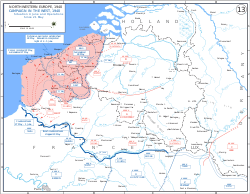
The siege of Lille or Lille pocket (28–31 May 1940) took place during the Battle of France in the Second World War. The siege of the French IV Corps and V Corps (about 40,000 men) of the First Army (General René Prioux) was conducted by four German infantry divisions supported by three panzer divisions. The III Corps of the First Army had managed to retreat to the Lys river with the British Expeditionary Force (BEF) divisions nearby. The two surrounded French corps resisted German attacks until forced to surrender at midnight on 31 May/1 June. The defence of the Lille Pocket enabled more Allied troops to retreat into the Dunkirk perimeter and take part in the Battle of Dunkirk.
Location Image
248 m

Saint-Maurice, Lille

The Église Saint-Maurice is a church on Rue Pierre-Mauroy, in the historic centre of Lille, northern France. Its construction began at the end of the 14th century and completed at the end of the 19th century, and it was extended over more than four centuries. A hall church in the Gothic style, it was made a monument historique in 1914.
Location Image
357 m

Column of the Goddess

The Column of the Goddess (French: Colonne de la Déesse) is the popular name given by the citizens of Lille, France, to the Memorial of the Siege of 1792. The memorial stands in the center of the city's Grand' Place (central square), and has been surrounded by a fountain since around 1990.
Location Image
357 m

Place du Général-de-Gaulle (Lille)

The Place du Général-de-Gaulle (French pronunciation: [plas dy ʒeneʁal də ɡol]) is an urban public space situated in the commune of Lille, Hauts-de-France region. It is the town's historic main square. It has a grand-place style, which is typical of many cities in the former Netherlands. Until the 21st century, the square was considered to be part of the Forum mentioned in the 1066 foundation act of the Collegiate Church of Saint-Pierre. It is believed to have originated in the 14th century when the town's aldermen decided to turn it into a market. The Deûle was canalized, the ground gradually raised by embankments, then paved to create a market square. In the 17th century, the construction of the Vieille Bourse divided the square into the Grand-Place and the Petite-Place (now the Place du Théâtre). After the liberation of Lille during World War II, the square was renamed in honor of Charles de Gaulle. The square is known locally as the Grand'Place or, more rarely, the Place de la Déesse. The Place du Général-de-Gaulle continues to serve as a grand plaza for festivities, exchanges, and commercial activities, as well as various events of all kinds. It's still the heart of Lille's braderie. The book trade, with the Furet du Nord bookshop and numerous secondhand booksellers, is also important. The square is surrounded by a number of buildings, eight of which are listed as historical monuments, including the Théâtre du Nord (formerly the Grande Garde) and the Vieille Bourse (formerly the Bourse de Commerce). At the center of the square stands the Column of the Goddess. Built in 1845, it represents the heroism of the people of Lille during the siege of 1792.
Location Image
384 m

Siege of Lille (1708)

The siege of Lille (12 August – 10 December 1708) was the main operation of the 1708 campaign season during the War of the Spanish Succession. Following their victory in the Battle of Oudenaarde, the Allies decided to besiege Lille, an important French city and perhaps the strongest fortress in Europe. After an obstinate defence of 120 days, the French garrison surrendered the city and citadel of Lille, commanded by Marshal Boufflers, to the forces of the Duke of Marlborough and Prince Eugene of Savoy.