

 English
 Français

The Shambles
The Shambles est une rue médiévale d'York en Angleterre.
Nearby Places View Menu

0 m
The Shambles
The Shambles is a historic street in York, England, featuring preserved medieval buildings, some dating back as far as the 14th century. The street is narrow, with many timber-framed buildings with jettied floors that overhang the street by several feet. It was once known as the Great Flesh Shambles, a name reflecting its historical use as a butchers' street. The word shambles derives from Old English sċeamol (“bench, stall”), referring to market or butcher’s stalls; the association with meat is historical rather than etymological. In 1885, thirty-one butchers' shops were located along the street but none remain today.

4 m
13 The Shambles
13 The Shambles is a historic building in York, England. A Grade II* listed building, located on The Shambles, the building dates to the early 17th century, but it was refronted in the 18th century and renovated in the 19th and 20th centuries.
The timber supports that ran down to a counter and the canopy of the original open stall are now incorporated into today's façade.
As of 2020, the building is occupied by The Earl Grey Tea Rooms.

6 m
Little Shambles
Little Shambles is a short historic street in the city centre of the city of York, England. The street dates back to medieval times and forms a small branch off street from the main street of The Shambles. The street was largely demolished in the 1950s and what remains now opens out onto a large, open space with market stalls known as Shambles Market.
By the time of the 1940s and 1950s, the area was in a very poor state of repair. Many of the buildings were on the edge of collapse. From the 1920s, York City Council had purchased numerous properties from private owners with the aim of saving them from ruin. The Second World War prevented much from being done to the Shambles and during this time, the buildings got worse. In 1948, planners drew up plans for the street and neighbouring areas to make extensive changes. They decided that they would demolish most of the buildings in the area to create a new "medieval" market. Shambles Market was created by the demolition of the vast majority of Little Shambles and many side streets.
Along with Little Shambles, many small and equally historic buildings built behind the Shambles were demolished in the 1950s. These included the small snickelways between the buildings that led to some medieval halls and old slaughter houses that the butcher shops used. Today, some of these restorations are seen as insensitive, since a great deal of historic fabric, including slaughterhouses and outbuildings at the rear of the properties, was demolished. The Yorkshire Architectural and York Archaeological Society's annual report of 1949 contains plans of the Shambles showing the buildings to be removed.
2 Jubbergate is one of the last surviving buildings to form part of Little Shambles. In 1928, the building was restored. It was grade II* listed in 1954, and in 1957, the York Conservation Trust purchased the freehold. As part of the creation of the Shambles Market, the neighbouring buildings that formed the street were demolished, and it is now freestanding, almost surrounded by the market.
Another surviving building is 1 Little Shambles, a 15th-century, timber framed, grade II listed building.

8 m
40 The Shambles
40 The Shambles is a historic building in York, England. Grade II listed, part of the structure dates to the early 18th century, with an alteration and shopfront added in the early and mid-19th century.
8 m
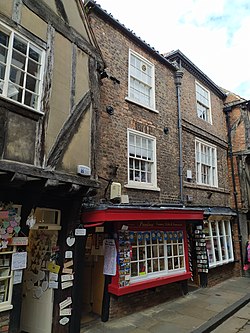
39 The Shambles
39 The Shambles is a historic building in York, England. Grade II* listed, part of the structure dates to the late 15th century, with an extension added in the late 17th century, followed by a remodelling in the early 19th century.
As of 2025, the building was occupied by Mrs B's Emporium of Gifts.