

 English
 Français
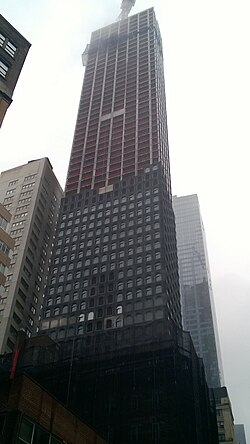
The Wall Street Tower
Le 130 William Street (aussi connu sous le nom de The Wall Street Tower) est un gratte-ciel de 244 mètres en construction à New York aux États-Unis. L'immeuble est développé par le groupe Lightstone et conçu par l'architecte britannico-ghanéen Sir David Adjaye.
Nearby Places View Menu

260 m
28 Liberty Street
28 Liberty Street, formerly known as One Chase Manhattan Plaza, is a 60-story International Style skyscraper between Nassau, Liberty, William, and Pine Streets in the Financial District of Manhattan in New York City. The building, designed by Gordon Bunshaft of Skidmore, Owings & Merrill (SOM), opened in 1961. It is 813 feet (248 m) tall.
28 Liberty Street occupies only about 28 percent of its 2.5-acre (1.0 ha) site. It consists of 60 above-ground stories, a ground-level concourse, and five basement levels. The tower is surrounded by a plaza that contains a sunken Japanese rock garden, designed by Isamu Noguchi, to the south. The building's design is similar to that of SOM's earlier Inland Steel Building in Chicago. It contains a stainless steel facade with black spandrels below the windows. The superstructure contains 40 steel columns, arranged around the perimeter and clustered around the core to maximize usable space. When the tower opened, it accommodated 7,500 employees but contained only 150 private offices.
David Rockefeller, then executive vice president of Chase Manhattan Bank, proposed the tower in the 1950s as a means to keep the newly merged bank (Chase National and the Manhattan Company) in Lower Manhattan while merging its 8,700 employees into one facility. Construction started in early 1957, and the building's tower opened in early 1961. One Chase Manhattan Plaza was nearly fully occupied from its opening, with numerous financial and legal tenants. The building's basements and plaza opened in 1964; during its early years, the structure faced some early challenges such as the discovery of weakened facade panels, a fire, and a bombing. The building was renovated in the early 1990s, and Chase moved its headquarters out in 1997. The New York City Landmarks Preservation Commission designated the building a landmark in 2008. Chase Manhattan's parent company, JPMorgan Chase, sold the building to Fosun International, a Chinese investment company, in 2013; the building was subsequently renamed 28 Liberty Street.
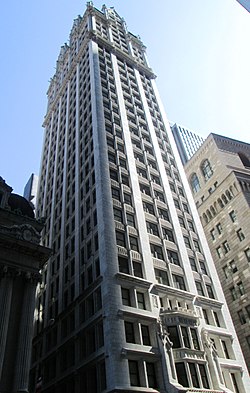
265 m
Liberty Tower (Manhattan)
The Liberty Tower, formerly the Sinclair Oil Building, is a 33-story residential building in the Financial District of Manhattan in New York City. It is at 55 Liberty Street at the northwest corner with Nassau Street. It was built in 1909–10 as a commercial office building and was designed by Henry Ives Cobb in a Gothic Revival style.
The site is adjacent to the New York Chamber of Commerce Building, while the Federal Reserve Bank of New York Building is to the east, across Nassau Street. Upon its completion, Liberty Tower was said to be the world's tallest building with such a small footprint, having a floor area ratio of 30 to 1. The building's articulation consists of three horizontal sections similar to the components of a column, namely a base, shaft, and capital. The limestone building is covered in white architectural terracotta with elaborate ornament.
When the building opened in 1910, one of its first commercial tenants was the law office of future U.S. president Franklin Delano Roosevelt. Shortly after World War I, the entire building was bought by Sinclair Oil. In 1979, architect Joseph Pell Lombardi converted the building from commercial use into residential apartments and renamed it the "Liberty Tower", in one of the first such conversions in Manhattan south of Canal Street. The building was designated a city landmark by the New York City Landmarks Preservation Commission in 1982 and was added to the National Register of Historic Places (NRHP) in 1983. It is also a contributing property to the Wall Street Historic District, an NRHP district created in 2007.

278 m
Group of Four Trees (Jean Dubuffet)
Group of Four Trees is an abstract outdoor sculpture completed in 1972 by the French 20th-century artist Jean Dubuffet. Originally commissioned by the American banker and philanthropist David Rockefeller, the work measures 43 feet and is installed in the public plaza of 28 Liberty Street (formerly One Chase Manhattan Bank Plaza) between Nassau Street and Pine Street in Financial District, Manhattan.
Dubuffet, a leading figure in the Art Brut movement, considered Group of Four Trees as part of his Hourloupe series. The series, originating from ballpoint pen doodles in 1962, features flat, interlocking shapes and striated coloring in red, white, and blue against black backgrounds. At the time of installation, Group of Four Trees was the largest outdoor sculpture in New York City and was said to have dramatized "the increasing environmental interdependence between architecture and outside sculpture" in the 1970s. It was Dubuffet's first outdoor sculpture installed in the United States.

288 m
Chamber of Commerce Building (Manhattan)
The Chamber of Commerce Building is a commercial building on 65 Liberty Street, between Liberty Place and Broadway, in the Financial District of Manhattan in New York City, New York, U.S. Designed by architect James Barnes Baker, the four-story Beaux-Arts building was constructed between 1901 and 1902 as the first headquarters to be built specifically for the Chamber of Commerce of the State of New York. The facade is a New York City designated landmark, and the building is listed on both the New York State Register of Historic Places and the National Register of Historic Places (NRHP) as a National Historic Landmark. It is also a contributing property to the Wall Street Historic District, listed on the NRHP.
The structure is clad with Vermont marble and includes a rusticated masonry base, a short colonnade, and a copper mansard roof. The facade formerly contained statues of John Jay, Alexander Hamilton, and DeWitt Clinton, which had been designed by Daniel Chester French and Philip Martiny. The second story contained the Chamber of Commerce's Great Hall, hung with portraits of important individuals from American history. The rest of the building was largely devoted to offices or meeting rooms for the chamber. Over the years, numerous stores and banks have rented out the ground story. The building's design was largely positively received upon its completion.
The building was constructed after wealthy members of the Chamber of Commerce raised funds. The architecture firm of Helmle and Corbett remodeled the interior and built a new floor in 1922, resulting in changes to the mansard roof. French and Martiny's sculptures, installed in 1903, were removed in 1926 due to severe deterioration. After the Chamber of Commerce relocated to Midtown Manhattan in 1979, the building stood vacant for ten years. The International Commercial Bank of China bought the building in 1989, and the interior was subsequently renovated by Haines Lundberg Waehler.

297 m
Financial District, Manhattan
The Financial District of Lower Manhattan, also known as FiDi, is a neighborhood located on the southern tip of Manhattan in New York City. It is bounded by the West Side Highway on the west, Chambers Street and City Hall Park on the north, Brooklyn Bridge on the northeast, the East River to the southeast, and South Ferry and the Battery on the south.
The City of New York was created in the modern-day Financial District in 1624, and the neighborhood roughly overlaps with the boundaries of the New Amsterdam settlement in the late 17th century. The district comprises the offices and headquarters of many of the city's major financial institutions, including the New York Stock Exchange and the Federal Reserve Bank of New York. Anchored on Wall Street in the Financial District, New York City has been called both the leading financial center and the most economically powerful city of the world, and the New York Stock Exchange is the world's largest stock exchange by total market capitalization. Several other major exchanges have or had headquarters in the Financial District, including the New York Mercantile Exchange, NASDAQ, the New York Board of Trade, and the former American Stock Exchange.
The Financial District is part of Manhattan Community District 1, and its primary ZIP Codes are 10004, 10005, 10006, 10007, and 10038. It is patrolled by the 1st Precinct of the New York City Police Department.