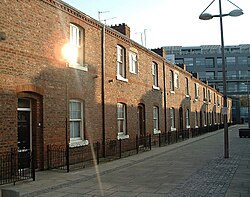
Ancoats est un secteur de la ville de Manchester, dans le nord-ouest de l'Angleterre. Appartenant historiquement au Lancashire, Ancoats est l'un des berceaux de la révolution industrielle et est surnommée « la première banlieue industrielle du monde ». Pendant plusieurs années à partir du XVIIIe siècle, Ancoats est un district industriel florissant. Mais la zone souffre d'un fort déclin économique à partir des années 1930, et de dépopulation après la Seconde Guerre mondiale, particulièrement au cours des années 1960. Depuis les années 1990, le patrimoine industriel d'Ancoats est reconnu, et avec la proximité du centre ville, cela conduit à la mise en place d'un plan de restructuration d'envergure. La partie sud de la banlieue est renommée New Islington, tandis que la partie nord conserve le nom d'Ancoats, centrant son développement nouveau autour du Daily Express Building (en). Pour les élections locales, Ancoats fait partie de la division d'Ancoats and Clayton.

Nearby Places View Menu
Location Image
4 m

Ancoats

Ancoats is an area of Manchester, England, next to the Northern Quarter, the northern part of Manchester city centre. Historically in Lancashire, Ancoats became a cradle of the Industrial Revolution and has been called "the world's first industrial suburb". For many years, from the late 18th century onwards, Ancoats was a thriving industrial district and known for its large Irish population. The area suffered accelerating economic decline from the 1930s and depopulation in the years after the Second World War, particularly during the slum clearances of the 1960s. Since the 1990s, Ancoats' industrial heritage has been recognised and its proximity to the city centre has led to investment and substantial regeneration. The southern part of the area was branded New Islington by property developers Urban Splash, with redevelopment centred on the Daily Express Building. In 2021, a plaque was put in place acknowledging Ancoats' status as a Little Italy. For the purpose of local government elections, the area is part of the Ancoats and Beswick ward on Manchester City Council.
Location Image
85 m

One Port Street

One Port Street is a high-rise residential building under construction in Manchester, England. Located on the edge of the city's Northern Quarter, it comprises a 100-metre (330 ft), 33-storey tower fronting on to Port Street, an 11-storey block facing Great Ancoats Street, as well as 9-storey and 7-storey elements. It was designed by SimpsonHaugh architects. As of December 2025, One Port Street is the 27th-tallest building in Greater Manchester.
Location Image
129 m

Royal Mill

Royal Mill, which is located on the corner of Redhill Street and Henry Street, Ancoats, in Manchester, England, is an early-20th-century cotton mill, one of the last of "an internationally important group of cotton-spinning mills" sited in East Manchester. Royal Mill was constructed in 1912 on part of the site of the earlier McConnel & Kennedy mills, established in 1798. It was originally called New Old Mill and was renamed following a royal visit by King George VI and Queen Elizabeth in 1942. A plaque commemorates the occasion. The Ancoats mills collectively comprise "the best and most-complete surviving examples of early large-scale factories concentrated in one area".
Location Image
142 m

Brownsfield Mill

Brownsfield Mill, located on Binns Place, Great Ancoats Street in Manchester, England, is an early 19th century room and cotton-spinning power mill constructed in 1825. Hartwell describes it as "unusually complete and well preserved". The chimney is now Manchester's oldest surviving mill chimney. The building housed the A.V. Roe and Company aviation factory in the early 20th century. In 1988, it was designated a Grade II* listed building.
Location Image
155 m

McConnel & Kennedy Mills

McConnel & Kennedy Mills are a group of cotton mills on Redhill Street in Ancoats, Manchester, England. With the adjoining Murrays' Mills, they form a nationally important group. The complex consists of six mills, Old Mill built in 1798, Long Mill from 1801 and Sedgewick Mill built between 1818 and 1820. A further phase of building in the early 20th century added Sedgewick New Mill in 1912, Royal Mill, originally the New Old Mill built in 1912 but renamed in 1942, and Paragon Mill also built in 1912. Paragon Mill, at eight storeys, was the world's tallest cast iron structure when it was built.