

 English
 Français

Royal Mill
Royal Mill, which is located on the corner of Redhill Street and Henry Street, Ancoats, in Manchester, England, is an early-20th-century cotton mill, one of the last of "an internationally important group of cotton-spinning mills" sited in East Manchester. Royal Mill was constructed in 1912 on part of the site of the earlier McConnel & Kennedy mills, established in 1798. It was originally called New Old Mill and was renamed following a royal visit by King George VI and Queen Elizabeth in 1942. A plaque commemorates the occasion. The Ancoats mills collectively comprise "the best and most-complete surviving examples of early large-scale factories concentrated in one area".
Nearby Places View Menu

62 m
McConnel & Kennedy Mills
McConnel & Kennedy Mills are a group of cotton mills on Redhill Street in Ancoats, Manchester, England. With the adjoining Murrays' Mills, they form a nationally important group.
The complex consists of six mills, Old Mill built in 1798, Long Mill from 1801 and Sedgewick Mill built between 1818 and 1820. A further phase of building in the early 20th century added Sedgewick New Mill in 1912, Royal Mill, originally the New Old Mill built in 1912 but renamed in 1942, and Paragon Mill also built in 1912. Paragon Mill, at eight storeys, was the world's tallest cast iron structure when it was built.

115 m
Murrays' Mills
Murrays' Mills is a complex of former cotton mills on land between Jersey Street and the Rochdale Canal in Ancoats, an area of Manchester, England. The mills were built for brothers Adam and George Murray.
The first mill on the site, Old Mill, was begun in 1797, and is the world's oldest surviving urban steam-powered cotton spinning factory. After Old Mill opened, the company continued to expand and prosper, and by 1806 the complex was the largest in the world, employing about 1,000 people at its peak: Decker Mill was opened in 1802, New Mill in 1804, Little Mill in 1822, and Doubling and Fireproof Mill in 1842. The main complex formed a quadrangle surrounding a private canal basin linked under the road to the Rochdale Canal, which opened in 1804. The canal basin was used to deliver raw cotton and coal and to transport spun cotton away from the complex.
In 1898 A & G Murray became part of the Fine Cotton Spinners' and Doublers' Association Limited (FCSDA). The mill complex began to decline in the early 20th century as the canal basin was filled in and Little Mill burnt down. The mill was replaced with the earliest mill in Greater Manchester that was built to use mains electricity. The mill complex continued producing cotton until the 1950s. The mills were later leased out to other companies and in some cases allowed to fall into disrepair. Between 2000 and 2003, Urban Splash redeveloped Fireproof and Doubling Mill into offices, winning a RIBA Award. The rest of the complex underwent a £17 million regeneration between 2004 and 2006 and are proposed to be used as flats and a hotel.

128 m
Old Mill, Manchester
Old Mill, completed in 1798 as part of Murrays' Mills, is the oldest surviving cotton mill in Manchester, England. Sited on the Rochdale Canal in Ancoats, it was powered by a Boulton and Watt steam engine, and its narrow six-storey brick structure "came to typify the Manchester cotton mill". Old Mill was designated a Grade II* listed building on 19 June 1988.
130 m
Ancoats
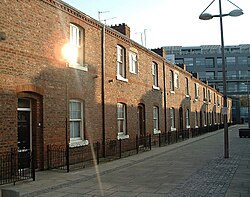
Ancoats is an area of Manchester, England, next to the Northern Quarter, the northern part of Manchester city centre.
Historically in Lancashire, Ancoats became a cradle of the Industrial Revolution and has been called "the world's first industrial suburb". For many years, from the late 18th century onwards, Ancoats was a thriving industrial district and known for its large Irish population. The area suffered accelerating economic decline from the 1930s and depopulation in the years after the Second World War, particularly during the slum clearances of the 1960s.
Since the 1990s, Ancoats' industrial heritage has been recognised and its proximity to the city centre has led to investment and substantial regeneration. The southern part of the area was branded New Islington by property developers Urban Splash, with redevelopment centred on the Daily Express Building.
In 2021, a plaque was put in place acknowledging Ancoats' status as a Little Italy.
For the purpose of local government elections, the area is part of the Ancoats and Beswick ward on Manchester City Council.