

 English
 Français

Château de Brough
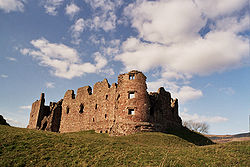
Le château de Brough (Brough Castle en anglais) est un château en ruine du village de Brough, en Cumbria, Angleterre. Il est maintenu par l'English Heritage. Le château est situé sur une large butte, sur laquelle il y a une rangée de constructions, avec une tour circulaire, et les restes d'un ancien donjon.
Nearby Places View Menu
4 m
Brough Castle
Brough Castle is a ruined castle in the village of Brough, Cumbria, England. The castle was built by William Rufus around 1092 within the old Roman fort of Verterae to protect a key route through the Pennine Mountains. The initial motte and bailey castle was attacked and destroyed by the Scots in 1174 during the Great Revolt against Henry II. Rebuilt after the war, a square keep was constructed and the rest of the castle converted to stone.
The Clifford family took possession of Brough after the Second Barons' War in the 1260s; they built Clifford's Tower and undertook a sequence of renovations to the castle, creating a fortification in a typical northern English style. In 1521, however, Henry Clifford held a Christmas feast at the castle, after which a major fire broke out, destroying the property. The castle remained abandoned until Lady Anne Clifford restored the property between 1659 and 1661, using it as one of her northern country homes. In 1666 another fire broke out, once again rendering the castle uninhabitable. Brough Castle went into sharp decline and was stripped first of its fittings and then its stonework. The castle's masonry began to collapse around 1800.
In 1921, Brough Castle was given to the state and is now run by English Heritage as a tourist attraction. It is a listed building and a scheduled monument.
562 m
Brough, Cumbria
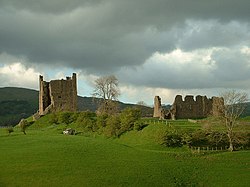
Brough (), sometimes known as Brough under Stainmore, is a village and civil parish in the historic county of Westmorland and the ceremonial county of Cumbria, England, within the Westmorland and Furness unitary authority area, on the western fringe of the Pennines near Stainmore. The village is on the A66 trans-Pennine road, and the Swindale Beck, and is about 8 miles (13 km) south east of Appleby-in-Westmorland. Brough is situated 5 miles (8.0 km) north east of Kirkby Stephen and 28 miles (45 km) north east of Kendal on the A685.
At the 2001 census it had a population of 680, increasing to 751 at the 2011 Census. This rose to 820 people at the 2021 Census.
622 m
Verterae
Verterae was a Roman fort in the modern-day village of Brough, Cumbria, England. Occupied between the 1st and 5th centuries AD, it protected a key Roman road in the north of England. In the 11th century, Brough Castle was built on part of the site by the Normans. Archaeologists explored the remains during the 20th century, and it is now protected under UK law.
1.4 km
Brough Sowerby
Brough Sowerby is a village and civil parish in the Westmorland and Furness district of Cumbria, England. It is located 22.3 miles southeast of the town of Penrith. According to the 2001 census it had a population of 127, increasing to 137 at the 2011 Census. The village is near the River Belah.
'A township in Brough parish, Westmoreland; 1½ mile S of Brough. Acres, 1,083. Real property with Kaber, £3,664. Pop., 140. Houses, 32.' There are quite a few Black Bull inns in the area surrounding Brough Sowerby, this comes from the old Scottish black cattle that were driven through the market town of Kirkby Stephen.

1.5 km
Augill Castle
Augill Castle is a Gothic Revival country house in Brough, Cumbria. Originally a private residence, it was later converted into a hotel.