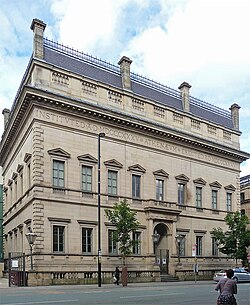
Manchester Art Gallery est un musée d'art public à Manchester, dans le Nord-Ouest de l'Angleterre. Ouvert en 1824, le musée occupe trois bâtiments, dont le plus ancien est classé. C'était à l'origine la Royal Manchester Institution, dont le bâtiment fut créé par Sir Charles Barry en 1824. Le musée a été étendu en 2002 par Hopkins Architects pour englober l'ancien bâtiment du Manchester Athenaeum, de style Palazzo, également dessiné par Barry en 1826. Il abrite beaucoup d'œuvres spécifiquement liées à Manchester, en particulier dans la salle éponyme.

1. Collections

La collection conjointe de la Manchester Art Gallery et du musée du Costume (The Gallery of Costume) est composée de plus d'objets issus des beaux-arts, des arts décoratifs et du costume. La collection consacrée aux beaux-arts contient 14 000 œuvres d'art, dont 2 000 peintures, 350 sculptures, dessins, aquarelles, estampes et photographies. Les arts décoratifs sont représentés par 13 000 objets en céramique, verre et autres matériaux. Enfin, le musée du Costume conserve 21 000 vêtements et accessoires.

1. Œuvres

Parmi les artistes et les œuvres de la collection, relevons :

Lawrence Alma-Tadema, A Roman Flower Market, 1868 Lawrence Alma-Tadema, Silver Favourites, vers 1903 Giovanni Ansaldo, Allegory of the Arts, 1635-1638 William Beechey, George the Third, non daté William Beechey, Children at Play (The Oddie children), vers 1800 Ford Madox Brown, Le Travail, 1855 Edward Burra, Medusa, vers 1938 John Constable, View from Hampstead Heath, looking towards Harrow, 1821 Jean-Baptiste-Camille Corot, Sunset: Figures under Trees, non daté Aelbert Cuyp, River scene with a view of Dordrecht and a windmill: anglers, right, non daté Gerrit Dou, Portrait d'une jeune femme, non daté Gaspard Dughet, Landscape with Shepherds, vers 1600 William Etty, The Sirens and Ulysses, 1837 William Etty, The Bather: At the Doubtful Breeze Alarmed,1839-1849 Henri Fantin-Latour, Roses dans un vase de verre, 1879 Frans Francken le Jeune, The Seven Works of Mercy, 1610-1615 Thomas Gainsborough, Landscape with Figures, 1784-1785 Thomas Gainsborough, A Young Gentleman, 1760-1765 Thomas Gainsborough, A Peasant Girl Gathering Faggots in a Wood, 1782 Paul Gauguin, Harbour Scene, Dieppe, 1885-1886 Luca Giordano, The Cave of Eternity, non daté William Hogarth, A Gentleman, 1739 William Hogarth, The Pool of Bethesda, 1734-1736 Pieter de Hooch, Merry Company with a Man and Two Women, 1668-1670 William Holman Hunt, Le Berger mercenaire, 1851 William Holman Hunt, The Scapegoat, 1854–1855 William Holman Hunt, L'Ombre de la mort, 1870–1873 Edwin Landseer, Bolton Abbey, Yorkshire, 1830-1835 Edwin Landseer, The Desert, 1849 Élie Lascaux, Les Vignes sous la Neige, 1929 Thomas Lawrence, James Curtis, 1804 Frederic Leighton, Captive Andromache, 1888 Peter Lely, Sir John Cotton and His Family, 1660 Laurence Stephen Lowry, Piccadilly Gardens, 1954 John Everett Millais, Feuilles d'automne, 1856 Auguste Charles Mengin, Sappho, 1877 Francesco de Mura, The Death of Verginia, 1768-1770 Christopher Nevinson, Making Aircraft: Making the Engine, 1917 James Northcote, Othello, the Moor of Venice, 1826 Jacob Ochtervelt, Merry Company, vers 1665 Camille Pissarro, Une rue de village, Louveciennes, dit aussi Rue de Voisins, 1871 Camille Pissarro, Pont de la Clef in Bruges, Belgium, 1903 Guido Reni, Sainte Catherine, 1638-1640 Pierre-Auguste Renoir, Seated Nude, vers 1897 Joshua Reynolds, Lady Anstruther, vers 1763 Frederick Sandys, Viviane, 1863 Frans Snyders, The Leopards, non daté Hendrik Martensz Sorgh, A Fish Stall by a Harbour, non daté Jan Steen, The Rommelpot: Interior with Three Figures, 1645-1679 George Stubbs, A Cheetah and a Stag with Two Indian Attendants, vers 1764 Annie Swynnerton, Rain-clouds, Monte Gennaro, 1904 David Teniers le Jeune, The Dentist, 1652 Gerard ter Borch, Cornelis Vos, Burgomaster of Deventer, vers 1667 Alessandro Turchi, The Flight into Egypt, non daté Joseph Mallord William Turner, Landscape with Trees by the River Thames, vers 1805 Pierre Adolphe Valette, Annie Barnett, 1917 Quirijn van Brekelenkam, A family seated round a kitchen fire, 1640-1668 Jan van de Cappelle, Shipping Anchored in a Calm Sea, vers 1650 Adriaen van de Velde, Winter scene with a group of golfers on a frozen river, 1660-1672 Willem van de Velde le Jeune, Seascape with a yacht sailing under a rainy sky, 1660-1670 Adriaen van Ostade, Two Peasants Smoking, 1650-1660 Salomon van Ruysdael, Winter scene with sledges and skaters on a river: a town at the right, 1656 Claude-Joseph Vernet, Coast Scene with a British Man of War, 1766 Sándor Wagner, The Chariot Race, 1872-1873 John William Waterhouse, Hylas and the Nymphs, 1896 Johan Zoffany, Venus Bringing Arms to Aeneas, 1759 Francesco Zuccarelli, Pastoral Landscape, 1750-1770

1. Galerie


1. Références

Portail des arts Portail de Manchester et de son comté Portail des musées Portail des monuments classés au Royaume-Uni

Nearby Places View Menu
Location Image
0 m

Manchester Art Gallery

Manchester Art Gallery, formerly Manchester City Art Gallery, is a publicly owned art museum on Mosley Street in Manchester city centre, England. The main gallery premises were built for a learned society in 1823 and today its collection occupies three connected buildings, two of which were designed by Sir Charles Barry. Both of Barry's buildings are listed. The building that links them was designed by Hopkins Architects following an architectural design competition managed by RIBA Competitions. It opened in 2002 following a major renovation and expansion project undertaken by the art gallery. Manchester Art Gallery is free to enter and open six days a week, closed Mondays. It houses many works of local and international significance and has a collection of more than 25,000 objects. More than half a million people visited the museum in the period of a year, according to figures released in April 2014.
Location Image
0 m

Manchester Athenaeum

The Athenaeum on Princess Street in Manchester, England, now part of Manchester Art Gallery, was originally a club built for the Manchester Athenaeum, a society for the "advancement and diffusion of knowledge", in 1837. The society, founded in 1835, met in the adjacent Royal Manchester Institution until funds had been raised for the building. The society survived financial difficulties to become the centre for Manchester's literary life. It ceased operations in 1938. Sir Charles Barry designed the Athenaeum building in the Italian palazzo style, the first such building in the city. Manchester Corporation acquired the building in 1938. In 2002 Manchester Art Gallery was extended by Hopkins Architects following an architectural design competition managed by RIBA Competitions to take in the Athenaeum. It is linked to the art gallery by a glass atrium. The Athenaeum was designated a Grade II* listed building in 1974.
Location Image
93 m

Guardian telephone exchange

Guardian Exchange was an underground telephone exchange built in Manchester from 1954 to 1957. It was built together with the Anchor exchange in Birmingham and the Kingsway exchange in London – all believed to provide hardened communications in the event of nuclear war; as well as linking the UK government in London to the US Government in Washington, D.C. by means of a secure and hardened transatlantic telephone cable making landfall near Oban and running through Glasgow, Manchester and Birmingham. Today, the underground site is used for telephone cabling. Constructed at a depth of below 35 metres (115 ft), the tunnels are about 2 metres (80 in) in diameter. The exchange cost around £4 million (approximately £126 million in 2015 prices), part of which was funded by the United Kingdom's NATO partners.
Location Image
96 m

Two St Peter's Square

Two St Peter's Square is a high-rise office building in St. Peter's Square, Manchester, England. Designed by SimpsonHaugh and Partners, the scheme was controversial as it involved the demolition of a 1930s Art Deco but unlisted building.
Location Image
100 m

Manchester Cenotaph

Manchester Cenotaph is a war memorial in St Peter's Square, Manchester, England. Manchester was late in commissioning a First World War memorial compared with most British towns and cities; the city council did not convene a war memorial committee until 1922. The committee quickly achieved its target of raising £10,000 but finding a suitable location for the monument proved controversial. The preferred site in Albert Square would have required the removal and relocation of other statues and monuments, and was opposed by the city's artistic bodies. The next choice was Piccadilly Gardens, an area already identified for a possible art gallery and library; but in the interests of speedier delivery, the memorial committee settled on St Peter's Square. The area within the square had been purchased by the City Council in 1906, having been the site of the former St Peter's Church; whose sealed burial crypts remained with burials untouched and marked above ground by a memorial stone cross. Negotiations to remove these stalled so the construction of the cenotaph proceeded with the cross and burials in situ. Having picked a site, it was originally proposed to choose an architect by open competition, but the memorial committee was criticised in the local press when it reserved the right to overrule the judgement of the independent assessor. A sub-committee therefore approached Sir Edwin Lutyens directly, who produced, in a matter of weeks, a variation of his design for the Cenotaph in London. The memorial consists of a central cenotaph and a Stone of Remembrance flanked by twin obelisks, all features characteristic of Lutyens' works. Raised steps on either side of the Stone of Remembrance provided east-facing tribunes for the colour party in memorial parades. The cenotaph is topped by an effigy of a fallen soldier and decorated with relief carvings of the imperial crown, Manchester's coat of arms and inscriptions commemorating the dead. The structures, based on classical architecture, use abstract, ecumenical shapes rather than overt religious symbolism. In submitting the design, Lutyens stated that he envisaged the crypts and cross as remaining in place; as the cenotaph could stand on the foundations of the former church tower and the cross would serve to "consecrate the site", while there would be no explicit religious symbolism on the cenotaph itself. The memorial was unveiled on 12 July 1924 by the Earl of Derby, assisted by Mrs Bingle, a local resident whose three sons had died in the war. It cost £6,940 and the remaining funds were used to provide hospital beds. In 2014, Manchester City Council dismantled the memorial and reconstructed it at the northeast corner of St Peter's Square next to Manchester Town Hall to make room for the expanded Metrolink tram network. It is a grade II* listed structure and in 2015, Historic England recognised Manchester Cenotaph as part of a national collection of Lutyens' war memorials.