Location Image

Guardian telephone exchange

Guardian Exchange was an underground telephone exchange built in Manchester from 1954 to 1957. It was built together with the Anchor exchange in Birmingham and the Kingsway exchange in London – all believed to provide hardened communications in the event of nuclear war; as well as linking the UK government in London to the US Government in Washington, D.C. by means of a secure and hardened transatlantic telephone cable making landfall near Oban and running through Glasgow, Manchester and Birmingham. Today, the underground site is used for telephone cabling. Constructed at a depth of below 35 metres (115 ft), the tunnels are about 2 metres (80 in) in diameter. The exchange cost around £4 million (approximately £126 million in 2015 prices), part of which was funded by the United Kingdom's NATO partners.

Nearby Places View Menu
Location Image
70 m

Three St Peter's Square

3 St Peter's Square is a high-rise hotel and aparthotel in Manchester city centre, England. Designed by Stephenson Studio with Leach Rhodes Walker as the delivery architect, the building comprises a 256-unit aparthotel operated by Staycity and a hotel containing 328 rooms operated by Motel One. As of February 2023, it is the largest purpose-built hotel in Manchester.
Location Image
93 m

Manchester Art Gallery

Manchester Art Gallery, formerly Manchester City Art Gallery, is a publicly owned art museum on Mosley Street in Manchester city centre, England. The main gallery premises were built for a learned society in 1823 and today its collection occupies three connected buildings, two of which were designed by Sir Charles Barry. Both of Barry's buildings are listed. The building that links them was designed by Hopkins Architects following an architectural design competition managed by RIBA Competitions. It opened in 2002 following a major renovation and expansion project undertaken by the art gallery. Manchester Art Gallery is free to enter and open six days a week, closed Mondays. It houses many works of local and international significance and has a collection of more than 25,000 objects. More than half a million people visited the museum in the period of a year, according to figures released in April 2014.
Location Image
93 m

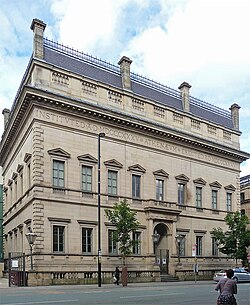
Manchester Athenaeum

The Athenaeum on Princess Street in Manchester, England, now part of Manchester Art Gallery, was originally a club built for the Manchester Athenaeum, a society for the "advancement and diffusion of knowledge", in 1837. The society, founded in 1835, met in the adjacent Royal Manchester Institution until funds had been raised for the building. The society survived financial difficulties to become the centre for Manchester's literary life. It ceased operations in 1938. Sir Charles Barry designed the Athenaeum building in the Italian palazzo style, the first such building in the city. Manchester Corporation acquired the building in 1938. In 2002 Manchester Art Gallery was extended by Hopkins Architects following an architectural design competition managed by RIBA Competitions to take in the Athenaeum. It is linked to the art gallery by a glass atrium. The Athenaeum was designated a Grade II* listed building in 1974.
Location Image
93 m

Two St Peter's Square

Two St Peter's Square is a high-rise office building in St. Peter's Square, Manchester, England. Designed by SimpsonHaugh and Partners, the scheme was controversial as it involved the demolition of a 1930s Art Deco but unlisted building.