The Tribute in Light is an art installation created in remembrance of what happened on September 11 2001. It consists of 88 vertical searchlights arranged in two columns of light to represent the Twin Towers. It stands six blocks south of the World Trade Center on top of the Battery Parking Garage in New York City. Tribute in Light began as a temporary commemoration of the attacks in early 2002, but it became an annual event, currently produced on September 11 by the Municipal Art Society of New York. The Tribute in Light was conceived by artists John Bennett, Gustavo Bonevardi, Richard Nash Gould, Julian LaVerdiere, and Paul Myoda, and lighting consultant Paul Marantz. The Tribute's illumination begins at dusk and ends at dawn, with the lights being turned off for 20-minute periods to allow migratory birds to escape as needed. On clear nights, the lights can be seen from 60 miles (97 km) away, visible in all of New York City and most of suburban Northern New Jersey and Long Island. The lights can also be seen in Fairfield County, Connecticut, as well as Westchester, Orange, and Rockland counties in New York. The 88 xenon spotlights (44 for each tower) each consume 7,000 watts. As of 2011, the annual cost for the entire project was about $500,000. A similar Tribute in Light has also appeared on occasion at the Pentagon in Arlington County, Virginia and at the crash site of United 93 in Shanksville, Pennsylvania, which were also targeted during the 9/11 attacks.

Nearby Places View Menu
34 m

Battery Tower (Manhattan)

Battery Tower was a proposed initial unit of a $50,000,000 1929 residential development on West Street in the Financial District of Manhattan, New York City, near Battery Park. It would have been the first hotel-apartment completed in the Financial District. It became one of a number of skyscraper projects left unfinished. Battery Park City was built on the site of the proposed development, nearly six decades later.
Location Image
57 m

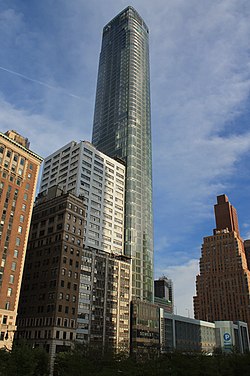
50 West Street

50 West Street is a 64-story, 778 ft (237 m) tall mixed-use retail and residential condominium tower developed by Time Equities Inc. in Lower Manhattan, New York City. It contains 191 residential units.
Location Image
84 m

88 Greenwich Street

88 Greenwich Street, also known as the Greenwich Club Residences and previously as 19 Rector Street, is a building located on the southern side of Rector Street between Greenwich and Washington Streets in the Financial District of Manhattan, New York City. Constructed in 1929–30, this 37-story structure was designed in the Art Deco style by Lafayette A. Goldstone and Alexander Zamshnick. An entrance to the Rector Street station of the New York City Subway was located in the basement of the building and opened in 1931. However, this entrance was closed by 1941. 88 Greenwich Street was added to the National Register of Historic Places in 2002. In 2006, the building was renovated into residential condominium use. In 2012, the building was severely affected by flooding from Hurricane Sandy. Approximately three million cubic feet of saltwater entered the building's basement, leading to extensive damage. Additionally, during the flooding, water dislodged an oil tank, causing it to crack upon hitting a ceiling beam.
Location Image
112 m

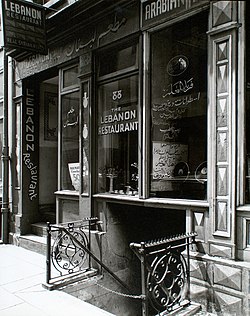
Little Syria, Manhattan

Little Syria (Arabic: سوريا الصغيرة) was a diverse neighborhood that existed in the New York City borough of Manhattan from the late 1880s until the 1940s. The name for the neighborhood came from the Arabic-speaking Christian population who emigrated from Ottoman Syria, an area which today includes the nations of Lebanon, Syria, Jordan, Israel, and Palestine. Also called the Syrian Quarter, or Syrian Colony in local newspapers it encompassed a few blocks reaching from Washington Street in Battery Park to above Rector Street. This neighborhood became the center of New York's first community of Arabic-speaking immigrants. In spite of this name the neighborhood was never exclusively Syrian or Arab, as there were also many Irish, German, Slavic, and Scandinavian immigrant families present. The neighborhood declined as the inhabitants began moving out to other areas, Brooklyn Heights, the Sunset Park area and Bay Ridge, with many shops relocating to Atlantic Avenue, in Brooklyn. The community disappeared almost entirely when a great deal of lower Washington Street was demolished to make way for the entrance ramps to the Brooklyn-Battery Tunnel. The quarter was located at the southern edge of the site that would become the World Trade Center. After the September 11 terrorist attacks the cornerstone of the Syrian St. Joseph's Maronite Church was found in the rubble.