
Boedo is a working-class barrio or neighborhood of Buenos Aires, Argentina. The neighborhood and one of its principal streets were named after Mariano Boedo, a leading figure in the Argentine independence. It is the home of San Lorenzo de Almagro football club.

1. Esquina Homero Manzi

The corner of San Juan and Boedo is mentioned in the opening verse of the tango Sur, one of the best-loved songs about Buenos Aires. The corner is now known as Esquina Homero Manzi after the author of the lyrics, and is the venue for several tango festivals.

1. Boedo Literary Group

The Boedo group were a group of left-leaning Argentine and Uruguayan writers in the 1920s. Notable members of the Boedo group included Enrique Amorim, Leónidas Barletta, Elías Castelnuovo, Roberto Mariani, Nicolás Olivari, Lorenzo Stanchina, César Tiempo, and Álvaro Yunque. Magazines associated with the Boedo group included Dínamo, Extrema Izquierda and Los Pensadores, and Antonio Zamora's publishing house Claridad. Olivari, who was a founder of the Boedo group, later became a member of the less political Florida group; Roberto Arlt was also associated with both groups.

1. Transportation

Boedo has access to many bus lines to the center and to the nearby Primera Junta transportation hub. It has also access to the E Line of the subte (subway). The main streets of the neighborhood are: Boedo to the South, San Juan/Directorio to the east, and Independencia/Alberdi to the West.

1. Cultural references

The suburb is immortalized in the tango 'Boedo', written in 1928 by Julio De Caro and with lyrics by Francisco Bautista Rímoli. The lyrics personify it as a working-class suburb, a home of tango and a refuge for the poor who created it; the lyrics include a reference to the poets of the 'corner'.

1. References
Nearby Places View Menu
Location Image
655 m

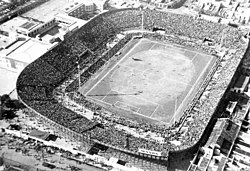
Estadio Gasómetro

El Gasómetro, officially named San Lorenzo Stadium, was a football stadium located in the neighborhood of Boedo in Buenos Aires. Inaugurated in 1916, the stadium was the home ground of club San Lorenzo de Almagro before they moved to their new venue, Estadio Pedro Bidegain, which is sometimes referred to as Nuevo Gasómetro ("New Gasometer"), in 1993. The stadium had a capacity of 75,000 people. The stadium was nicknamed Gasómetro due to its exterior facade that reminded of a gas holder, very common at the time. It has a capacity of 75,000 spectators, being the largest stadium of Argentina until the construction of El Cilindro, home venue of Racing Club de Avellaneda, inaugurated in 1950. Racing's stadium had a capacity of 100,000 spectators, then reduced to 66,000 in the 1990s. The stadium was one of the venues for the 1929 South American Championship.
Location Image
897 m

Boedo (Buenos Aires Underground)

Boedo is a station on Line E of the Buenos Aires Underground located at the intersection of San Juan and Boedo avenues. The area is known for tango dance. The station was opened on 16 December 1944 as a one station extension from General Urquiza. However, a temporary platform was in operation, and the current station was only opened on 9 December 1960. On 24 April 1966, the line was extended to Avenida La Plata.
Location Image
973 m

Hospitales (Buenos Aires Underground)

Hospitales Station is a station and terminus on Line H of the Buenos Aires Underground. Here passengers may transfer to Metrobus Sur. It was opened on 27 May 2013 as a one-station extension from Parque Patricios. It is currently serving as the southern terminus of the line, until it is extended to Sáenz.
Location Image
1.2 km

Parque Patricios (Buenos Aires Underground)

Parque Patricios Station is a station on Line H of the Buenos Aires Underground. It was inaugurated on 4 October 2011 as the southern terminus of one-station extension from Caseros. It remained the terminus of the line until 27 May 2013, when the line was extended to Hospitales.