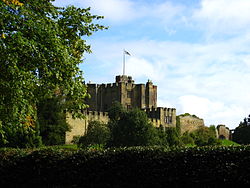
Le château de Bothal est un château et une demeure seigneuriale dans le village du même nom près de la rivière Wansbeck, entre Morpeth et Ashington dans le comté anglais de Northumberland. Botl est le mot de vieil anglais pour une habitation. Bothal pourrait faire référence à une habitation ou à un manoir particulier. Il est fortifié avant la conquête normande, et plusieurs fois rénové et remanié. C'est un monument ancien classé et un bâtiment classé Grade I.

1. Histoire

En 1095, Bothal est donné par le roi Guillaume le Roux à Guy Ier de Balliol, dont la fille Alice épouse Guillaume Bertram, baron de Mitford, qui construit probablement une maison-halle. Plusieurs générations plus tard, en 1343, Sir Robert Bertram reçoit l'autorisation de transformer son manoir en château, comprenant une impressionnante guérite. La tour de la porte et les fragments de courtine sont médiévaux, dont une bonne partie subsiste encore à ce jour. Par le mariage de Hellen, la fille de Bertram, avec Sir Robert Ogle (dc1363), le domaine passe à la famille Ogle au XIVe siècle. En août 1583, Cuthbert Ogle, 7e baron Ogle, négocie un mariage entre sa fille Jane et Edward Talbot, fils de George Talbot, 6e comte de Shrewsbury. Les agents de Shrewsbury visitent Bothal et décrivent la maison comme «un château battu, et pas sans rappeler le Haddon Hall où habite maître John Manners». En 1591, le domaine passe à la famille Cavendish-Bentinck (ducs de Portland), par le mariage de Catherine, comtesse d'Ogle avec Charles Cavendish de Welbeck. Le roi Jacques Ier y est le 5 mai 1617 alors qu'il se rend en Écosse et y reste deux nuits. La restauration est effectuée au XIXe siècle. Le bâtiment est utilisé comme résidence privée de la famille Cavendish-Bentinck et abrite également le Welbeck Estate Office. Le château est en excellent état et n'est pas accessible au public.

1. Références

(en) Cet article est partiellement ou en totalité issu de l’article de Wikipédia en anglais intitulé « Bothal Castle » (voir la liste des auteurs).

Fry, Plantagenet Somerset, Le livre des châteaux de David et Charles, David et Charles, 1980. (ISBN 0-7153-7976-3)

1. Liens externes

Ressource relative à l'architecture : National Heritage List for England

Portail de l’Angleterre Portail des châteaux Portail des monuments classés au Royaume-Uni

Nearby Places View Menu
Location Image
0 m

Bothal

Bothal is a hamlet (place) in the civil parish of Ashington, in Northumberland, England. It is situated between Morpeth and Ashington. There is a castle, a church, a vicarage opposite the church gates, some stepping stones over the River Wansbeck, and a few houses. Bothal was the headquarters of the extensive Welbeck Estates in Northumberland. Half a mile upstream of the castle are the remains of a watermill that still had a working waterwheel up to about the First World War. It had a turbine for electricity production for the mill house from 1947 to 1980. Until 1866 Bothal was a civil parish, In 1831 the parish had a population of 1319. Bothal was also a drift mine ('Bothal Barns Drift') though this is something of a misnomer. Bothal Drift was merely another entrance to the Ashington colliery. Now, Bothal Barns Drift is the site of a private house with the old entrance to the drift mine being long disused. The Bothal Drift is situated on the top of the bank on the Ashington side. Further west ( a few hundred yards) from the church and castle, it is possible to walk along the river Wansbeck for some 30–45 minutes west towards Morpeth. The name Morpeth apparently means 'murder path' and was once the main thoroughfare along the river. Further along the footpath is the remains of an old chapel. The footpath starts near the site of the old mill. You can park your car near the gate (at the bridge) and then walk westwards past the weir. The path does not allow bikes or horses and is not wheelchair accessible,
Location Image
0 m

Bothal Castle

Bothal Castle is a castle and stately home in the village of the same name near the River Wansbeck, between Morpeth and Ashington in the English county of Northumberland. The word "Bothal" is Old English for a dwelling, and may have referred to a particular dwelling or hall.
Location Image
1.9 km

Sheepwash, Northumberland

Sheepwash is a village and former civil parish, now in the parish of Ashington, in the county of Northumberland, England. It is adjacent to Stakeford and Guide Post and across the River Wansbeck from Ashington. In 1931 the parish had a population of 68.
2.0 km

Guide Post

Guide Post (also referred to as Guidepost) is a village in South East Northumberland, England, about 17 miles (27 km) north of Newcastle upon Tyne. It lies south of the River Wansbeck along with Stakeford (with whom it shares an undefined boundary). It is part of the civil parish of Choppington. Guide Post is mainly a residential village. There are two pubs, The Anglers Arms and The Shakespeare Tavern, and a Social Club. It has several shops and three schools; Cleaswell Hill, Mowbray Primary and Ringway Primary.
Location Image
2.1 km

A197 road (England)

The A197 is a road in Northumberland, in the United Kingdom. It connects Morpeth, Pegswood, Ashington and Newbiggin by the Sea.