

 English
 Français

Swinton South (ward)
Swinton South (ward) is an electoral ward of Salford, England. It is represented in Westminster by Rebecca Long-Bailey MP for Salford and Eccles. A profile of the ward conducted by Salford City Council in 2014 recorded a population of 11,458. The ward is to be abolished following a review by the Local Government Boundary Commission for England
Nearby Places View Menu

663 m
Salford and Eccles
Salford and Eccles was a constituency in the House of Commons of the UK Parliament. For its entire creation since 2010, it was represented by members of the Labour Party.
Further to the completion of the 2023 Periodic Review of Westminster constituencies, the seat was abolished. Subject to boundary changes, involving the loss of Eccles, it was reformed as Salford, which was contested at the 2024 general election.
708 m
Victoria Park, Swinton
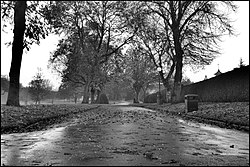
Victoria Park is a park in Swinton, Greater Manchester. Situated on Manchester Road (A6), Swinton, it opened as a public park in 1897. Victoria Park is made up of the grounds of Swinton Old Hall; the hall itself being demolished in 1993. Having tennis courts and two bowling greens, Victoria Park is home to a Grade II listed Victorian bandstand built to commemorate the 60th year of the reign of Queen Victoria; the bandstand being built around 1897.
Swinton and Pendlebury received its Charter of Incorporation as a municipal borough from Edward Stanley, 18th Earl of Derby at a ceremony in Victoria Park on 29 September 1934.
Victoria Park has been awarded three Green Flag Awards. The Green Flag Scheme is a national standard for public parks and green spaces that aims to raise standards across the UK. This award puts Victoria Park alongside Brighton Pier, London Zoo, Alton Towers and the Norfolk Broads.
769 m
Salford Civic Centre
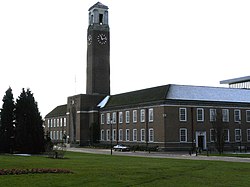
Salford Civic Centre, formerly Swinton and Pendlebury Town Hall, is a municipal building at Chorley Road, in Swinton, Greater Manchester, England. It is the administrative headquarters of Salford City Council.
809 m
Clifton Hall Tunnel
Clifton Hall Tunnel, also called (locally) the Black Harry Tunnel, was a railway tunnel passing beneath much of Swinton and Pendlebury, in Greater Manchester, England. It was located on the Patricroft and Clifton branch of the London and North Western Railway line, linking Patricroft with Molyneux Junction.
Originally opened in 1850, the Clifton Hall Tunnel was heavily used by freight trains to and from Clifton Hall Colliery and other neighboring collieries. Construction had been complicated by the unstable ground, which had already been subject to mining. Throughout its operational life, it was subject to routine inspections and several rounds of remedial work aimed at stabilising sections of the tunnel roof, principally using steel ribbing. The neighbouring land around and above the tunnel was also subject to urbanisation, leading to housing being built directly above it.
The tunnel acquired a level of public infamy when it suffered a partial collapse on 28 April 1953, which resulted in the deaths of five occupants of houses in Temple Drive, Swinton, located directly above one of the construction shafts that had been infilled and forgotten about. No danger was posed to rail traffic as a temporary closure had already been enacted earlier that month following the discovery of debris in the tunnel. The tunnel was subsequently stabilised and largely infilled; further measures were taken during 2007, the 2010s and in 2025 to reinforce the closed tunnel and infill any remaining voids.