Location Image

Victoria Park, Swinton

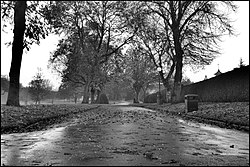
Victoria Park is a park in Swinton, Greater Manchester. Situated on Manchester Road (A6), Swinton, it opened as a public park in 1897. Victoria Park is made up of the grounds of Swinton Old Hall; the hall itself being demolished in 1993. Having tennis courts and two bowling greens, Victoria Park is home to a Grade II listed Victorian bandstand built to commemorate the 60th year of the reign of Queen Victoria; the bandstand being built around 1897. Swinton and Pendlebury received its Charter of Incorporation as a municipal borough from Edward Stanley, 18th Earl of Derby at a ceremony in Victoria Park on 29 September 1934. Victoria Park has been awarded three Green Flag Awards. The Green Flag Scheme is a national standard for public parks and green spaces that aims to raise standards across the UK. This award puts Victoria Park alongside Brighton Pier, London Zoo, Alton Towers and the Norfolk Broads.

Nearby Places View Menu
198 m

Clifton Hall Tunnel

Clifton Hall Tunnel, also called (locally) the Black Harry Tunnel, was a railway tunnel passing beneath much of Swinton and Pendlebury, in Greater Manchester, England. It was located on the Patricroft and Clifton branch of the London and North Western Railway line, linking Patricroft with Molyneux Junction. Originally opened in 1850, the Clifton Hall Tunnel was heavily used by freight trains to and from Clifton Hall Colliery and other neighboring collieries. Construction had been complicated by the unstable ground, which had already been subject to mining. Throughout its operational life, it was subject to routine inspections and several rounds of remedial work aimed at stabilising sections of the tunnel roof, principally using steel ribbing. The neighbouring land around and above the tunnel was also subject to urbanisation, leading to housing being built directly above it. The tunnel acquired a level of public infamy when it suffered a partial collapse on 28 April 1953, which resulted in the deaths of five occupants of houses in Temple Drive, Swinton, located directly above one of the construction shafts that had been infilled and forgotten about. No danger was posed to rail traffic as a temporary closure had already been enacted earlier that month following the discovery of debris in the tunnel. The tunnel was subsequently stabilised and largely infilled; further measures were taken during 2007, the 2010s and in 2025 to reinforce the closed tunnel and infill any remaining voids.
Location Image
387 m

St Augustine's Church, Pendlebury

St. Augustine's Church is an active Anglican church in Pendlebury, Greater Manchester, England. Dedicated to St Augustine, it is part of the benefice of Swinton and Pendlebury along with St Peter's Church in Swinton and All Saints' Church in Wardley. The church is in the Eccles deanery, the archdeaconry of Salford and the diocese of Manchester. The church was granted Grade II* listed status in 1966 but has since been upgraded to Grade I. Called the "Miners' Cathedral", due to its almost cathedralesque stature, in the heart of a one time coal-mining community, it was also sometimes locally called "Gussie's". The church is situated on Bolton Road and has a connected primary school.
Location Image
508 m

Municipal Borough of Swinton and Pendlebury

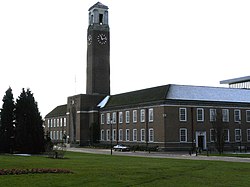
Swinton and Pendlebury was a local government district of the administrative county of Lancashire, England. It was created in 1894 as an urban district and enlarged in 1934, gaining the status of a municipal borough. Before the new town hall was built to accommodate the new municipal borough in the 1930s, the urban district was governed from Pendlebury Town Hall on Bolton Road at the junction with Carrington Street. This building eventually became the town's main public library and was used as such until a new library was opened within the newly built Lancastrian Hall on Chorley Road, Swinton at the junction with Station Road (B5231).
Location Image
571 m

Pendlebury railway station

Pendlebury railway station was a station serving the town of Pendlebury in the City of Salford, Greater Manchester, England. It was closed in 1960 by British Railways.